
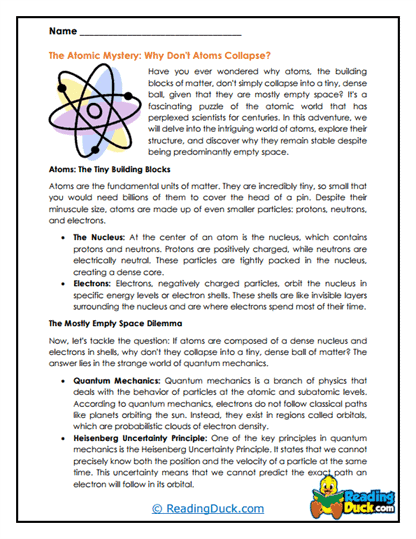
Atomic Puzzle Short Answer
This passage addresses the mystery of why atoms don’t collapse despite being made of mostly empty space. It explains that the nucleus holds most of the atom’s mass, while electrons orbit in specific energy levels. The passage introduces the concept of quantum mechanics, which helps explain the behavior of subatomic particles. Key principles, like the Heisenberg uncertainty principle, are discussed to show why atoms remain stable despite their largely empty composition.
Reading this passage builds students’ vocabulary with terms like quantum mechanics, Heisenberg uncertainty principle, and electron orbitals. It challenges students’ comprehension by requiring them to grasp abstract concepts, such as atomic stability. The passage stimulates critical thinking as students reflect on the nature of matter and the laws governing atomic structures. Additionally, the precise scientific explanations serve as excellent examples for improving grammar and technical writing skills.