
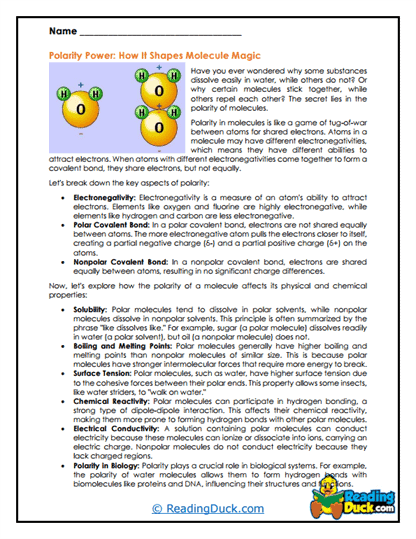
Polarity Power
This passage explains polarity in molecules, describing how atoms with different electronegativities share or pull electrons unevenly, leading to polar bonds. It introduces key concepts such as electronegativity, covalent bonds, and solubility, explaining how polar molecules dissolve in water while nonpolar ones do not. The passage also highlights the importance of polarity in biological systems, such as how DNA and proteins rely on molecular shapes. This information helps clarify why some substances mix well and others do not.
By reading this passage, students expand their vocabulary with scientific terms like electronegativity and covalent bonds. They enhance their comprehension by learning how molecular properties determine chemical behavior. It also encourages critical thinking by inviting students to apply these concepts to everyday examples, such as why oil and water don’t mix. Additionally, it helps them improve their grammar through exposure to clear, structured sentences explaining scientific relationships.
Questions:
Answer Keys: