Compound Clarity Open Response
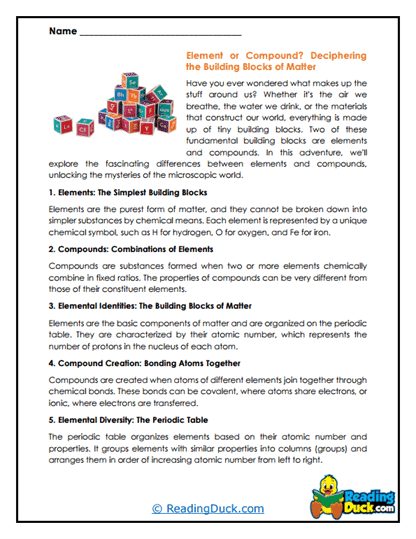
This passage explores the differences between elements and compounds, explaining that elements are pure substances while compounds form from chemical combinations of two or more elements. It also discusses the periodic table, which organizes elements by their atomic number and properties. The passage provides examples of compounds like water and carbon dioxide, emphasizing how combining different elements creates new substances with unique properties. Additionally, it highlights how chemical bonding in compounds can be covalent or ionic.
This passage expands vocabulary with scientific terms such as element, compound, and periodic table. It enhances comprehension as students explore the relationships between elements and compounds. By analyzing how new substances form from different combinations, students strengthen critical thinking skills. The passage also helps improve grammar proficiency by offering clear explanations of complex scientific ideas, which students can mimic in their writing.