
Simple vs. Complex Multiple Choices
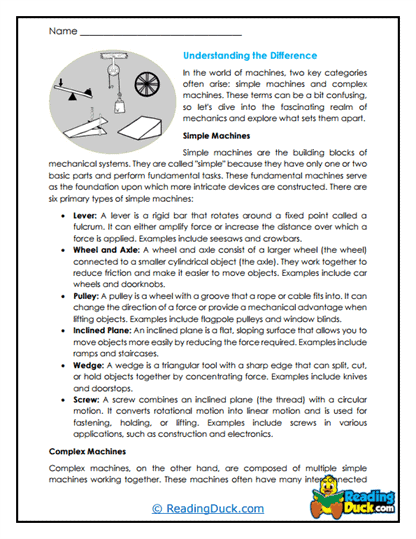
The passage explains the difference between simple machines and complex machines, focusing on how simple machines serve as the foundational components of more elaborate systems. It revisits the six basic types of simple machines—lever, wheel and axle, pulley, inclined plane, wedge, and screw—and contrasts these with complex machines, which combine multiple simple machines for more sophisticated tasks. Examples of both machine types are provided to illustrate how they function in real-world applications. The text highlights the fundamental importance of simple machines in mechanical design and everyday technology.
Students enhance their comprehension by understanding how simple machines combine to form complex systems. The passage reinforces vocabulary related to engineering and physics, with terms like mechanical systems and amplify force, encouraging deeper scientific literacy. Critical thinking is fostered by prompting students to distinguish between simple and complex systems, encouraging analysis of how everyday machines function. The organized structure of the passage also strengthens grammar and writing skills through the logical progression of ideas.