
Wave Types
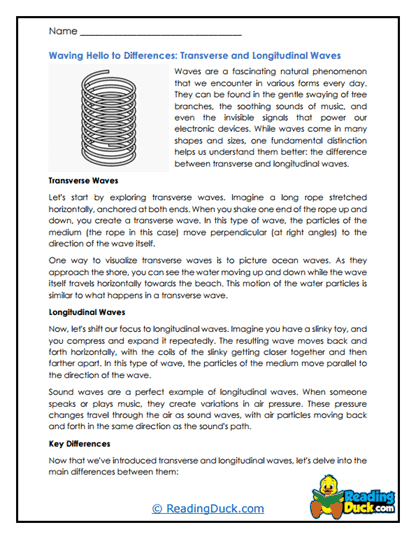
This passage explains the difference between transverse and longitudinal waves, using clear analogies and relatable examples. Transverse waves, like those on a rope, have particles moving perpendicularly to the wave’s direction, while longitudinal waves, such as sound waves, have particles moving parallel to the wave’s direction. The passage uses visuals like a slinky toy to demonstrate how these waves move through different mediums. It also highlights the importance of understanding the differences between these two wave types.
By comparing two different wave types, the passage sharpens students’ analytical abilities and fosters conceptual understanding. The use of analogies helps break down complex ideas, promoting better comprehension of scientific content. Vocabulary development is enhanced through the introduction of terms like transverse and longitudinal, while students also practice their critical thinking as they compare and contrast the characteristics of each wave type. This type of passage encourages students to make connections between scientific concepts and everyday objects.
Questions:
Answer Keys: