
Nature Reverence
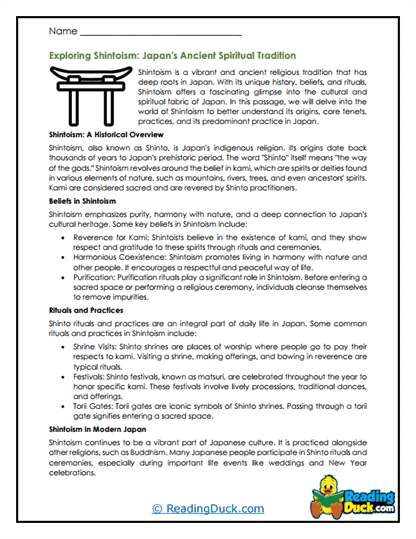
The passage describes Shintoism, Japan’s ancient indigenous religion, which emphasizes a deep connection to nature and the kami, or spirits believed to inhabit natural elements like mountains and rivers. Shintoism promotes purity, harmony, and respect for nature and ancestral spirits, and many of its rituals involve offerings and prayers at shrines. Key beliefs include showing reverence to the kami and maintaining purity, with purification rituals being central to the faith. Shintoism is still an integral part of Japanese culture today, often practiced alongside other religions during important life events and festivals.
Reading passages like this help students expand their vocabulary, introducing terms such as “kami” and “Torii gates” while deepening their understanding of cultural practices. These texts promote comprehension by guiding students to explore both the historical context and the spiritual aspects of a religion. By analyzing the cultural significance of different rituals and comparing Shintoism with other belief systems, students also develop their critical thinking skills. Finally, the grammatical structures and informational layout enhance language arts proficiency, especially in summarizing and identifying key details in complex texts.
Questions:
Answer Keys: