
Invisible Giants Short Answer
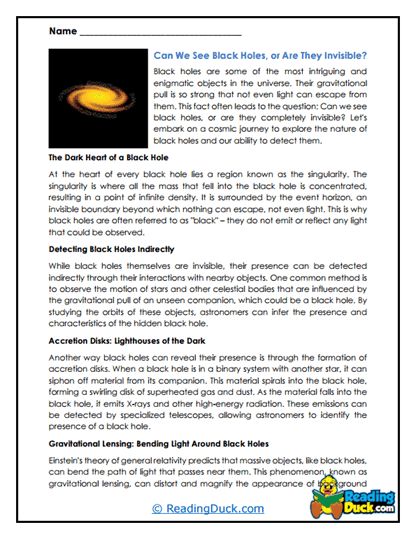
This passage explains why black holes are invisible to the naked eye and how scientists can detect them indirectly. It describes how black holes do not emit light but can be observed through their influence on nearby stars or the formation of accretion disks. Additionally, it introduces the concept of gravitational lensing, where the immense gravity of a black hole bends light from surrounding objects, allowing astronomers to detect them. The passage underscores the challenge of observing black holes and the innovative methods scientists use to study them.
Reading about black holes’ invisibility strengthens students’ critical thinking as they learn how scientists observe objects that cannot be seen directly. The passage introduces vocabulary related to astrophysics, such as “gravitational lensing” and “accretion disks,” improving students’ technical language skills. It also fosters comprehension by explaining how various scientific methods are applied to uncover hidden cosmic phenomena. Additionally, the well-organized information serves as a guide for clear and precise writing in technical and scientific contexts.