
Decoding Life Short Answer
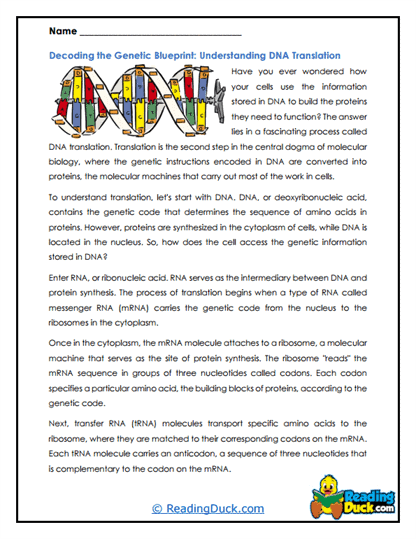
This passage explains the process of DNA translation, the second step in the central dogma of molecular biology, where genetic instructions encoded in DNA are converted into proteins. It describes how the sequence of amino acids in proteins is determined by messenger RNA (mRNA), which acts as a template, and how transfer RNA (tRNA) delivers the correct amino acids during protein synthesis. The role of ribosomes, the cellular machinery for reading mRNA and building proteins, is also explained. This intricate process is essential for the function of all cells, allowing them to produce the proteins they need to survive and perform their roles.
By reading about biological processes like DNA translation, students can enhance their critical thinking skills as they piece together how cells operate on a molecular level. This passage introduces advanced vocabulary in a digestible way, helping students engage with scientific terminology and improving their language mastery. It also fosters comprehension abilities through clear explanations of complex concepts, allowing students to practice understanding detailed informational texts. Moreover, the structured nature of this text helps students observe and learn the flow of logical sequencing in science writing.