
Lunar Craters Open Response
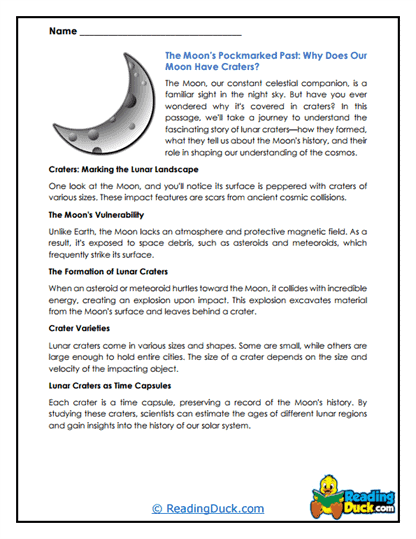
This passage delves into the Moon’s surface, focusing on craters and how they were formed by impacts with asteroids and meteorites. It explains why the Moon is more vulnerable to such impacts due to its lack of atmosphere and protective magnetic field. The passage also discusses the variety of crater sizes and how scientists use them as time capsules to understand the Moon’s history. By studying these craters, scientists can trace back the violent history of the solar system.
This passage builds vocabulary knowledge through specific geological terms like “crater” and “impact.” It also enhances comprehension skills as students learn how the Moon’s surface tells its history. The focus on scientific investigation promotes critical thinking and curiosity about the natural world. Additionally, the clear and informative structure aids in understanding complex scientific processes.