
Painted Walls
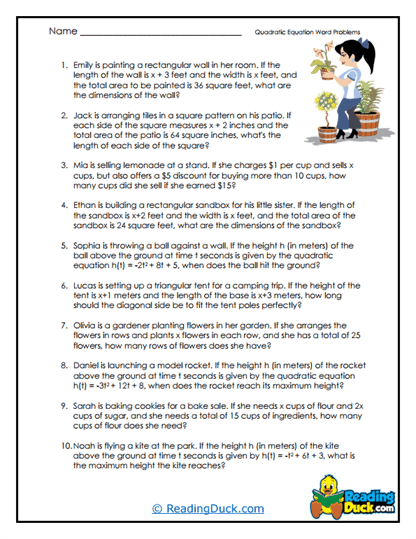
The problems in this passage combine painting, tiling, and other household activities with quadratic equations. Students calculate areas of rectangular walls or patios and determine dimensions based on word problems. The scenarios also touch on selling lemonade, baking, and planting, combining practical life activities with algebraic thinking. Through these scenarios, students must calculate pricing, areas, and proportions using quadratic models.
By solving problems with familiar life activities, students develop a more intuitive understanding of quadratic equations and how they apply to everyday tasks. These problems encourage the use of applied math and foster an ability to problem-solve in both academic and real-world situations. Vocabulary acquisition related to construction, geometry, and business is another benefit, making this passage useful for both math and reading comprehension improvement. Furthermore, it encourages students to think about how math influences their surroundings.