
Aperture Insights Multiple Choices
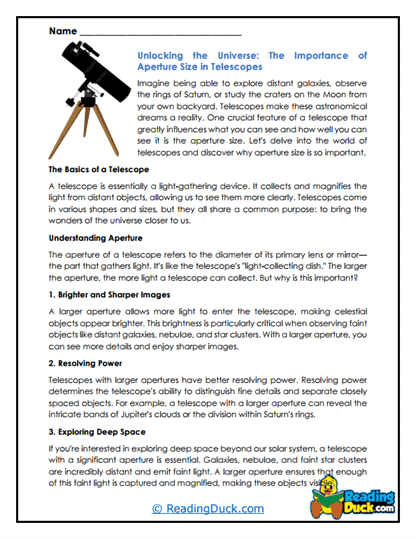
This passage focuses on the concept of aperture size, which refers to the diameter of a telescope’s primary lens or mirror. It explains how a larger aperture allows for brighter, clearer images and improves the telescope’s ability to resolve fine details. The passage highlights how aperture size impacts the observation of faint celestial objects, making it a critical factor in choosing a telescope. Understanding aperture size is key to maximizing the potential of astronomical observations.
This passage enhances scientific literacy by focusing on the technical aspects of telescopes and their design. Students are introduced to the relationship between aperture size and image quality, building comprehension of how scientific instruments work. By explaining how telescopes improve visibility of distant objects, the passage strengthens critical thinking skills as students connect cause and effect. It also develops vocabulary related to optics and astronomy.