About Our Articles of Confederation Reading Worksheets
Imagine trying to run a country with no real power to tax, no president, and only a congress where each state has one vote. That was the Articles of Confederation-a rock-bottom attempt at a national government that somehow almost worked but mostly didn't. These worksheets take that chaotic experiment and turn it into a learning adventure that's part detective story, part civics class, and part "uh-oh, what were they thinking?" moment.
Why does studying a government that couldn't enforce taxesor regulate trade matter? Because it set the stage for everything that comes next-the drafting of the Constitution, the creation of federalism, and the idea that sometimes, just sometimes, you need enough power to get anything done. These worksheets let students walk in the Founders' moccasins, feeling both their revolutionary zeal and their profound frustration.
Dive into this collection, and you'll see how a fragile union of 13 sovereign states birthed a nation-and why scholars today still giggle (a little) about its staggering limitations. But don't worry-no need for powdered wigs here. These PDFs deliver multiple-choice, short answer, and open-ended prompts with a dash of insight, an answer key for grading, and enough historical missteps to make students gasp-and then perhaps appreciate the U.S. Constitution just a bit more.
A Look At Each Worksheet
Articles' Downfall
This worksheet explores how the Articles of Confederation began to crumble under their own weaknesses, turning America's first governing framework into a political pothole. It lights up the roadblocks-like the inability to tax or enforce laws-and frames them in a way students can really grasp. It also inspires a sort of "aha!" moment when learners realize this system wasn't built to last. Bonus thought: Could the founders have predicted that their greatest weakness would actually lead to something even greater?
Bright Achievements
Here, the spotlight shines on the surprising successes of the Articles-such as winning the Revolutionary War and passing the Northwest Ordinance. This worksheet champions how even flawed systems can achieve greatness in unexpected ways. It challenges students to find the silver lining in early American governance. And there's an added wink: sometimes, even half-baked plans can still deliver big results.
Central Weakness
Centered on the pitfalls of a weak central government, this worksheet walks students through why lacking authority to regulate commerce or levy taxes was such a hamstring. It encourages them to imagine navigating interstate quarrels without any judicial backup. By dramatizing these limitations, it helps learners understand why America needed a stronger core. Ponder-worthy: What if the Articles had an "Executive Branch 1.0"?
Early Backbone
Think of this one as the sturdy (if rickety) frame that held early America together through war and political shake-ups. It emphasizes how the Articles provided a shared foundation-even without strong enforcement powers. The tone helps students appreciate the historical context without glamorizing it. And a twist: they'll learn that even shaky structures can hold on when driven by unity and purpose.
Early Blueprint
This worksheet delves into how the Articles served as a preliminary sketch for American government-as a blueprint that guided, but didn't build, the future. It encourages learners to view the document as both a first draft and a cautionary tale. Students get to see how early leaders tweaked ideas into something more functional. A neat thought: What if the founders had been planners-but not perfectionists?
Farmers' Revolt
Here, Shays' Rebellion steals the stage-a farmers' uprising that exposed just how powerless the Confederation government really was. This worksheet brings the chaos of post-war debt and angry farmers into sharp focus. It helps students understand how grassroots unrest can fuel major constitutional change. And fun fact material: those pitchforks and staves weren't just props-they were wake-up calls.
Foundation Flaws
This worksheet breaks down the structural issues-like no national court, unanimous amendment rules, and meager revenue powers-that made the Articles unstable. It spotlights how some design choices can hobble a government from the start. Students get to critique early institutional setup in a way that feels alive. Plus: these flaws read like a "what not to do" checklist for future constitution-writers.
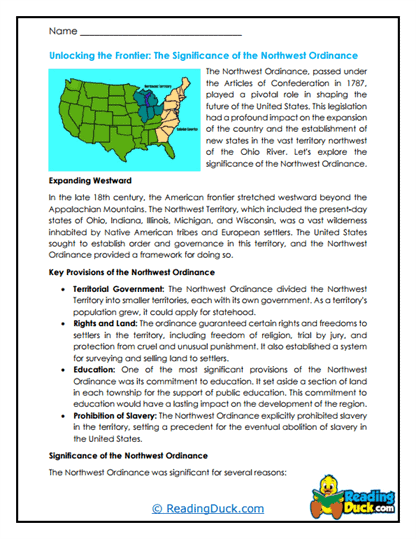
Frontier Growth
Explore how the Articles actually helped manage western expansion-particularly through the Northwest Ordinance-even while the government had very limited powers. This worksheet frames territorial expansion as one of the Confederation's few shining moments. It helps students see how the document wasn't pure failure. And it prompts an interesting thought: what if there had been a colonial GPS for managing new lands?
Government Shift
This one charts the pivot from the inadequate Articles to the more robust U.S. Constitution. It guides students through convention debates and shifts in political philosophy. It reinforces that change often comes when systems can no longer keep up with reality. And a spark for discussion: could the designers at Philadelphia have kept parts of the old system?
Nation's Birth
Celebrate the symbolic birth of the United States under the Articles-how they announced unity even as practical governance struggled. The worksheet leans into the optimism and ambition of the era. It balances pride in independence with clear-eyed perspective. And for reflection: isn't it wild how a document that barely worked still declared a nation?
Revenue Struggles
Here, the focus is on the Articles' critical failure to generate funds-highlighting how free-riding states and no tax power led to fiscal nightmares. Students get to diagnose why the national government was perpetually broke. It brings alive the tension between autonomy and responsibility in something as everyday as funding. And to ponder: what's a government without money, but a paper unicorn?
Voting Struggles
This worksheet examines how giving each state one vote in Congress-regardless of size-caused representation issues and power imbalances. It shows students that fairness on paper doesn't always translate to fairness in practice. It asks them to think about "one person, one vote" in a brand-new republic. And a curious aside: were bigger states secretly muttering about "not fair" back then?
About Articles of Confederation
Understanding the Articles of Confederation is like diving into a political band-aid: the world's first American "constitution," born from the fear of tyranny yet saddled with more holes than Swiss cheese. It created a government that brought the former colonies together in name and war-but without enough teeth to enforce decisions. With no president, no judiciary, and an under-funded Congress, it was a fragile framework held together more by goodwill than governance.
Historically, the Articles emerged amid a whirlwind of revolutionary fervor and a deep distrust of centralized power. Adopted by the Continental Congress in November 1777 and ratified by all thirteen states by March 1781, they captured an era of idealism-and serious mismanagement. A confederation of "firm friends," they allowed each state to retain nearly all authority, only lightly tethered to unity by a weak national hand.
Key concepts include sovereignty, league of friendship, and state equality. By granting each state one vote in Congress and requiring unanimous consent for amendments, the Articles emphasized individual autonomy over collective action. Terms like Northwest Ordinance and Shay's Rebellion help students grasp how early successes and failures shaped the country's trajectory-especially when the government couldn't raise taxes or regulate trade.
The Articles' significance lies in their role as a trial run for American governance. They helped win the Revolutionary War and settle western territories-but they also exposed the dangers of under-powered unions. These lessons directly inspired the 1787 Convention in Philadelphia, leading to the Constitution's strong federal structure. The story of the Articles reminds us that even shaky beginnings can teach valuable lessons-and lead to something much sturdier.
Today, debates still swirl around federal vs. state power, taxation, and representation-echoes of those Confederation-era struggles. What if the Articles had lasted longer? Could America have survived as a looser confederation? And, more playfully: what if there had been a "president" just for handling chicken disputes? These what-ifs keep the topic vibrant, reminding us that history isn't just about the past-it's fuel for imaginative civic inquiry.
Make sure to bookmark our website now.
Enjoy all our free reading worksheets.
Our materials adhere to the principles of the Science of Reading.