Our Political Systems Reading Worksheets invite students to explore how people organize, share, and use power within societies. Through engaging and accessible texts, readers discover how governments form, why rules exist, and how different systems shape the way communities function; from ancient empires to modern democracies.
Each worksheet blends reading comprehension with critical thinking. Students strengthen vocabulary and reading fluency while also considering deeper questions about leadership, fairness, and civic responsibility. The included discussion prompts encourage meaningful conversation, giving learners a chance to connect what they've read to real-world examples and to their own experiences and values.
The readings cover a wide variety of topics, such as the foundations of government, the contrasts between democracies, monarchies, and dictatorships, and the balance between freedom and authority. They also explore historical examples of governments that have thrived or failed, the importance of citizen participation and elections, and the continuing struggles for justice, human rights, and ethical leadership in today's world.
A Look At Each Worksheet
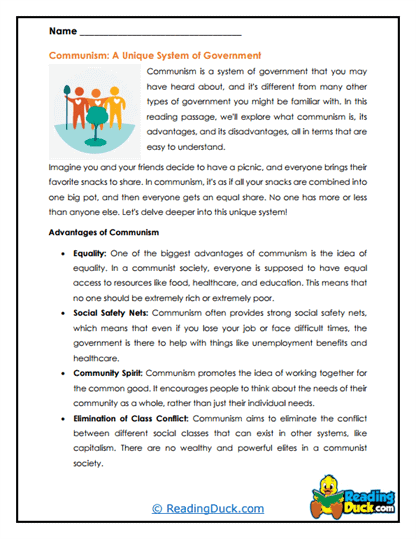
Communal Equality
Dive into a system built on fairness, where community needs trump individual gains and resources are shared. This worksheet challenges students to ponder how collective systems work in theory and what stands in their way in practice. Expect questions about cooperation, equity, and historical examples of communitarian governance. Bonus insight: communal systems often flourish in tight-knit societies-but scaling them up is the ultimate test in balancing fairness and efficiency.
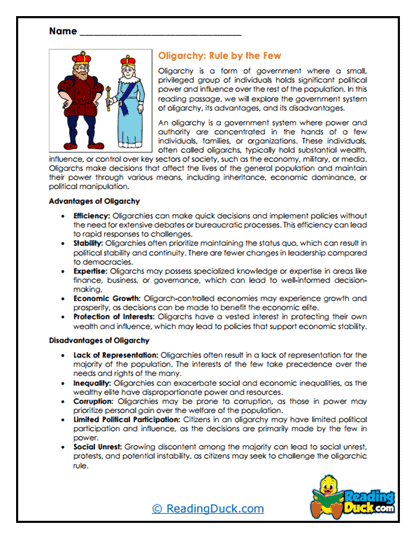
Elite Control
Step into a world where a select few-by birth, wealth, or influence-wield power over the many. Students explore how authority is maintained, upheld, and sometimes contested in oligarchic or elitist systems. The worksheet prompts discussion around legitimacy, inequality, and the tension between tradition and reform. Small twist: while elite control can bring stability or vision, it often struggles with adaptability and broad legitimacy.
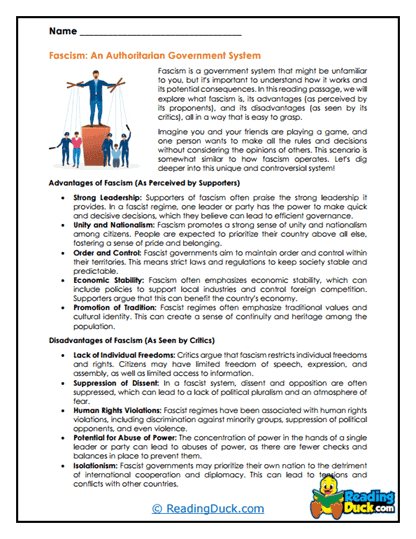
Forceful Order
Enter regimes ruled by iron-where authority is enforced, resistance is low, and dissent is dealt with swiftly. The worksheet peels back layers on authoritarianism and coercive governance, asking learners why stability comes at the price of freedom. Activities may ask: how does force shape society, and what happens when control becomes oppression? Thought to ponder: the strongest walls can also leech trust-order built on fear is brittle underneath.
One Voice
Explore systems where unity is enforced, dissent discouraged, and conformity elevated-sometimes in the name of harmony, sometimes of control. The worksheet questions how collective speech is shaped and who determines what "one voice" means. Students are nudged to distinguish between consensus and coercion. And here's a kink: while one voice might sound efficient, it may also drown out the whispers of progress.
People Power
Discover governance by and for the people-where democratic ideals and popular participation aim to keep rulers in check. Students examine how democracy works-and where it falters. Open-ended prompts may ask: can we balance efficiency with fairness, or participation with stability? Fun fact: democracy is often messy-but simplicity isn't always justice.
People's Voice
Focus on how citizen opinion is heard and channeled-from town halls to polls to protests. This worksheet delves into representation, advocacy, and the mechanics of public influence. Learners are encouraged to reflect on civic tools and how voices become action. Extra note: in many systems, voices whisper-but the press, protests, and people can amplify them into roars.
Power Control
Unpack systems built to regulate power-checks, balances, divisions, and oversight. Students explore how institutions resist tyranny, distribute authority, and uphold justice. Key questions may center on how power corrupts-and how systems aim to contain it. Consider this paradox: systems prevent power's abuse-but only if their own rules are respected.
Power Pizza
A whimsical yet powerful metaphor-imagine governance as a pizza: slices may represent layers of power shared across regions, branches, or roles. The worksheet invites students to map how a "power pizza" gets distributed-thin crust or deep dish? Engaging prompts ask how slices could represent branches, states, or groups. And yes, everyone gets a slice-but how big, how layered, how shared?
Royal Rule
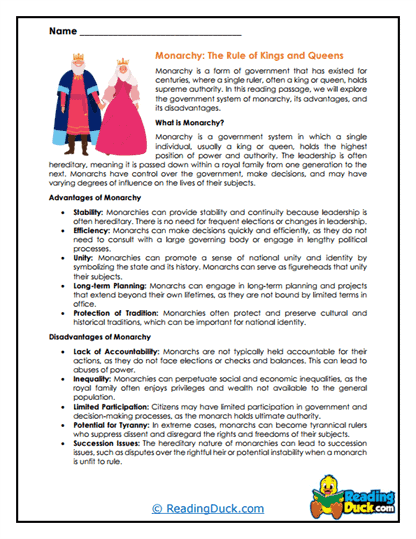
Step into kingdoms where bloodlines reign, traditions matter, and power comes with a crown. Students explore monarchies-from absolute rulers to constitutional figureheads-and their societal roles. Questions might ask: does royal continuity bring stability or stagnation? Royal side note: in constitutional monarchies, kings or queens may symbolize unity, while real power often rests with elected ministers.
Shared Power
Delve into systems where authority is divided and shared-between states, branches, or stakeholders-to prevent dominance. Themes may include federalism, separation of powers, or collective leadership. Prompts steer students to weigh trade-offs: is divided power stronger-or slower to act? Insight: shared power can feel slow-moving, but it's often resilient in the long run.
Shared Resources
Study governance focused not on rulers but on resources-how water, land, or public goods are governed, allocated, and protected. Learners explore communal management, equity, and sustainability. The worksheet may ask how shared resources impact both community health and conflict. Just think: governing water wells or forest commons means balancing need, stewardship, and fairness.
Total Control
Experience governance at the extreme-where every aspect of life is monitored, ideology enforced, and identities shaped by the state. Students grapple with totalitarian regimes, personal freedoms erased in the name of unity. Prompts push them to reflect on propaganda, surveillance, and resistance. Last point: total control can bend a society-but it also breaks the human spirit trying to breathe.
Exploring the World's Political Systems
Democracy
Democracy is built on the belief that people should have a say in the decisions that govern their lives-through voting, debate, and public participation. It thrives on open discourse, the rule of law, and the protection of rights for all citizens. In practice, it can be lively, messy, and occasionally frustrating, as compromise is the currency of progress. This system often evolves through institutions that keep power in check and leaders accountable. Interesting thought: democracy is less a finished product than a living experiment-always in need of tuning, tending, and a dash of patience.
Republic
A republic is a cousin to democracy, where citizens elect representatives to make decisions on their behalf, balancing efficiency with public consent. It's designed to prevent concentrated power, relying on constitutions, separation of powers, and the rule of law. The system works best when representatives truly serve the public interest rather than their own agendas. While efficient, it sometimes risks disconnect between the people and their leaders. Fun twist: in a healthy republic, the most powerful person isn't a ruler-it's the collective will of informed citizens.
Monarchy
In monarchies, crowns, thrones, and royal bloodlines define the ruling class, either as symbolic figureheads or as all-powerful sovereigns. Constitutional monarchies, like in the UK or Japan, keep most power in elected bodies, while absolute monarchies hand the keys to the king or queen entirely. Monarchies often draw on centuries of tradition, pageantry, and symbolism to maintain cultural identity. The system can bring stability, but it may struggle to adapt to modern democratic ideals. Side note: while some monarchs still wield political power, many today are more about ribbon-cutting than law-making.
Oligarchy
Oligarchy means "rule by the few"-typically the wealthy, well-connected, or influential. Decisions are often made in the interests of the elite, which can create deep inequality and public frustration. This system thrives in secrecy, where backroom deals replace open debates. While it can be stable in the short term, it risks stagnation and dissent when too many feel excluded. Curious fact: some argue that many modern systems flirt with oligarchy when wealth starts pulling the political strings.
Authoritarianism
Authoritarian systems centralize power in the hands of one leader or a small group, often limiting freedoms to maintain control. Order and stability are prized, but often at the cost of personal liberty, free press, and political opposition. Leaders may justify restrictions as necessary for unity, security, or economic growth. While such regimes can make quick decisions, they can also silence creativity and suppress dissent. Observation: authoritarianism often promises safety, but its greatest fear is the voice of its own people.
Totalitarianism
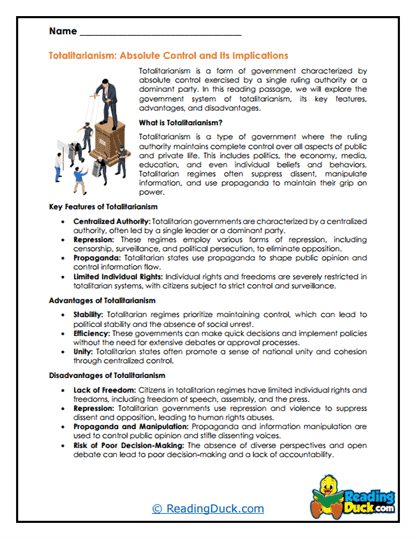
A step beyond authoritarianism, totalitarianism seeks control over every aspect of public and private life-from politics to culture, economy to thought. Propaganda, surveillance, and strict ideology are the main tools, leaving little room for individuality or resistance. In this system, the state isn't just in power-it is life, dictating even the smallest details. While it can mobilize entire populations quickly, it often leaves behind repression and fear. Chilling thought: in totalitarian states, even silence can be interpreted as defiance.
Theocracy
Theocracies weave political authority with religious doctrine, placing leaders who are also spiritual figures at the helm. Laws are often based on sacred texts, and governance is seen as a divine duty. Such systems can foster strong moral and cultural unity among believers, but may struggle with religious diversity and dissent. The blend of faith and law creates unique challenges for modern rights and freedoms. Question to consider: can a theocracy evolve while keeping both faith and fairness intact?
Communism
Communism envisions a classless society where resources are shared equally, production is collectively owned, and wealth is distributed based on need. In theory, it eliminates inequality and competition; in practice, it often relies on strong central control to organize production and distribution. While it can create stability and access to basic services, it has also been criticized for limiting personal freedoms and innovation. Many communist states evolve into single-party systems to maintain control. Fun paradox: communism seeks equality-but the leaders who enforce it often end up with more than their share.
Socialism
Socialism mixes collective ownership of major resources with democratic participation, aiming to reduce inequality while preserving some market freedoms. Citizens often benefit from universal healthcare, education, and social safety nets funded by higher taxes. The system can promote fairness, but may face challenges in efficiency or innovation if balance is lost. Variations range from democratic socialism to more centralized approaches. Food for thought: socialism is less about eliminating capitalism and more about taming its sharper edges.
Anarchy
Anarchy strips away formal government entirely, relying on voluntary cooperation, mutual aid, and local decision-making. To its critics, it's chaos; to its supporters, it's freedom in its purest form. Without central authority, communities must create their own systems of order and justice. While it can inspire creativity and autonomy, it's vulnerable to power vacuums and instability. Irony alert: anarchy is about having no rulers-but still requires a surprising amount of rules to work well.
Make sure to bookmark our website now.
Enjoy all our free reading worksheets.
Our materials adhere to the principles of the Science of Reading.