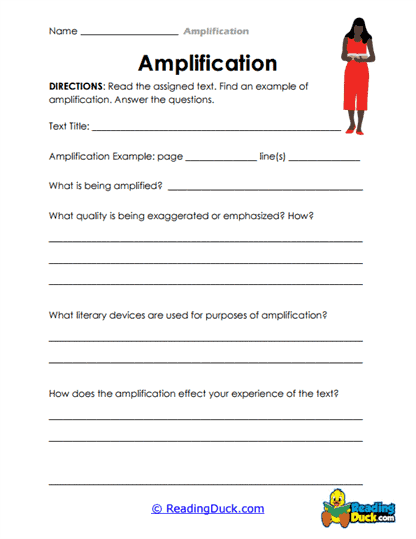
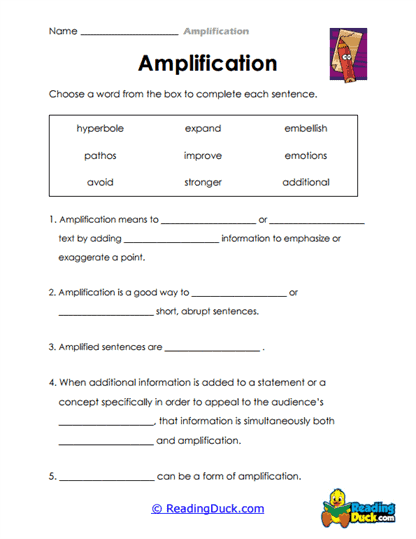
If your students tend to write short, simple sentences and struggle to explain their ideas clearly, you're not alone. Many learners know what they want to say-but not how to expand it.
Amplification is a writing skill that helps students take a basic idea and develop it with meaningful detail. Instead of stopping at a simple statement, students learn to elaborate, clarify, and strengthen their message so it's easier-and more interesting-for the reader to understand.
This skill is essential for both writing and reading comprehension. When students learn how ideas are expanded, they also become better at understanding how authors build meaning in texts.
These amplification worksheets guide students step-by-step-from expanding simple sentences to building full paragraphs-so they can grow into more confident, thoughtful writers.
Key Language Arts Concepts Covered
What is Amplification in Writing?
Amplification is the process of adding detail to a sentence or idea to make it clearer and more meaningful. Students learn that writing isn't just about stating facts-it's about developing ideas so the reader fully understands them.
This concept helps students move beyond basic writing and begin expressing thoughts with purpose and clarity.
Expanding Simple Sentences
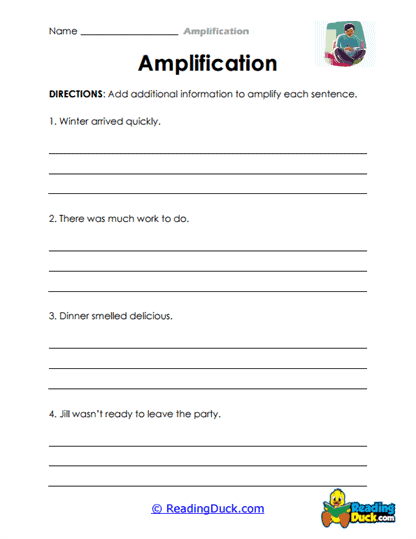
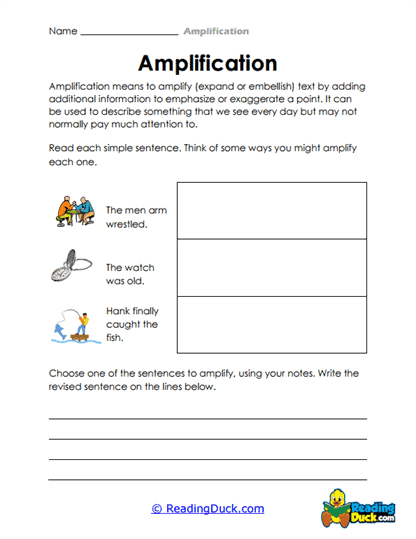
Students begin with short, basic sentences and learn how to add information. They might include who, what, where, when, and why to make their writing more complete.
This foundational skill encourages students to slow down and think more deeply about their ideas.
Adding Meaningful Details
Not all details improve writing. Students learn how to choose details that actually help the reader understand what's happening.
This builds stronger comprehension and helps students organize their ideas more effectively.
Revising and Improving Writing
Amplification teaches students that writing is a process. They begin to revisit their work, add details, and refine their sentences.
Over time, this builds the habit of revision-one of the most important skills in writing development.
Recognizing Amplification in Texts
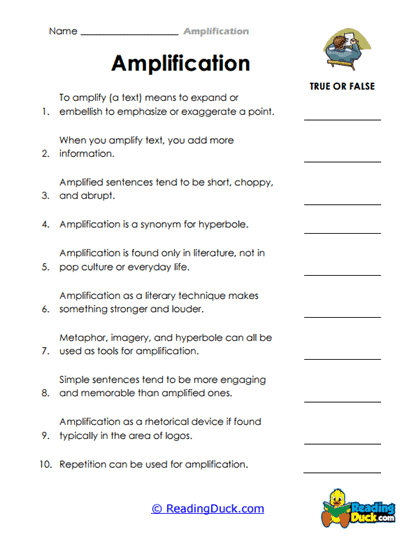
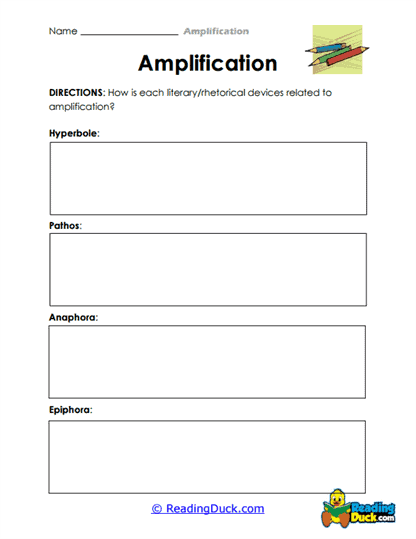
Students also learn to identify amplification in reading passages, speeches, and advertisements. They see how authors and speakers use detail, repetition, and emphasis to strengthen ideas.
This improves both reading comprehension and critical thinking.
Exploring the Worksheet Collection
Building the Foundation - Sentence Expander, Amplification Practice, Sentence Rewriter
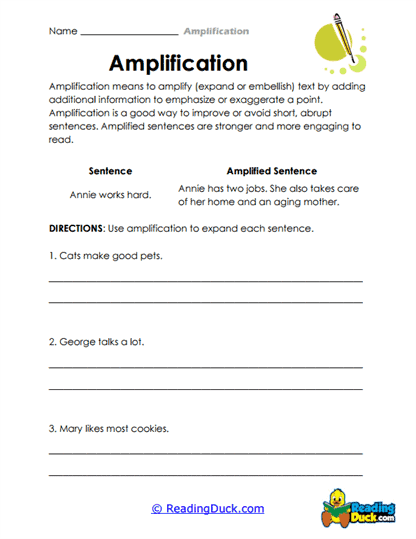
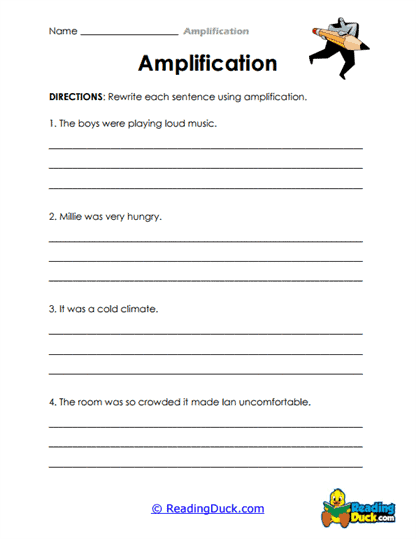
These worksheets introduce amplification in a simple, approachable way. Students start with short sentences and gradually learn how to expand them by adding relevant details.
The step-by-step structure helps students build confidence. Instead of feeling overwhelmed, they focus on improving one sentence at a time. This repetition helps the concept "click."
As students practice, they begin to understand that stronger writing comes from clearer, more developed ideas-not just longer sentences.
Strengthening Detail & Clarity - Detail Builder, Idea Expansion Organizer, Idea Web Expansion
This group focuses on helping students think more intentionally about the details they add. Instead of randomly expanding sentences, they learn to choose information that improves clarity.
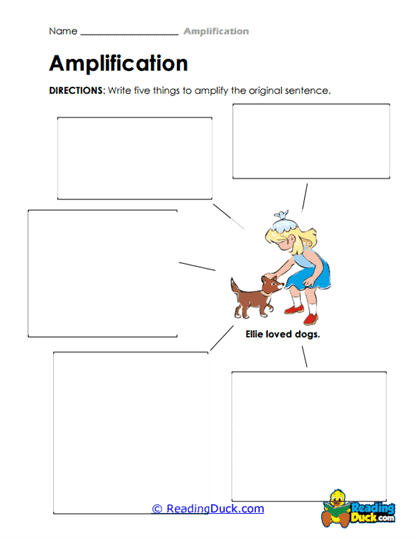
Visual tools like organizers and idea webs support brainstorming and planning. These activities are especially helpful for students who struggle to generate ideas or organize their thoughts.
Together, these worksheets strengthen both writing structure and comprehension by teaching students how ideas connect.
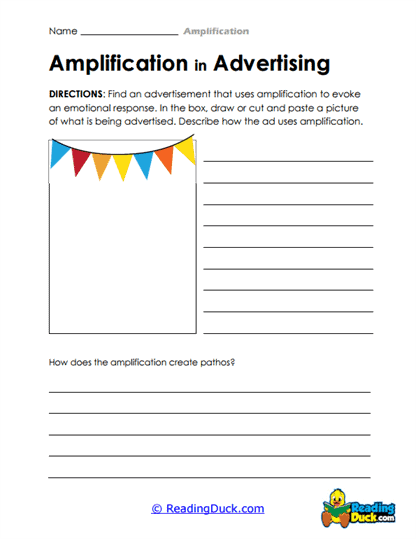
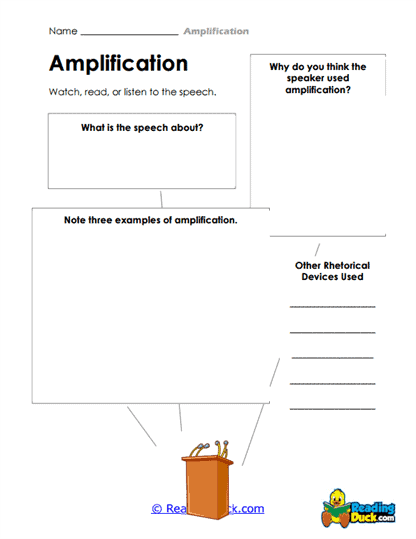
Applying Amplification in Context - Amplification in Advertising, Text Analysis, Speech Analysis Organizer
Here, students explore how amplification is used in real-world writing and speaking. They analyze how authors, advertisers, and speakers use detail and emphasis to influence an audience.
This not only improves writing skills but also builds critical thinking. Students begin to recognize persuasive techniques and understand how language shapes meaning.
These activities help bridge the gap between classroom learning and real-life communication.
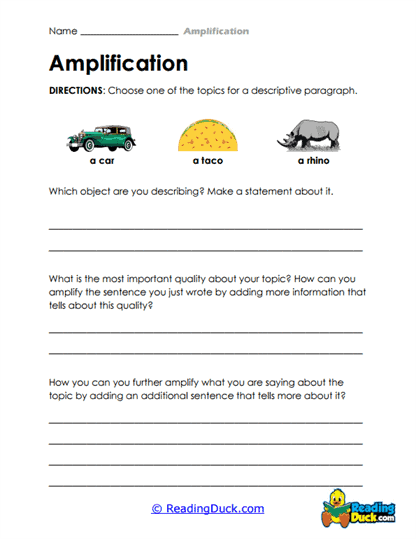
Moving to Paragraph Writing - Paragraph Builder, Descriptive Paragraph Builder
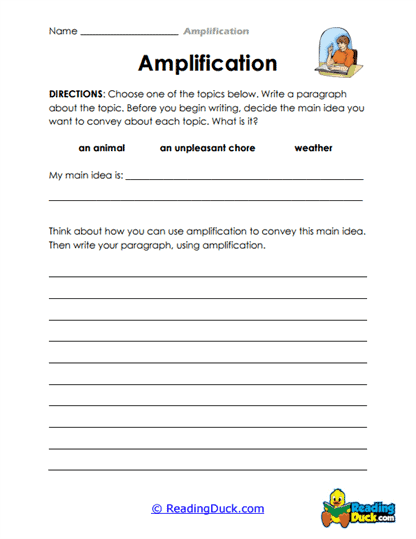
Students take the next step by expanding ideas across multiple sentences. Instead of focusing on one sentence, they learn how to develop a full paragraph with supporting details.
This is where amplification becomes a powerful writing tool. Students practice staying focused on one main idea while adding layers of detail.
Over time, this builds confidence in longer writing tasks and improves overall organization.
These worksheets help students solidify their understanding of amplification. They review key concepts, connect amplification to other writing techniques, and build vocabulary related to the skill.
Reflection activities encourage students to think about how and when to use amplification in their own writing.
This final stage helps move the skill from practice to independent use.
Instructional Tips for Teachers & Homeschool Parents
The "Say More Than You Think" Trick
Tell students: "If your sentence feels finished, try adding one more helpful detail."
This simple mindset shift helps them naturally expand their writing without overthinking it.
Common Student Mistakes
Adding random details that don't improve meaning
Making sentences longer but not clearer
Forgetting to explain actions or ideas fully
Remind students: More words doesn't mean better writing-better details do.
Quick Classroom Activity
Write a simple sentence on the board: "The dog ran."
Ask students to take turns adding one detail at a time:
Where did it run?
Why did it run?
What did it look like?
By the end, you'll have a fully amplified sentence-and students will see how writing grows.
Grade Levels and Standards Alignment
These amplification worksheets align with key writing and language standards across multiple grade levels.
Common Core State Standards (CCSS)
CCSS.ELA-LITERACY.W.3.3 / W.4.3 / W.5.3
Students develop narratives using descriptive details and clear event sequences. Amplification supports adding detail and clarity.
CCSS.ELA-LITERACY.W.4.2 / W.5.2
Students write informative texts that include facts, definitions, and details. Amplification directly supports elaboration.
CCSS.ELA-LITERACY.L.3.1 / L.4.1 / L.5.1
Demonstrate command of grammar and sentence structure. Expanding sentences strengthens sentence construction.
WIDA English Language Development Standards
WIDA Standard 2: Language of Language Arts
Amplification helps multilingual learners expand ideas, add detail, and improve clarity in writing.
Supports development in:
Expanding sentence complexity
Adding descriptive language
Improving academic writing clarity
TEKS (Texas Essential Knowledge and Skills)
TEKS 3.11(B), 4.11(B), 5.11(B)
Develop drafts by adding details and elaboration. Amplification is directly aligned with this skill.
Florida B.E.S.T. Standards
ELA.3.C.1.2 / ELA.4.C.1.2 / ELA.5.C.1.2
Students improve writing by adding relevant details and elaboration.
Virginia SOL
3.7, 4.7, 5.7 Writing Standards
Focus on elaboration, organization, and clarity in writing-all supported through amplification practice.
Make sure to bookmark our website now.
Enjoy all our free reading worksheets.
Our materials adhere to the principles of the Science of Reading.