Subject-verb agreement is the rhythm section of a sentence: the subject keeps the beat, and the verb plays along in perfect time. When they don't match-The dogs barks-the music skids to a stop. These worksheets turn that "match the number/person" idea into an easy habit with quick reps, clear examples, and a dash of humor to keep things moving.
Why does it matter? Because readers notice agreement instantly, even if they can't name the rule. Clean agreement makes instructions precise, arguments convincing, and stories smooth. It also strengthens understanding of verb agreement and sentence structure, helping students see how subjects and verbs must work together for clarity. Whether the sentence uses a simple subject, a collective noun, or a tricky indefinite pronoun, students learn to choose the verb that fits correctly every time.
This collection builds from simple to subtle. Learners begin with obvious switches (dog runs / dogs run), then tackle interrupters (A pile of leaves is...), either/or pairs, and tricky pronouns like each and everyone. With answer keys on every page, growth is easy to spot-and even easier to celebrate.
A Look At Each Worksheet
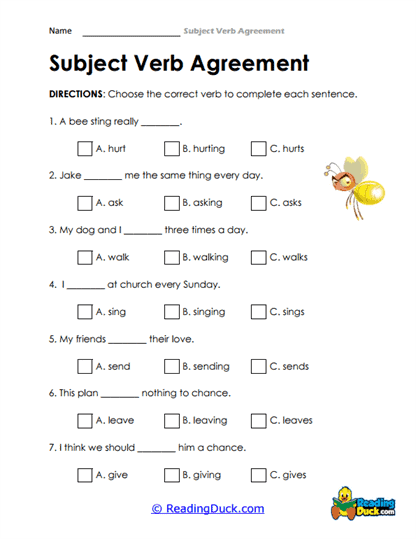
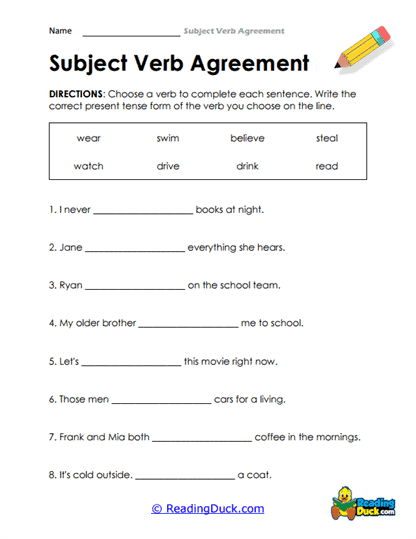
Completing Sentences
Fill-in lines require the verb form that correctly matches the subject. The tight focus makes agreement feel automatic. Short, clear, and confidence-building.
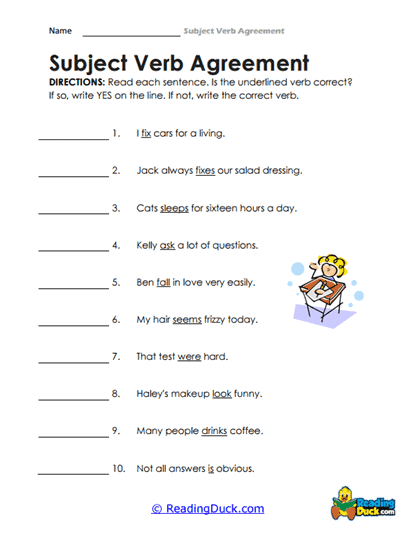
Correct or Fix
Students decide if a sentence is right as-is or needs a quick repair, then make the fix. The yes/no judgment sharpens instincts fast. Editing becomes a satisfying snap.
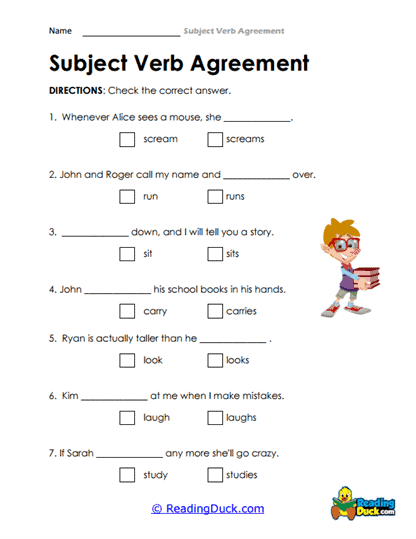
Correct Verb Check
Two verb forms appear; learners choose the one that agrees with the subject in number and person. Immediate feedback locks the pattern in. Accuracy climbs line by line.
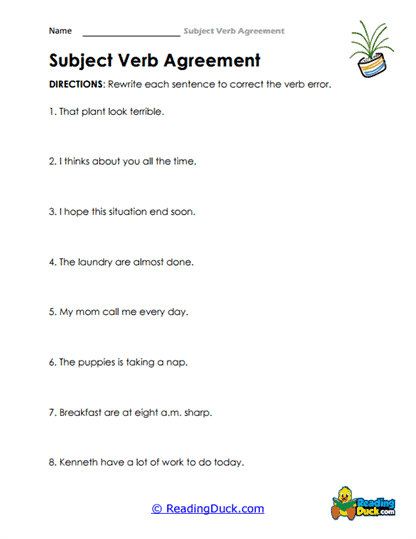
Error Fixer
A mini-clinic of common mistakes-collective nouns, prepositional phrases, and compound subjects-ready for repair. To master the trickiest part of this "clinic," head over to our collective nouns worksheets, where students learn exactly when a group acts as a single "is" and when it acts as a plural "are."
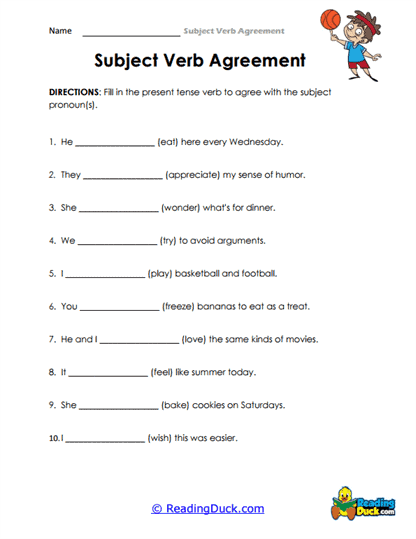
Make It Present
All about present-tense agreement, especially third-person singular -s endings. Students convert prompts into clean, correctly matched sentences. Present tense stops wobbling and starts gliding.
Match and Don't Repeat
Match subjects to the verbs that agree, then rewrite to avoid clunky repetition. The pairing step builds accuracy; the rewrite builds style. Form and flow, together at last.
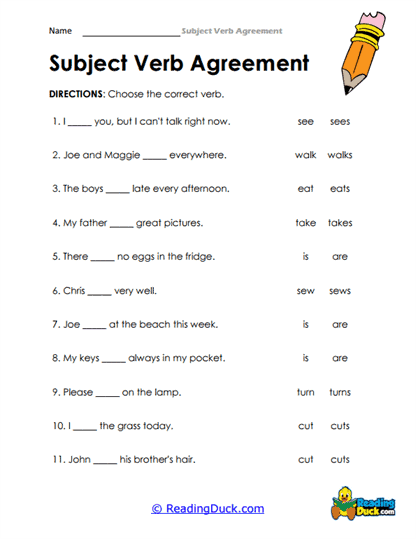
Picking Verbs
Multiple-choice items test close calls-is/are, was/were, has/have. Context clues steer the right choice. Tiny decisions lead to big confidence.
Present Tense Verbs
A focused warm-up on present forms for singular vs. plural subjects. Learners practice the everyday lines they use most. The "sounds right" instinct gets a rule to stand on.
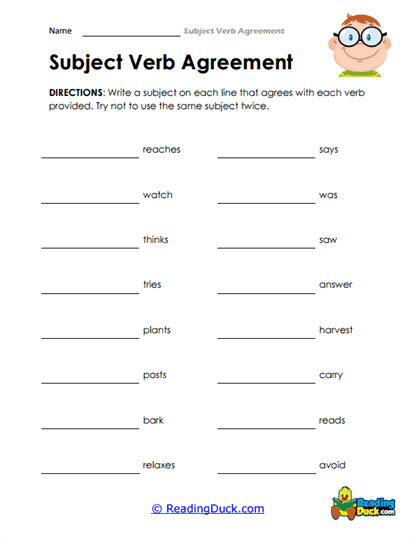
Subject Filler
Given a predicate, students supply a subject that makes the verb agree. It flips the usual task and deepens understanding. Agreement becomes a two-way street.
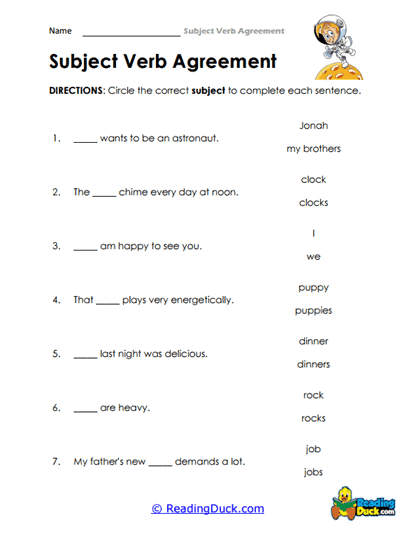
Subject Selector
Pick the best subject (noun or pronoun) from options so the verb doesn't need changing. The exercise spotlights how subjects drive agreement. Smart choices = smoother sentences.
Verb Agreement Underline
Underline the correct verb in pairs embedded in sentences. Fast reps, no fluff. Recognition becomes reflex.
Verb Choices
Choose the correct verb, then defend the decision in one short sentence. The micro-explanation cements the rule. Precision becomes habit, not guesswork.
Verb Chooser
Similar to "Verb Choices," but with trickier contexts-intervening phrases, indefinite pronouns, and either/or structures. Students learn to ignore distractions and find the true subject. The right verb practically chooses itself.
Writing Prompt Challenge
Short prompts push students to write original sentences that sound right and are right. Production proves mastery more than picking does. Voice grows while grammar stays solid.
Yes or No Grammar
Read, decide "Yes" (correct) or "No" (fix), and repair if needed. It's quick quality control for agreement. The green-light/red-light format keeps energy high.
What Is Subject-Verb Agreement?
Subject-verb agreement is the rule that the verb must match the subject in number (singular/plural) and person (first/second/third). In simple cases, that means choosing forms like is/are, was/were, or adding -s to present-tense verbs with third-person singular subjects (She runs). When agreement is right, the sentence feels effortless to read.
Complications arise when words come between the subject and the verb. Prepositional phrases and other add-ons can distract the eye: A bouquet of roses smells amazing-agree with bouquet, not roses. Train the brain to find the simple subject first, then pick the verb that matches it.
Compound subjects joined by and usually take a plural verb (Taco Tuesday and Movie Night are popular). With either/or and neither/nor, the verb agrees with the subject closest to it: Either the snacks or the main dish is ready; Either the main dish or the snacks are ready. Keeping an eye on what's nearest prevents awkward mismatches.
Indefinite pronouns can be sneaky. Words like each, every, everyone, neither, somebody are grammatically singular in formal classroom English (Everyone is here), while few, many, several, both are plural (Many are ready). Some-all, any, most, none, some-depend on the noun that follows (All of the cake is gone; All of the cupcakes are gone). Context decides the verb.
Collective nouns (team, class, staff) act singular when the group is one unit (The team wins), but can be treated as plural when emphasizing individuals (The team are arguing among themselves-more common in some varieties of English). Choose the form that fits your curriculum and the meaning you want. With practice, students learn to spot the true subject, ignore distractions, and choose the verb that keeps the sentence in perfect step.
Common Mistakes with Subject Verb Agreement
Sentence - "The bouquet of roses smell amazing."
Corrected Sentence - "The bouquet of roses smells amazing."
Why Is That Correct? - The verb agrees with the simple subjectbouquet (singular), not with roses inside the prepositional phrase. Matching number restores smooth, standard agreement.
Sentence - "Either the cookies or the cake are on the counter."
Corrected Sentence - "Either the cookies or the cake is on the counter."
Why Is That Correct? - With either/or, the verb agrees with the subject closest to it. Here that subject is cake (singular), so the verb should be is.
Sentence - "Everyone are bringing snacks."
Corrected Sentence - "Everyone is bringing snacks."
Why Is That Correct? -Everyone is grammatically singular in formal classroom English, so it takes a singular verb. Using is keeps number and person aligned.
Make sure to bookmark our website now.
Enjoy all our free reading worksheets.
Our materials adhere to the principles of the Science of Reading.