Tiny Particles, Big Reactions
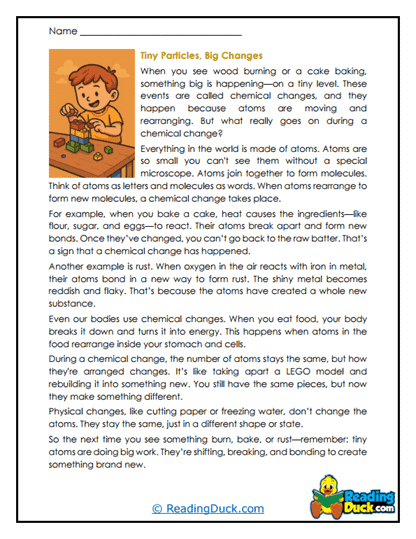
One of the hardest parts of learning chemistry is understanding that the most important changes happen where our eyes can’t see them. This passage helps students picture what happens during a chemical reaction by introducing atoms and molecules in an age-appropriate way. Readers learn that chemical changes occur when atoms rearrange and form brand-new substances with different properties. The text uses familiar examples such as baking, rusting, and even digestion to show that tiny particles are constantly breaking apart and joining together. By the end of the passage, students realize that every chemical change begins with invisible building blocks working together.
Reading science passages like this helps students develop the ability to understand abstract ideas through clear examples and comparisons. Children strengthen their comprehension by connecting scientific explanations with real-life situations they already know. Vocabulary such as atom, molecule, chemical reaction, and substance expands both science knowledge and reading skills. These experiences also encourage students to think critically about how everyday events can be explained through science, making nonfiction reading both meaningful and engaging.
Questions:
Answer Keys: