About Our Conservation of Matter Reading Comprehension Worksheets
Matter is all around us, and one of the most amazing facts in science is that it never simply disappears. Whether wood burns in a campfire, water freezes into ice, or food is digested inside our bodies, matter is always changing from one form to another. These worksheets introduce students to the Law of Conservation of Matter through familiar, real-world examples that make this important scientific principle easier to understand. Along the way, children discover that every chemical and physical change follows the same basic rule: matter is never created or destroyed.
Our Conservation of Matter Reading Comprehension Worksheets help students strengthen nonfiction reading skills while exploring essential science concepts. As they read, students practice identifying main ideas, recognizing cause-and-effect relationships, following sequences, and expanding academic vocabulary. The passages also encourage critical thinking by helping readers connect scientific ideas to everyday experiences such as cooking, weather, recycling, and growing plants. These skills support success in science, reading, and many other areas of learning.
Learning about the conservation of matter helps children become more curious about the world around them. They begin asking thoughtful questions, making careful observations, and using evidence to explain what they see. As students gain confidence reading informational texts, they also develop a stronger understanding of how scientists investigate and explain natural phenomena. We hope these worksheets inspire a lasting appreciation for science and the incredible ways matter moves through our world.
Meet the Worksheets
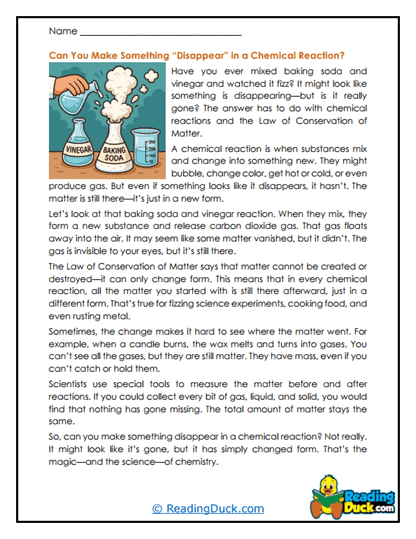
Can Matter Really Disappear?
Students investigate what really happens during chemical reactions that seem to make matter vanish. They learn that gases produced during reactions still contain matter, even when they cannot be seen. This worksheet strengthens scientific reasoning through familiar kitchen experiments. Readers discover that appearances can sometimes be misleading in science.
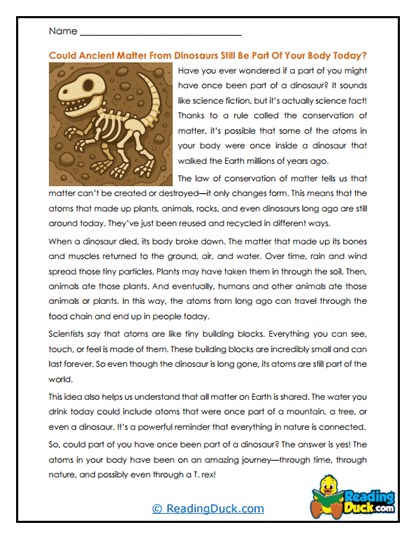
Could You Be Part Dinosaur?
Students explore the incredible journey of atoms through Earth's history. They learn how matter is constantly recycled through plants, animals, water, soil, and even ancient living things. This worksheet builds sequencing and big-picture thinking skills. It helps readers understand that they are part of nature's ongoing cycle of matter.
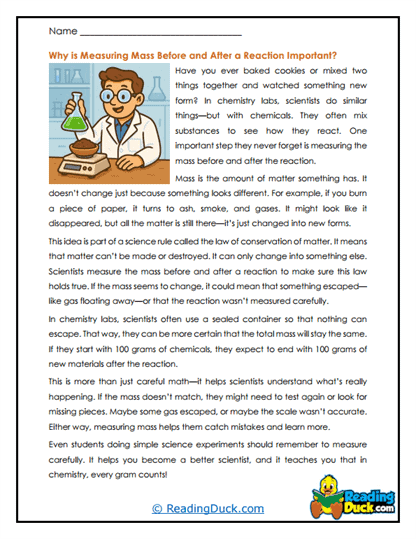
Every Gram Counts
Students discover why scientists carefully measure mass before and after chemical reactions. They learn how accurate measurements provide evidence that matter is always conserved. This worksheet develops observation and evidence-based reasoning skills. Readers see how careful data collection supports scientific discoveries.
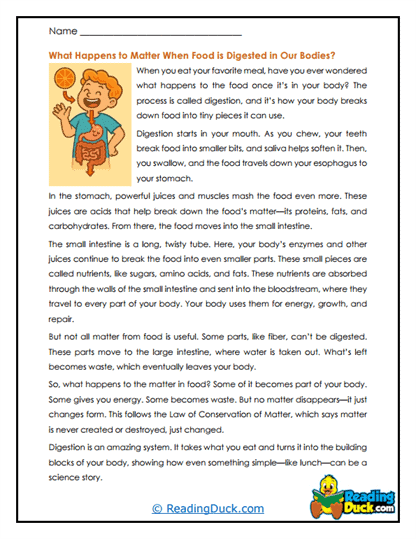
From Lunch to Life
Students follow the journey food takes through the human body. They learn how digestion transforms food into nutrients, energy, and materials used for growth without destroying matter. The passage connects chemistry and biology through an everyday experience. Readers gain a greater appreciation for the amazing science happening inside their own bodies.
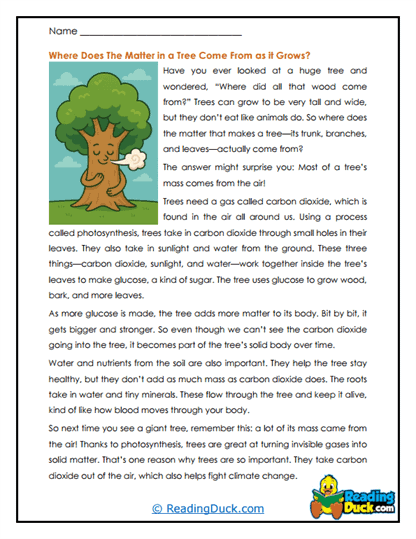
Growing From Thin Air
Students investigate where trees get the matter they need to grow. They discover how carbon dioxide, water, and sunlight work together during photosynthesis to create new plant material. This worksheet challenges common misconceptions while strengthening scientific understanding. Readers are often surprised to learn that much of a tree's mass comes from the air.
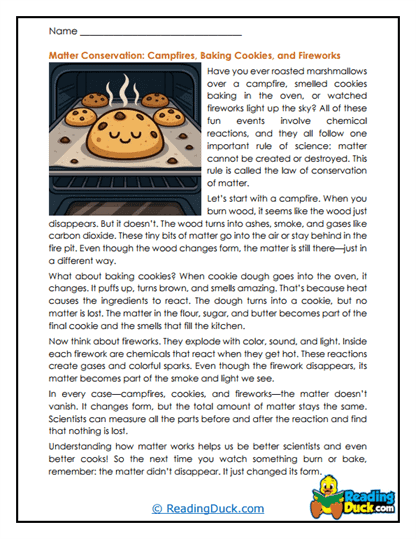
Matter Never Vanishes
Students explore how campfires, baking, and fireworks all demonstrate the Law of Conservation of Matter. They compare several exciting examples to see how matter changes form without ever disappearing. This worksheet strengthens comparison skills and scientific reasoning. It helps readers recognize chemistry in many everyday experiences.
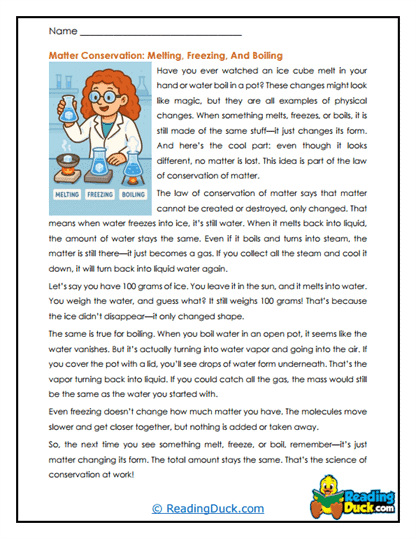
Melting, Freezing, and Boiling
Students learn how matter changes between solids, liquids, and gases during physical changes. They discover that although the appearance of water changes, every molecule remains the same. The passage strengthens understanding of physical changes and conservation of matter. Readers see that changing state is very different from creating a new substance.
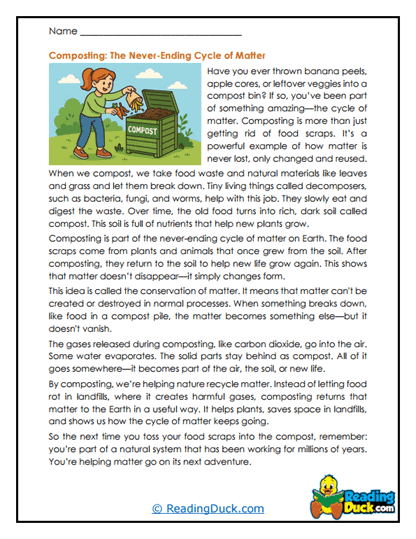
Nothing Goes to Waste
Students explore how composting recycles matter back into nature. They learn how decomposers break down food scraps and plant materials into nutrients that support new growth. This worksheet connects environmental science with the conservation of matter. Readers discover that nature is one of the world's greatest recyclers.
Rust That Weighs More?
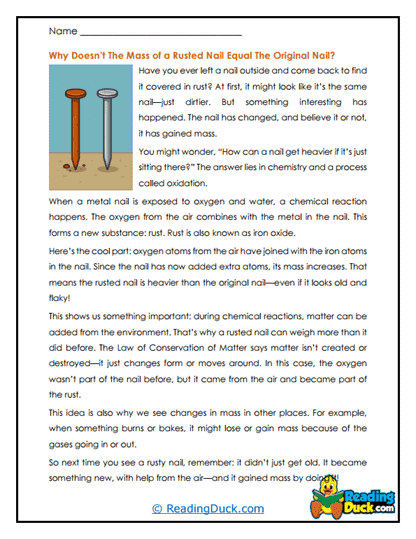
Students investigate the surprising science behind rust formation. They learn how iron combines with oxygen to create rust and why a rusty object can actually weigh more than it did before. This worksheet strengthens cause-and-effect thinking through a familiar example. Readers discover that matter can move from one place to another during a chemical reaction.
The Water Cycle
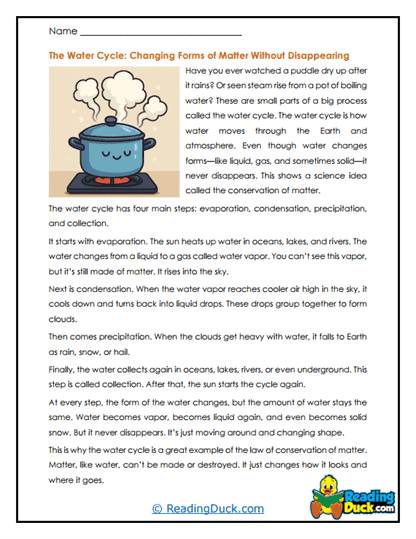
Students follow water as it moves through evaporation, condensation, precipitation, and collection. They learn that water continually changes form while remaining the same matter throughout the cycle. This worksheet strengthens sequencing skills and reinforces natural cycles. Readers gain a deeper appreciation for one of Earth's most important systems.
Understanding Burning and Conservation
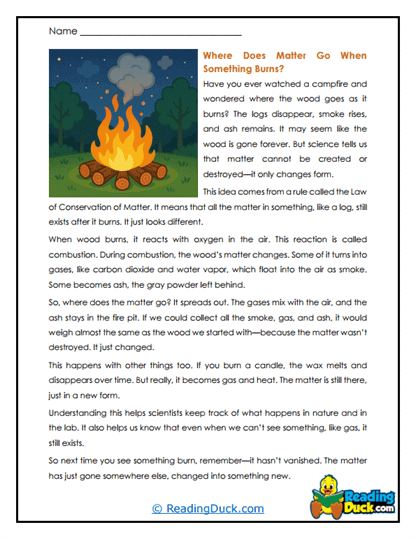
Students are introduced to the Law of Conservation of Matter through the familiar example of a campfire. They learn how burning wood creates gases and ash instead of making matter disappear. This worksheet builds a strong foundation for understanding chemical reactions. Readers quickly recognize that matter is always changing, not vanishing.
Why Scientists Use Sealed Containers
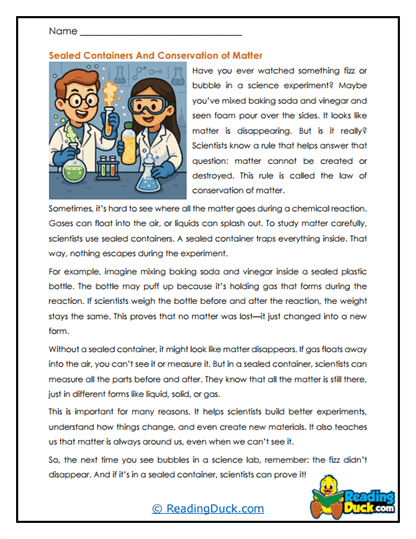
Students discover how scientists design experiments to prove that matter is conserved. They learn why sealed containers prevent gases from escaping and make accurate measurements possible. This worksheet strengthens understanding of scientific investigations and experimental design. Readers see how evidence helps scientists confirm important scientific laws.
A Better Look At the Law of Conservation of Matter
The Law of Conservation of Matter is one of the most important ideas in science because it explains what happens during both physical and chemical changes. Whether matter burns, rusts, melts, freezes, grows into a tree, or moves through the water cycle, it is never created or destroyed. Instead, it changes form or moves from one place to another. Understanding this principle helps students make sense of many natural processes they observe every day.
Reading about the conservation of matter also helps students become stronger readers and scientific thinkers. They practice analyzing evidence, following scientific explanations, building academic vocabulary, and connecting ideas across different examples. These skills support learning in science, reading, and many other subjects. With every passage, students gain confidence while discovering that matter is constantly changing, yet always remains part of the world around us.
Make sure to bookmark our website now.
Enjoy all our free reading worksheets.
Our materials adhere to the principles of the Science of Reading.