
Glow in the Dark
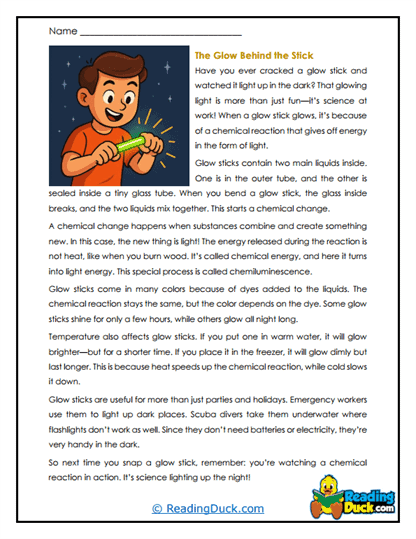
Few things capture a child’s attention like snapping a glow stick and watching it light up. This passage explains that the colorful glow isn’t magic-it’s chemistry in action. Students learn how two separate liquids mix together inside the glow stick to create a chemical reaction that releases energy as light instead of heat. The text also explores how temperature affects the brightness and length of the glow and introduces the scientific term chemiluminescence. Readers discover that glow sticks are useful not only for fun celebrations but also for emergencies, camping, and nighttime safety.
This type of real-world science passage helps students see that chemistry is happening all around them. Children practice identifying cause-and-effect relationships while learning how changing one condition, such as temperature, affects the outcome of a reaction. New vocabulary like chemiluminescence, energy, reaction, and temperature strengthens both reading comprehension and scientific understanding. These connections make science feel exciting, practical, and much easier for students to remember.
Questions:
Answer Keys: