
Salads, Saltwater, and Solutions
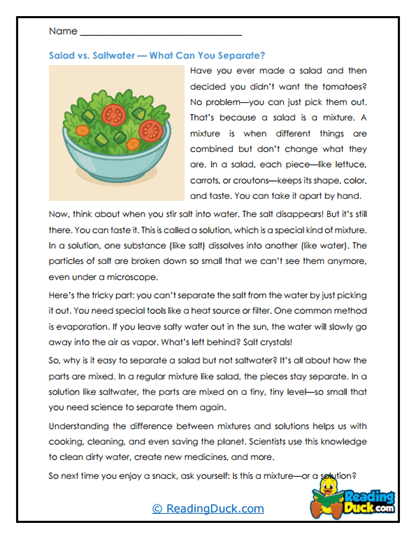
Have you ever picked tomatoes out of a salad or wondered why you can’t scoop the salt back out of saltwater? This passage uses those familiar experiences to explain the difference between ordinary mixtures and solutions. Students learn that the ingredients in a salad remain easy to separate because they never change, while salt dissolves into water to form a solution where the particles are spread evenly throughout the liquid. Readers also discover that solutions can often be separated using methods such as evaporation, helping them understand how scientists and engineers separate materials in the real world.
Reading passages that use everyday examples makes science concepts much easier for students to understand and remember. Children practice comparing and contrasting while strengthening their ability to explain scientific ideas using evidence from the text. Academic vocabulary such as solution, dissolve, evaporation, mixture, and particles expands both science knowledge and reading confidence. These meaningful connections help students recognize that chemistry is happening all around them, even during everyday activities like making lunch or mixing a drink.
Questions:
Answer Keys: