
Nothing Goes to Waste Short Answer
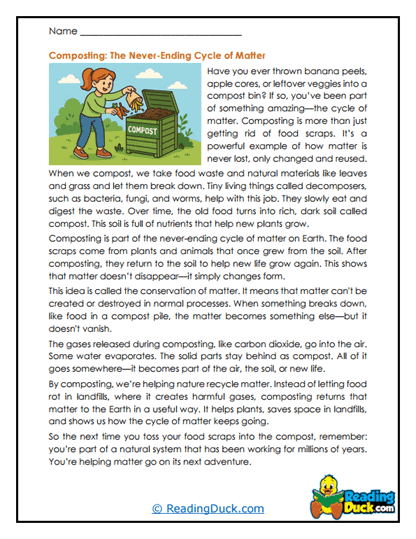
Composting is one of nature’s best examples of the Law of Conservation of Matter in action. This passage explains how food scraps, fallen leaves, and other organic materials are broken down by tiny decomposers such as bacteria and fungi. Students learn that while these materials may seem to disappear, their matter simply changes into nutrient-rich compost, gases, and other substances that continue supporting life. The text also explores how compost improves soil, helps plants grow, and reduces waste sent to landfills. By following the journey of a banana peel or apple core, readers discover that matter is constantly being recycled throughout nature.
Reading informational passages about natural cycles helps students build strong connections between science and environmental responsibility. Children practice identifying cause-and-effect relationships, tracing sequences, and explaining how matter moves through ecosystems. Vocabulary such as compost, decomposer, organic matter, nutrients, decomposition, and conservation of matter strengthens both scientific understanding and reading skills. These engaging examples encourage students to appreciate how nature recycles materials and reminds them that even everyday actions can help care for the environment.