
Can Matter Really Disappear? Multiple Choices
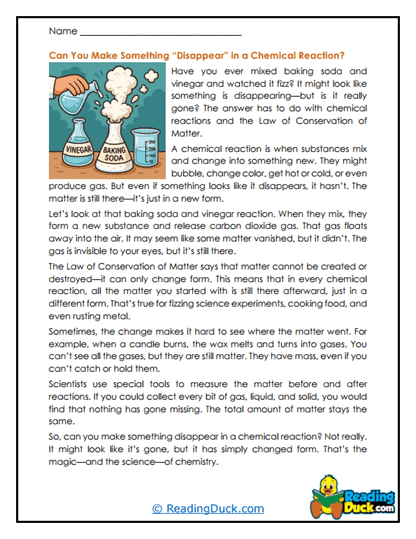
Watching baking soda and vinegar bubble together can make it seem like something simply vanishes into thin air. This passage helps students understand that even when gases are produced and become invisible, matter has not disappeared. Readers learn that chemical reactions often create new substances, such as carbon dioxide gas, but the total amount of matter remains exactly the same. The text introduces scientists’ use of careful measurements before and after reactions to prove that matter is always conserved. By using familiar kitchen experiments, students discover that chemistry often changes what matter looks like without changing how much matter exists.
Reading nonfiction passages like this helps students strengthen both their scientific reasoning and reading comprehension. Children practice recognizing cause-and-effect relationships while learning to support scientific ideas with evidence from the text. Vocabulary such as chemical reaction, conservation of matter, carbon dioxide, gas, and mass expands both science knowledge and academic language. These engaging examples encourage students to question what they observe and understand that science often explains things that are invisible to the eye.