
Spacecrafts to Mars?
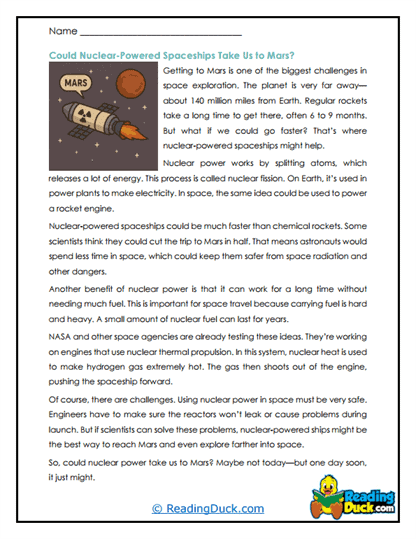
Traveling to Mars is one of humanity’s biggest dreams, but the journey is long and challenging. This passage introduces students to the exciting idea of nuclear-powered spacecraft and how nuclear energy could help future astronauts travel farther through space. Readers learn how nuclear reactors or nuclear thermal propulsion systems might provide powerful, long-lasting energy for deep-space missions. The text also explains the advantages of carrying fuel that lasts much longer than traditional rocket fuel while discussing the engineering challenges scientists must solve before these spacecraft become common. Students discover how today’s research could shape tomorrow’s space exploration.
This engaging nonfiction passage builds reading comprehension while connecting science with technology and space exploration. Students practice following scientific explanations, identifying cause-and-effect relationships, and recognizing how new discoveries often begin with research and experimentation. Vocabulary including spacecraft, nuclear propulsion, reactor, astronaut, Mars, and exploration helps expand both science knowledge and academic language. The exciting real-world topic encourages curiosity while showing how science can help solve future challenges.
Questions:
Answer Keys: