
Forceful Bonds
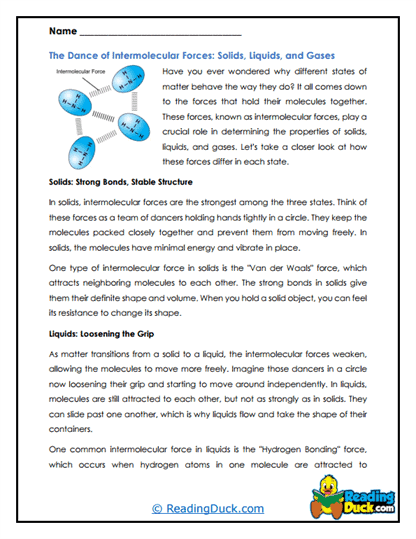
This passage delves into intermolecular forces, which determine how tightly particles in different states of matter are bound together. Solids have the strongest forces, keeping particles tightly packed and giving them a defined shape, while liquids have weaker forces, allowing particles to move more freely. Gases have the weakest forces, resulting in particles that move independently of each other. It also mentions specific forces like the Van der Waals force in solids and the hydrogen bonding found in liquids.
This passage introduces students to complex scientific vocabulary such as intermolecular forces and Van der Waals forces, improving their ability to understand technical terms. It requires careful reading comprehension to grasp how these forces impact the behavior of particles. The comparative explanation between solids, liquids, and gases builds analytical skills, as students must evaluate and contrast these states. Additionally, the detailed discussion of bonding reinforces logical reasoning and encourages students to think about how microscopic forces influence macroscopic behavior.
Questions:
Answer Keys: