About Our Explorers Reading Comprehension Worksheets
Explorers have traveled across oceans, deserts, mountains, frozen landscapes, and unfamiliar territories in search of new routes, knowledge, trade, and adventure. This collection introduces students to twelve famous explorers whose journeys helped shape how people understood the world. Readers meet figures such as Marco Polo, Ferdinand Magellan, Zheng He, Ibn Battuta, James Cook, Roald Amundsen, and Ernest Shackleton while learning about the challenges they faced along the way. Students also discover that exploration had complicated consequences, bringing cultures into contact while sometimes leading to conflict, exploitation, and lasting changes for the people already living in explored regions.
Our Explorers Reading Comprehension Worksheets help students strengthen nonfiction reading skills through engaging historical biographies. As they read, students practice identifying main ideas, finding supporting details, following chronological events, recognizing cause and effect, comparing challenges, and examining motivations. The passages also introduce useful vocabulary related to navigation, geography, trade, exploration, and historical travel. These skills build reading confidence while helping students understand how exploration influenced maps, trade routes, cultural connections, and knowledge of the world.
Learning about explorers also gives children an opportunity to examine perseverance, preparation, leadership, curiosity, and decision-making. Many of these journeys involved dangerous seas, extreme temperatures, disease, unfamiliar terrain, limited supplies, and months or even years away from home. Students see how navigational skills, careful observations, written accounts, and adaptability could determine whether an expedition succeeded or failed. We hope these worksheets encourage readers to approach exploration as an important and complex part of world history.
Meet the Worksheets
African Quest
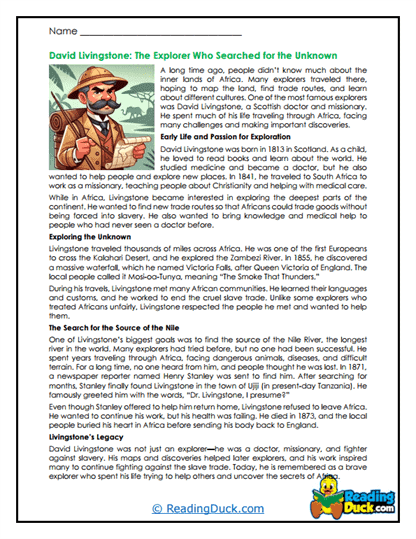
Students follow David Livingstone's travels through Africa as a doctor, missionary, and explorer. They learn about his journeys across the Kalahari Desert and along the Zambezi River, his search for the source of the Nile, and the hardships he encountered along the way. This worksheet strengthens sequencing and cause-and-effect skills by connecting Livingstone's goals with the challenges he faced. Readers also examine how his travels contributed to European knowledge of African geography.
Eastern Adventures
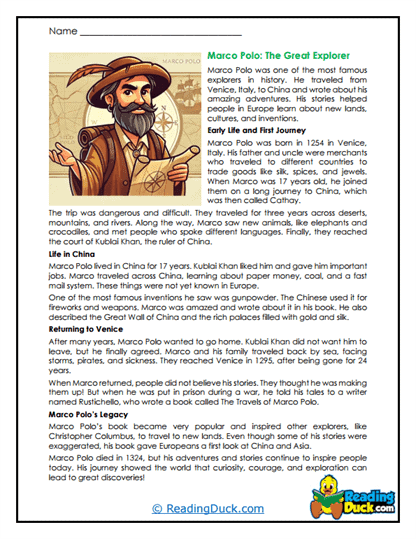
Students travel with Marco Polo from Venice across deserts, mountains, and important trade routes to the court of Kublai Khan in China. They learn about his experiences in Asia, eventual return to Venice, and the stories later recorded in The Travels of Marco Polo. This worksheet strengthens chronological comprehension by helping readers organize a journey that lasted more than two decades. Students also discover how written travel accounts could introduce distant places and cultures to new audiences.
Endurance Rescue
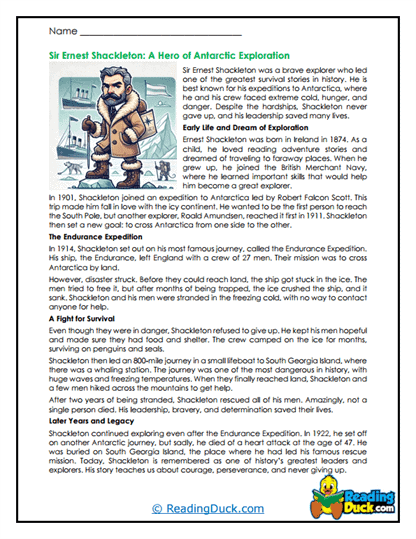
Students explore Ernest Shackleton's remarkable Antarctic survival story after his ship, the Endurance, became trapped and crushed by ice. They follow the crew across floating ice and to Elephant Island before learning about Shackleton's dangerous journey to South Georgia Island for help. This worksheet strengthens sequencing skills while asking readers to identify examples of leadership, courage, and teamwork. Students discover how persistence and decision-making contributed to the eventual rescue of every member of the crew.
Endless Traveler
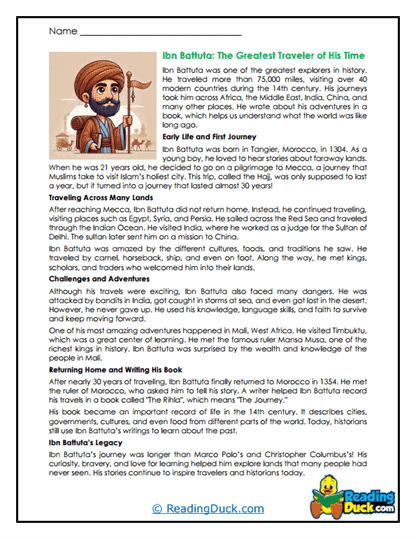
Students follow Ibn Battuta on an extraordinary journey that covered more than 75,000 miles across much of the medieval world. They learn how a pilgrimage to Mecca developed into decades of travel through Africa, the Middle East, India, China, and other regions. This worksheet strengthens supporting-detail and chronological comprehension while examining the many cultures and places Battuta encountered. Readers also discover how his experiences, recorded in the Rihla, provide later generations with information about medieval life.
Frozen Mystery
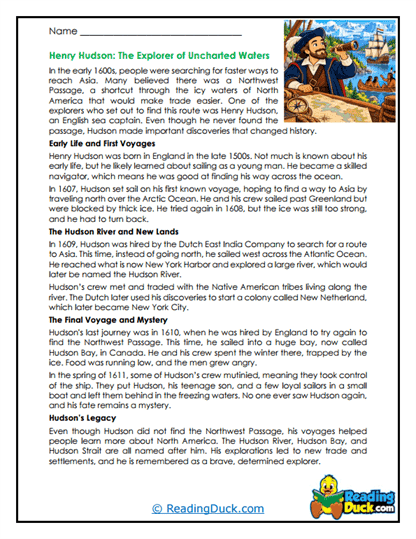
Students investigate Henry Hudson's dangerous attempts to find a faster sea route between Europe and Asia. They follow his searches for the Northeast and Northwest Passages, his travels through icy waters, and the final expedition that ended in mutiny and his disappearance. This worksheet strengthens cause-and-effect comprehension by connecting difficult conditions with growing tensions among Hudson's crew. Readers also discover how unsuccessful expeditions can still contribute to later geographic knowledge and trade.
Global Voyage
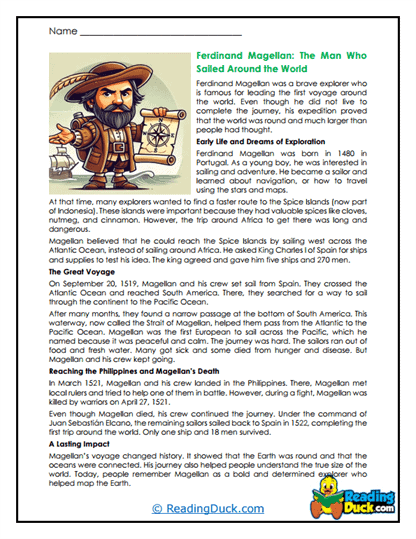
Students follow Ferdinand Magellan's ambitious expedition as it attempts to reach the Spice Islands by sailing west. They learn about storms, the difficult passage around South America, the enormous Pacific Ocean, Magellan's death in the Philippines, and Juan Sebastián Elcano's completion of the voyage. This worksheet provides strong practice with sequencing a long series of historical events. Readers also discover how the expedition expanded European understanding of the world's size and geography.
Naming America
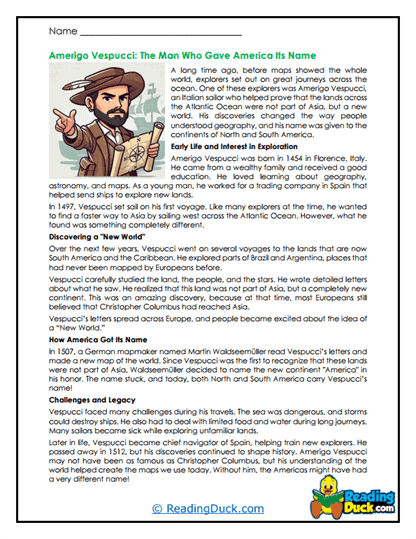
Students explore Amerigo Vespucci's voyages along parts of the South American coastline. They learn how his observations and popular letters helped Europeans recognize that these lands were not part of Asia and how the name "America" eventually appeared on a map. This worksheet strengthens cause-and-effect skills by connecting exploration, written accounts, and changes in European geographic understanding. Readers also see how maps and firsthand observations can influence the way people picture the world.
Ocean Crossing
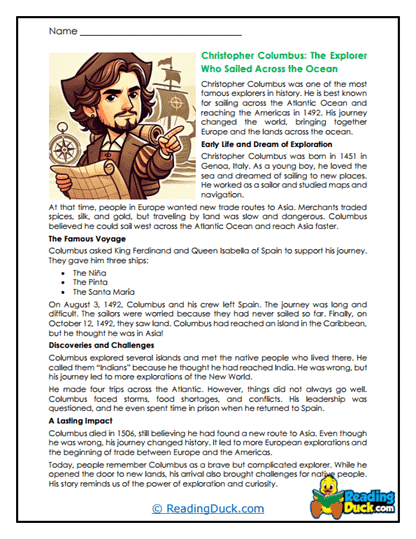
Students examine Christopher Columbus's 1492 Atlantic voyage and the complicated consequences that followed. They learn about his search for a western route to Asia, the Niña, Pinta, and Santa María, his arrival in the Caribbean, and his mistaken belief that he had reached the Indies. This worksheet strengthens sequencing and critical-reading skills by examining both motivations and consequences. Readers also consider the conflicts and hardships experienced by native peoples following European arrival.
Pacific Mapper
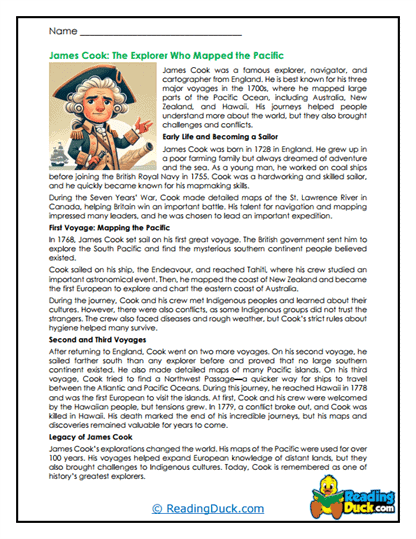
Students discover how James Cook combined exploration with careful navigation, observation, and mapmaking. They follow his voyages to places including Tahiti, New Zealand, Australia, Antarctica, and Hawaii while learning about his efforts to improve health aboard his ships. This worksheet strengthens chronological comprehension by helping readers organize Cook's accomplishments across several expeditions. Students also discover how detailed maps and observations expanded European knowledge of the Pacific.
Polar Pioneer
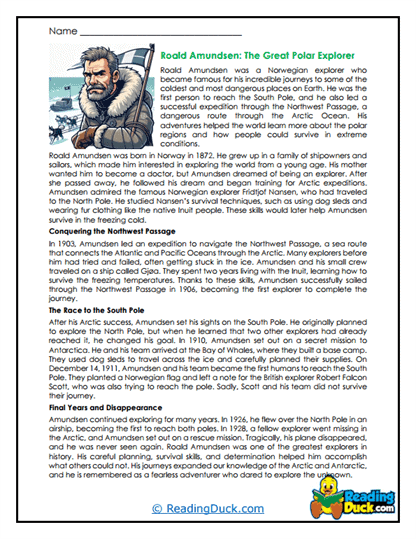
Students explore how careful preparation helped Roald Amundsen succeed in some of Earth's harshest environments. They learn how he studied Arctic survival techniques, traveled through the Northwest Passage, and raced Robert Falcon Scott to the South Pole. This worksheet strengthens comparison and sequencing skills by connecting Amundsen's preparation with the challenges of polar exploration. Readers discover how adaptability, planning, and knowledge can become important tools for survival.
Spice Route
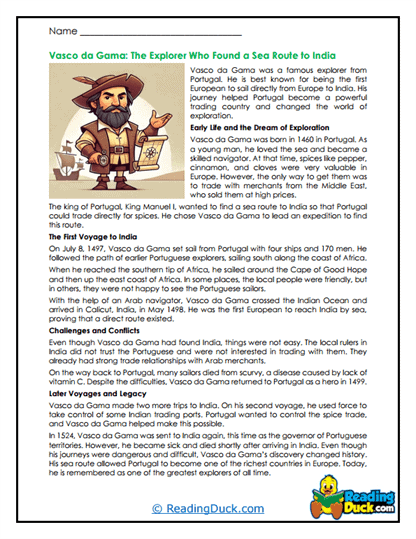
Students follow Vasco da Gama's search for a sea route connecting Europe with India. They learn why spices made the journey so important to European traders and how da Gama traveled around the Cape of Good Hope and across the Indian Ocean to Calicut. This worksheet strengthens comprehension by connecting motivations, challenges, and outcomes throughout the voyage. Readers also examine how new maritime routes influenced international trade and interactions between distant regions.
Treasure Voyages
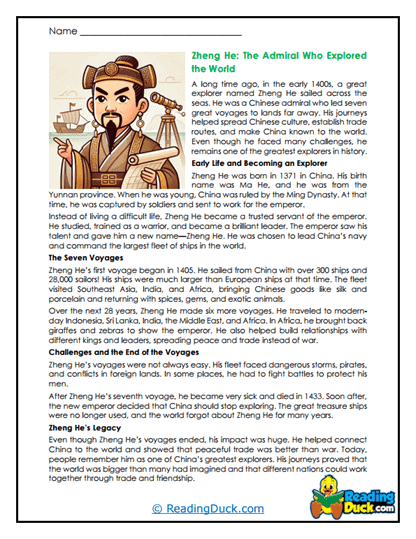
Students discover the enormous naval expeditions commanded by Zheng He during the early 1400s. They learn how his fleets traveled throughout Southeast Asia, India, the Middle East, and Africa while carrying goods and building relationships with foreign leaders. This worksheet strengthens supporting-detail and cause-and-effect skills by examining trade, diplomacy, cultural exchange, storms, and other challenges. Readers see how exploration could connect distant civilizations as well as expand geographic knowledge.
A Better Look At Explorers
Exploration has taken many forms throughout history. Some travelers searched for profitable trade routes, while others pursued geographic knowledge, diplomatic relationships, scientific observations, personal adventure, or national goals. Their journeys could require years of travel through dangerous and unfamiliar environments, and their written accounts and maps sometimes changed how other people understood the world. At the same time, exploration could bring conflict and harmful consequences, making it important to consider both accomplishments and the effects these journeys had on other people and cultures.
Reading about explorers also helps students become stronger readers and historical thinkers. They practice following complicated journeys, identifying motivations, recognizing cause-and-effect relationships, comparing challenges, and examining how preparation and leadership influenced outcomes. These stories also encourage students to consider history from more than one perspective rather than viewing exploration only as a series of discoveries. With every passage, students gain reading confidence while developing a deeper understanding of the journeys, decisions, and consequences that shaped exploration throughout history. Pasted text
Make sure to bookmark our website now.
Enjoy all our free reading worksheets.
Our materials adhere to the principles of the Science of Reading.