About Our Artists Reading Comprehension Worksheets
Artists can help us see the world in entirely new ways through color, shape, imagination, emotion, and storytelling. This collection introduces students to twelve influential artists from different countries, cultures, time periods, and artistic movements. Readers meet figures such as Leonardo da Vinci, Vincent van Gogh, Pablo Picasso, Claude Monet, Frida Kahlo, and Yayoi Kusama while exploring the experiences that shaped their work. Students also discover movements and styles including Renaissance art, Impressionism, Cubism, Surrealism, Pop Art, murals, printmaking, and contemporary installations.
Our Artists Reading Comprehension Worksheets help students strengthen nonfiction reading skills through engaging biographies. As they read, students practice identifying main ideas, finding supporting details, following chronological events, recognizing cause and effect, and connecting an artist's experiences with the work they created. The passages also introduce useful vocabulary related to artistic techniques, movements, careers, and creative expression. These skills help students become more confident readers while giving them a broader understanding of art and history.
Learning about artists also gives children a chance to explore ideas such as creativity, persistence, individuality, and self-expression. Many of these artists faced criticism, personal challenges, or pressure to follow traditional expectations, yet continued developing their own distinctive approaches. Students see how family, culture, surroundings, historical events, and personal experiences can all influence creativity. We hope these worksheets encourage readers to appreciate famous works of art while thinking about what inspires people to create.
Meet the Worksheets
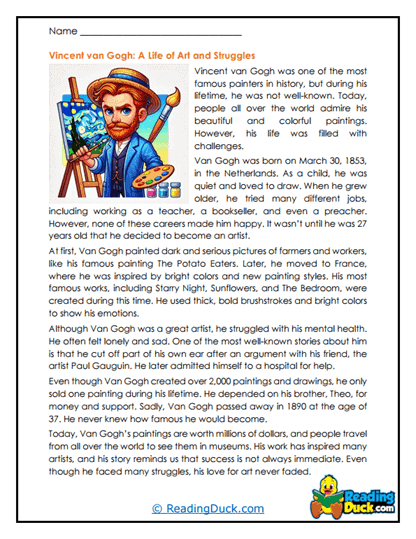
Brilliant Brushstrokes
Students explore the life and remarkable career of Vincent van Gogh, from his childhood in the Netherlands to his eventual decision to become an artist. They learn about famous works such as Starry Night and Sunflowers while examining the bold colors and energetic brushstrokes that made his style so recognizable. This worksheet strengthens chronology and cause-and-effect skills by contrasting Van Gogh's struggles during his lifetime with his later fame. Readers also consider how persistence can matter even when success does not happen right away.
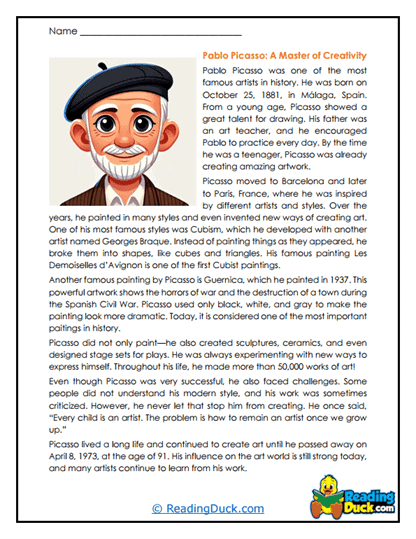
Cubist Pioneer
Students discover how Pablo Picasso challenged traditional ideas about what artwork could look like. They learn about his childhood in Spain, move to Paris, experiments with Cubism, and work in painting, sculpture, ceramics, and stage design. This worksheet strengthens main-idea and comparison skills by asking readers to connect Picasso's experimentation with the development of a new artistic movement. Students see how creative people can influence future generations by being willing to try something different.
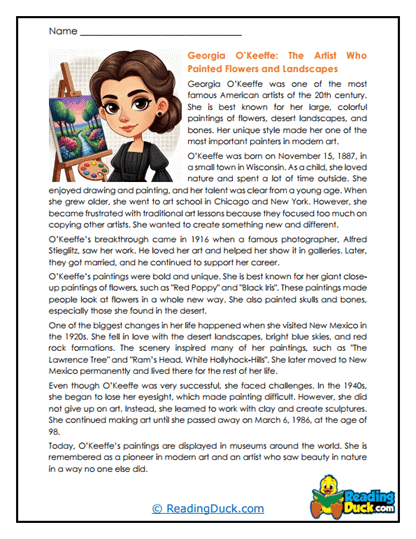
Desert Blooms
Students follow Georgia O'Keeffe from her childhood in Wisconsin to the landscapes of New Mexico that became an important source of inspiration. They explore her enormous flower paintings, Southwestern landscapes, and distinctive approach to natural subjects. This worksheet strengthens comprehension by connecting an artist's surroundings with changes in her artwork. Readers also explore perseverance and independence as they discover how O'Keeffe developed a style that was uniquely her own.
Dreamlike Visions
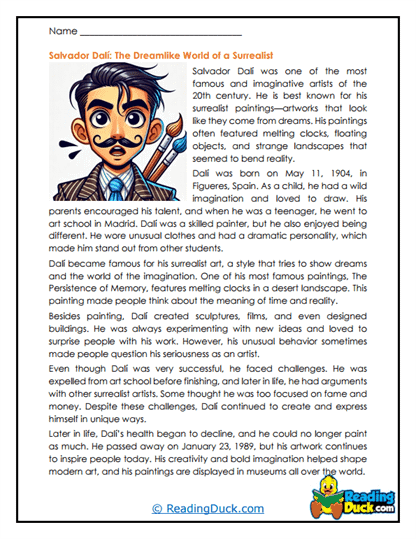
Students enter the imaginative world of Salvador Dalí and the Surrealist movement. They learn how Dalí combined unexpected objects and dreamlike scenes in works such as The Persistence of Memory to challenge ordinary ideas about reality. This worksheet develops supporting-detail and inference skills by connecting Dalí's personality, ideas, and artistic choices. Readers discover how individuality and imagination can become defining parts of an artist's work.
Making Waves
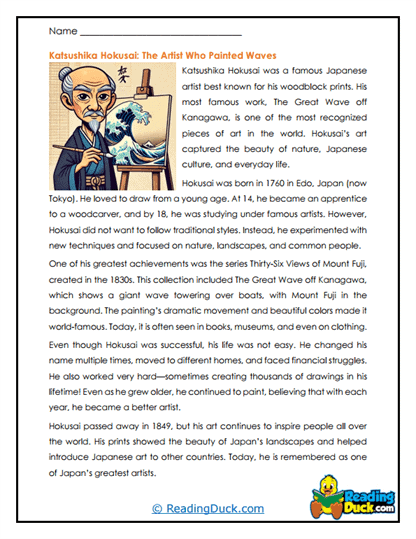
Students explore the life and work of Japanese artist Katsushika Hokusai. They learn about his artistic experimentation, Thirty-Six Views of Mount Fuji, and the famous image The Great Wave off Kanagawa. This worksheet strengthens sequencing and biographical comprehension while connecting an artist's culture and surroundings with his work. Readers also discover how Hokusai's art eventually influenced audiences far beyond Japan.
Painted Strength
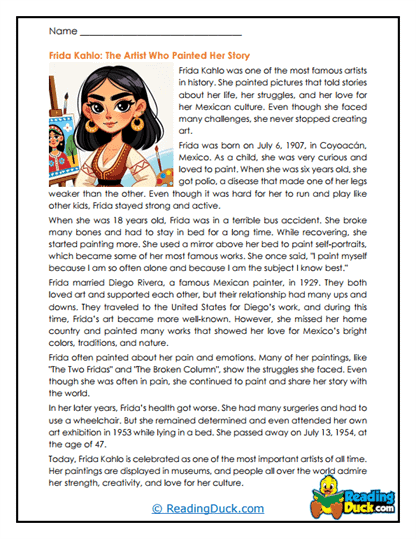
Students learn how Frida Kahlo transformed difficult personal experiences into deeply meaningful artwork. They follow major events in her life, including childhood illness, a serious bus accident, and the period of recovery when she began creating self-portraits. This worksheet strengthens sequencing and cause-and-effect comprehension by connecting Kahlo's experiences with the subjects she painted. Readers also explore themes of resilience, identity, and artistic expression.
Painting Light
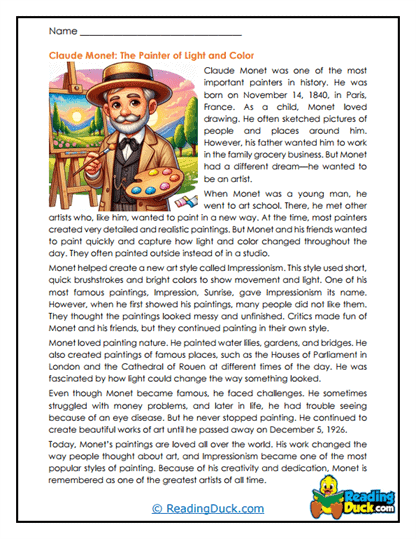
Students discover how Claude Monet helped change painting through his fascination with light, color, and everyday scenes. They learn about Impressionism, Monet's quick brushstrokes, and works depicting water lilies, gardens, bridges, and changing conditions throughout the day. This worksheet strengthens comprehension by connecting Monet's artistic choices with the development of a new movement. Readers also see how he continued creating despite criticism, financial difficulties, and problems with his eyesight.
Polka Dot Dreams
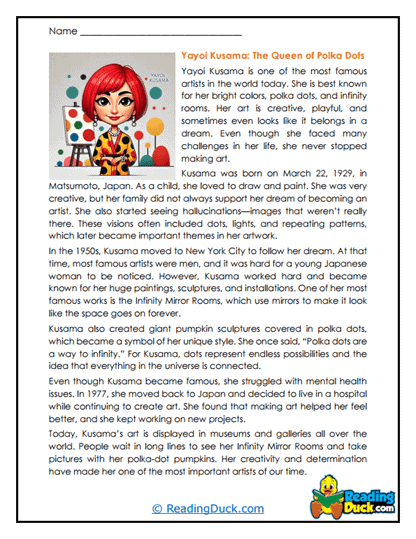
Students explore Yayoi Kusama's unmistakable world of dots, repetition, pumpkins, sculptures, installations, and Infinity Mirror Rooms. They learn how experiences from her childhood influenced recurring patterns in her work and how her artistic career eventually reached audiences around the world. This worksheet strengthens main-idea and chronological reading skills by connecting personal experiences with artistic themes. Readers also discover how persistence and individuality can shape a lifelong creative vision.
Pop Art Fame
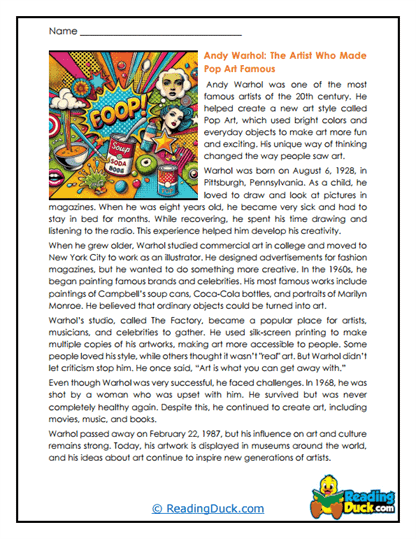
Students discover how Andy Warhol turned everyday products and famous faces into groundbreaking works of Pop Art. They follow his journey from Pittsburgh to New York City while learning about his images of soup cans, Coca-Cola bottles, celebrities, and the creative community surrounding his Factory studio. This worksheet strengthens chronology and supporting-detail skills while exploring the influence of popular culture. Readers are encouraged to think about how Warhol challenged traditional definitions of what could be considered art.
Renaissance Genius
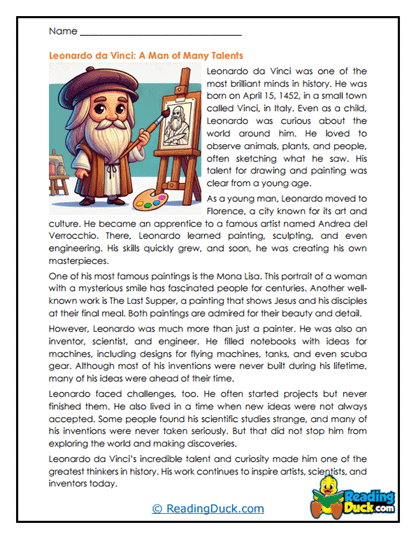
Students meet Leonardo da Vinci and explore the remarkable range of interests that made him one of the Renaissance's best-known figures. They learn about masterpieces such as the Mona Lisa and The Last Supper while discovering his interests in anatomy, engineering, science, and invention. This worksheet strengthens sequencing and biographical comprehension while helping readers distinguish between Leonardo's artistic and scientific achievements. Students also see how curiosity can lead one person to explore many different fields.
Stories in Murals
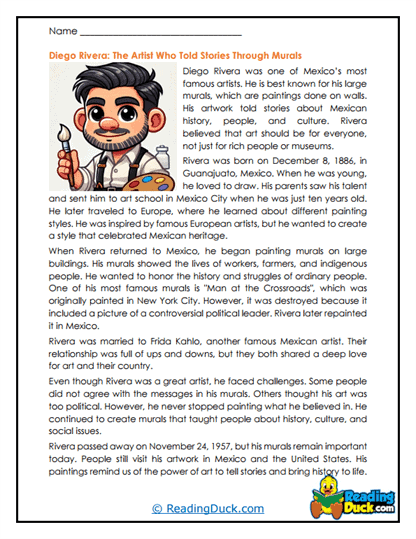
Students learn how Diego Rivera used enormous public murals to tell stories about history, culture, workers, farmers, and everyday people. They explore his childhood and artistic training in Mexico along with his belief that art should be accessible outside traditional museums. This worksheet strengthens author's-purpose and supporting-evidence skills by connecting Rivera's subjects with the ideas he wanted to communicate. Readers also discover how artwork can inspire debate and discussion as well as admiration.
Street Art Star
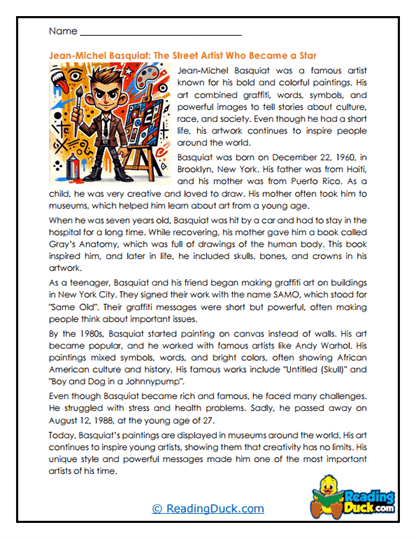
Students follow Jean-Michel Basquiat's journey from creating graffiti-inspired work in New York City to exhibiting paintings in major galleries and museums. They examine his use of words, crowns, skulls, symbols, bright colors, and references to African American culture and history. This worksheet strengthens biographical comprehension by connecting Basquiat's surroundings and experiences with his distinctive artistic identity. Readers discover how art can take many forms and communicate ideas about culture and society.
A Better Look At Artists
Artists throughout history have found countless ways to communicate ideas, emotions, experiences, and observations about the world around them. Some experimented with light and color, while others used geometric shapes, dreamlike scenes, enormous murals, repeating dots, familiar products, or deeply personal self-portraits. Their surroundings and life experiences often played an important role in determining what they created and how their styles developed. Studying these artists helps students understand that art is not one single approach but a constantly changing form of human expression.
Reading about artists also helps students become stronger readers while introducing them to history, culture, and creativity. They practice following biographies, comparing artistic styles, recognizing cause-and-effect relationships, identifying important details, and explaining how experiences influenced creative choices. Just as importantly, these stories show that artistic success can involve experimentation, persistence, curiosity, and the willingness to develop an individual voice. With every passage, students gain reading confidence while discovering some of the people and ideas that have shaped the world of art. Pasted text
Make sure to bookmark our website now.
Enjoy all our free reading worksheets.
Our materials adhere to the principles of the Science of Reading.