About Our Tech Innovators Reading Comprehension Worksheets
Technology innovators have changed the way people communicate, learn, work, play, and solve problems. This collection introduces students to twelve influential people and teams whose ideas helped shape computers, the Internet, programming, video games, space exploration, wireless communication, and online platforms. Readers meet figures such as Grace Hopper, Katherine Johnson, Shigeru Miyamoto, Hedy Lamarr, Linus Torvalds, and Sundar Pichai while learning about the problems they worked to solve. Students also discover that major technological advances often begin with curiosity, experimentation, collaboration, and a willingness to approach familiar problems in new ways.
Our Tech Innovators Reading Comprehension Worksheets help students strengthen nonfiction reading skills through engaging biographies and stories of technological development. As they read, students practice identifying main ideas, finding supporting details, following sequences, recognizing cause and effect, examining challenges, and connecting inventions with their later impact. The passages also introduce useful vocabulary related to computers, programming, engineering, the Internet, artificial intelligence, and digital communication. These skills build reading confidence while helping students understand some of the people and ideas behind technologies they encounter every day.
Learning about technology innovators also gives children an opportunity to explore creativity, persistence, teamwork, leadership, and problem-solving. Some innovators created entirely new technologies, while others improved existing ideas, built successful organizations, or found new ways for people to interact with computers. Students also see that influential technologies can create challenges involving privacy, misinformation, accessibility, and responsible use. We hope these worksheets encourage readers to become curious about how technology works and recognize that today's digital world was built through generations of ideas and discoveries.
Meet the Worksheets
Coding Pioneer
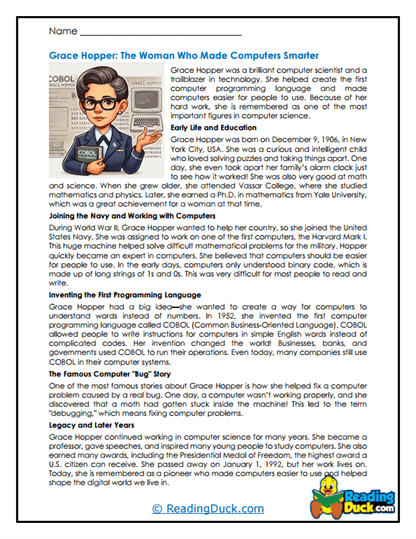
Students explore how Grace Hopper helped make computer programming easier for people to understand and use. They learn about her work with the Mark I computer, development of an early compiler, contributions to COBOL, and the famous story connected with the term "debugging." This worksheet strengthens sequencing and cause-and-effect comprehension by connecting Hopper's ideas with changes in programming. Readers also discover how persistence and innovative thinking can make complicated technology more accessible.
Digital Builder
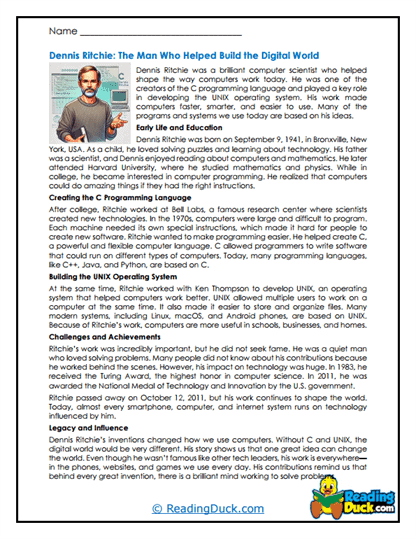
Students discover how Dennis Ritchie helped create foundations that continue to influence modern computing. They learn about his work at Bell Labs, development of the C programming language, and contributions to the UNIX operating system. This worksheet strengthens cause-and-effect comprehension by connecting Ritchie's inventions with later programming languages, operating systems, and digital devices. Readers see how foundational technologies can quietly influence computing for decades.
Future Thinker
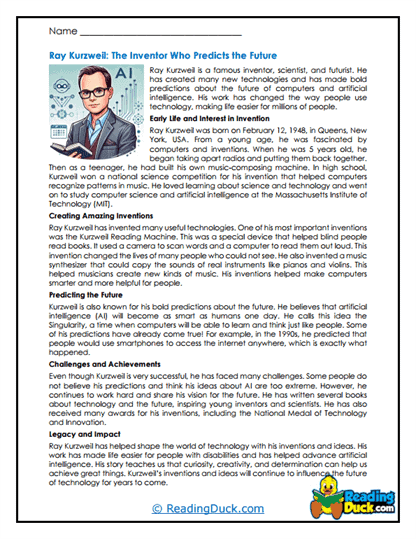
Students investigate the inventions and predictions of computer scientist and futurist Ray Kurzweil. They learn about his early interest in machines, work with technologies that recognize printed text, inventions designed to help people with disabilities, and ideas about artificial intelligence. This worksheet strengthens critical-reading skills by asking students to distinguish established facts from predictions about the future. Readers also consider how imagination and scientific knowledge can work together when people think about future technologies.
Gaming Visionary
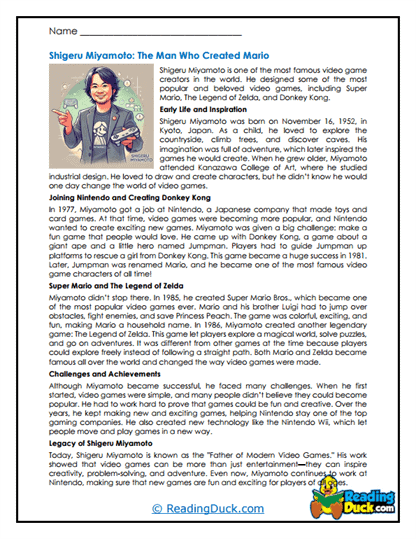
Students explore how Shigeru Miyamoto transformed childhood interests in exploration and drawing into a groundbreaking career in video game design. They learn about his work at Nintendo and his role in creating games and characters associated with Donkey Kong, Super Mario Bros., and The Legend of Zelda. This worksheet strengthens chronological comprehension by connecting Miyamoto's interests with important stages in his career. Readers discover how curiosity, experimentation, and imagination can lead to entirely new forms of entertainment.
Google Leader
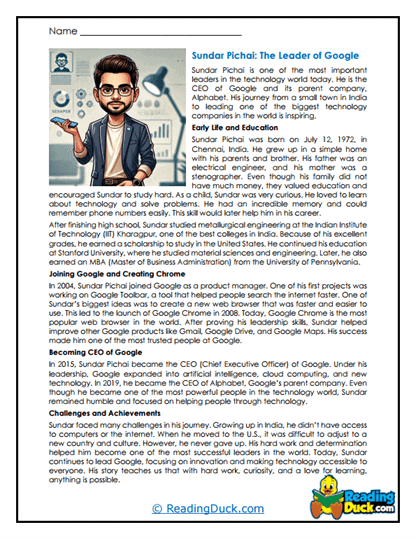
Students follow Sundar Pichai's journey from his childhood in India to becoming a major technology executive. They learn about his education, work on Google Toolbar and Google Chrome, and eventual leadership of Google and Alphabet. This worksheet strengthens sequencing and character-trait comprehension by connecting important decisions and accomplishments throughout Pichai's career. Readers also explore how education, curiosity, innovation, and leadership can contribute to long-term success.
Internet Architects
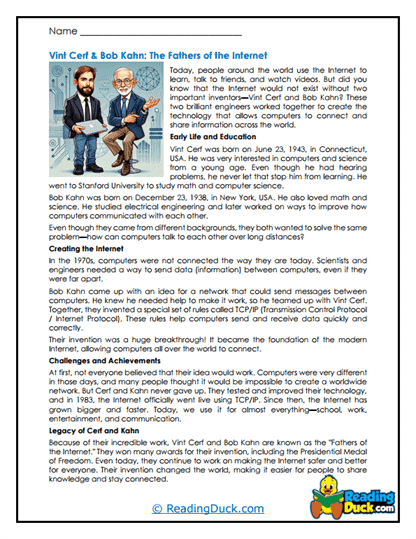
Students discover how Vint Cerf and Bob Kahn helped create technology that allows different computer networks to communicate. They learn how TCP/IP breaks information into packets, moves it across networks, and allows it to be reconstructed at its destination. This worksheet strengthens sequencing and cause-and-effect skills by connecting a technological problem with the solution Cerf and Kahn developed. Readers also see how collaboration can produce foundational technology that eventually changes everyday life around the world.
NASA Number Genius
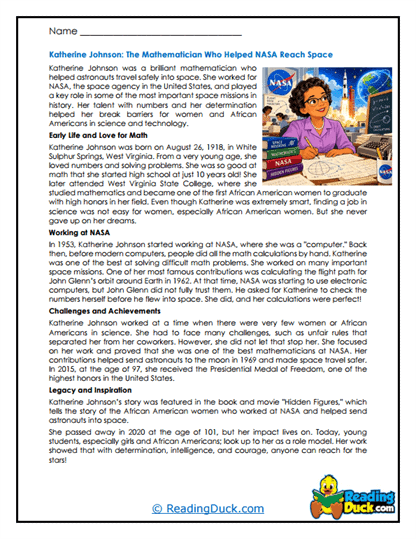
Students explore how Katherine Johnson's mathematical abilities helped NASA send astronauts safely into space. They follow her journey from a childhood love of numbers to calculating flight paths for important missions, including John Glenn's orbit around Earth and Apollo 11. This worksheet strengthens sequencing and supporting-detail skills while examining the racial and gender barriers Johnson faced during her career. Readers discover how determination, accuracy, and mathematical knowledge can contribute to extraordinary achievements.
Open-Source Revolution
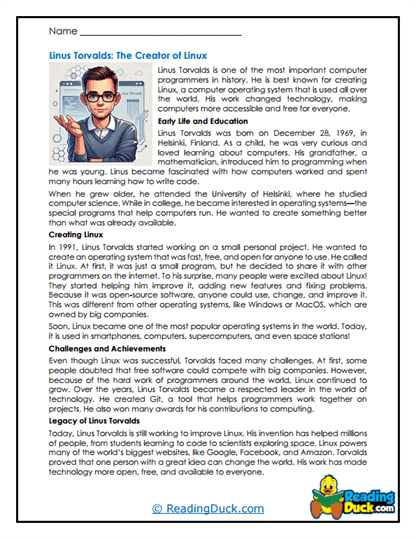
Students learn how Linus Torvalds turned a personal programming project into the Linux operating system. They discover how programmers around the world could freely use, modify, and improve Linux and how the technology eventually became important for servers, smartphones, supercomputers, and other systems. This worksheet strengthens main-idea and chronological comprehension by tracing an innovation from its beginning to its wider influence. Readers also discover how sharing ideas and collaborating with a large community can help technology grow.
Search Engine
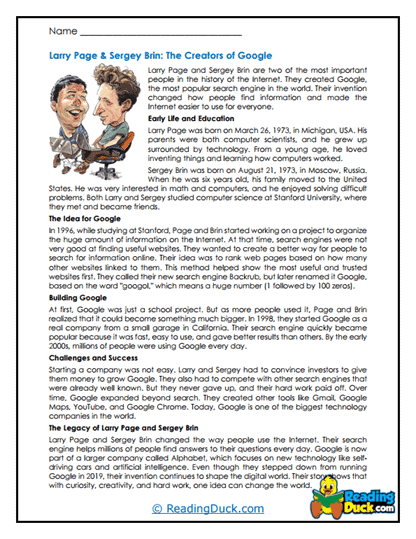
Students explore how Larry Page and Sergey Brin approached the challenge of organizing the enormous amount of information available online. They learn how a Stanford University research project led to Google and a new system for ranking websites based partly on their connections with other pages. This worksheet strengthens main-idea and problem-solving comprehension by connecting a technological challenge with a creative solution. Readers see how collaboration and a different approach to an existing problem can lead to an innovation used around the world.
Social Network
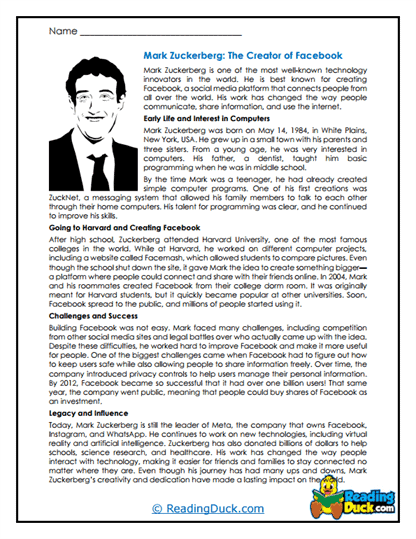
Students follow the development of Facebook from a website for Harvard students into a massive global social network. They learn about Mark Zuckerberg's early interest in programming as well as the competition, legal disputes, privacy concerns, and misinformation issues that accompanied Facebook's growth. This worksheet strengthens cause-and-effect comprehension by examining both accomplishments and challenges. Readers are encouraged to consider how influential technologies can create new opportunities while also raising difficult questions.
Wireless Visionary
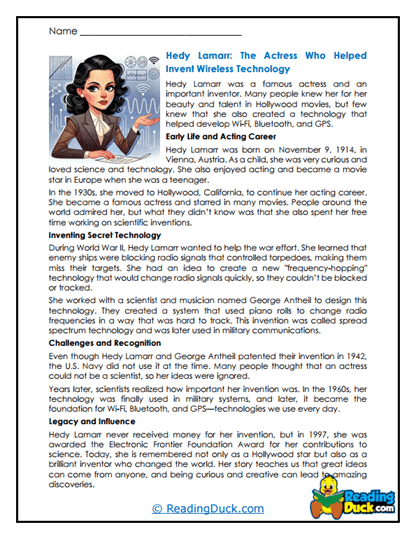
Students discover the lesser-known inventive work of actress Hedy Lamarr. They learn how Lamarr and composer George Antheil developed a frequency-hopping communication system during World War II and how the idea was later recognized for its importance to wireless communication. This worksheet strengthens cause-and-effect skills by connecting an earlier invention with technologies that developed afterward. Readers also see how creativity and technical curiosity can cross very different fields.
YouTube Trailblazer
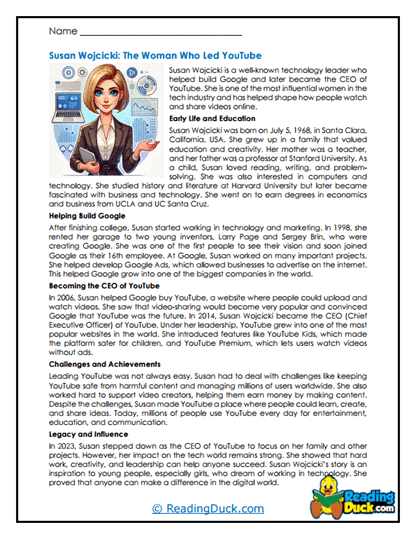
Students explore Susan Wojcicki's role in the growth of both Google and YouTube. They learn about Google's beginnings in her garage, her work as an early employee, her influence on Google's advertising business, and her later leadership of YouTube. This worksheet strengthens chronological comprehension by helping readers trace important decisions and accomplishments throughout her career. Students also discover how leadership choices can influence the development of technology platforms used by millions of people.
A Better Look At Tech Innovators
Technology rarely develops because of one idea appearing all at once. The innovations in this collection grew from people identifying problems, experimenting with possible solutions, collaborating with others, and continuing to improve their work over time. Their contributions range from programming languages and Internet communication systems to video games, search engines, spaceflight calculations, and wireless technology. Studying these innovators helps students understand that the devices and digital services they use today depend on many layers of earlier discoveries.
Reading about tech innovators also helps students become stronger readers and problem-solvers. They practice following technological developments, identifying causes and effects, comparing challenges and solutions, recognizing important accomplishments, and explaining how earlier inventions influenced later technologies. These stories also show that innovation can come from mathematicians, programmers, engineers, designers, inventors, entrepreneurs, and leaders with very different backgrounds. With every passage, students gain reading confidence while developing a deeper understanding of the people and ideas that helped build our modern technological world. Pasted text
Make sure to bookmark our website now.
Enjoy all our free reading worksheets.
Our materials adhere to the principles of the Science of Reading.