Our 1st Grade Writing Prompts are created to help young writers stretch their imaginations while learning to put ideas into clear sentences. At this stage, children are ready to move from drawing and labeling into storytelling, opinion sharing, and descriptive writing. These prompts gently guide them into organizing their thoughts, adding details, and making their words shine on paper. Each activity feels like an adventure, but behind the fun is solid skill-building that strengthens literacy step by step.
These prompts also focus on essential language arts skills like sequencing, using descriptive adjectives, and practicing "who, what, when, where" details. By working through these prompts, students learn not only to answer a question but to expand their answers with complete thoughts and lively vocabulary. This gives them confidence to speak and write more clearly.
The worksheets are structured to offer variety-some invite silly storytelling, others encourage reflective or descriptive responses. That variety keeps children excited, while giving parents and teachers tools to match the right prompt with the right moment. With plenty of themes to choose from, every child finds something they love to write about.
Each prompt also strengthens basic grammar, spelling, and punctuation skills in a natural, playful way. Instead of drills, kids practice these skills in stories, opinions, and adventures that feel personal and fun. By the end, students see writing as something they can do with confidence-an important step toward becoming strong readers and thinkers.
Looking At Each Worksheet
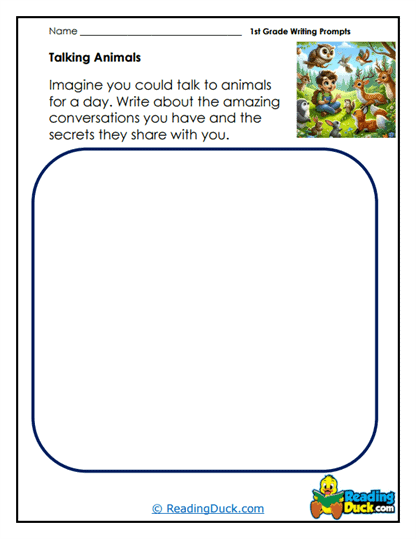
Animal Talk
Students imagine a conversation with a favorite animal and write what each character "says," practicing quotation-style sentence starters like The fox said.... This builds dialogue rhythm, clear sentence boundaries, and voice-all first‑grade superpowers. It's silly enough to spark giggles ("Does a turtle tell jokes slowly?") yet focused enough to reinforce capitalization and end marks. Perfect for centers or partner reading, since kids love performing the lines out loud. Bonus: add speech bubbles to a quick sketch and write one extra line of dialogue using because.
Fairy Help
Writers describe a tiny helper who solves a real‑life problem-lost shoe, messy desk, rainy recess-using first/next/finally to show sequence. The prompt encourages adjectives (sparkly, helpful, sneaky) and verbs (flutters, fixes, vanishes) for richer sentences. It's an easy tie‑in to classroom routines-"How could the fairy help us clean faster?". Kids practice cause/effect: The fairy helped, so.... Bonus: write a thank‑you note to the fairy using a greeting and closing.
Magic Brush
A paintbrush that brings drawings to life pushes students to add sensory detail and strong verbs. They practice who/what/where while explaining what the brush creates and what happens next. The goofy image of a dancing sandwich or tap‑shoes on a goldfish keeps the tone light and memorable. Great for art‑to‑writing transfers or Friday fun. Bonus: list three "rules" for using the brush, each starting with a capital and ending with a period.
Robot Buddy
Students design a helpful robot and explain its best feature using because to add reasons. This blends opinion and explanatory writing with clear nouns and precise verbs (beeps, sorts, zooms). The built‑in tech vibe makes even reluctant writers curious-"Can my robot do homework?" (Nice try!). Use it for home‑school connections by having kids teach their family one robot "command." Bonus: add a labeled diagram with one caption sentence.
Secret Door
A mysterious door appears at school or home, and writers describe what's behind it using setting words and sequence. The prompt encourages sentence starters like First I open... and Then I see... to strengthen organization. The quirky twist-tiny door in a bookshelf or a door only pets can see-keeps ideas flowing. Ideal for mini‑lessons on adjectives and prepositions. Bonus: end with a one‑sentence cliffhanger that uses a question mark.
Space Journey
Young astronauts plan a quick trip using transition words to chart launch, travel, and landing. They practice domain vocabulary (rocket, helmet, orbit) while keeping sentences complete and tidy. The "moon cheese" joke never gets old, and it actually helps kids remember to add details. Works well with science tie‑ins or a star‑themed word bank. Bonus: name the ship and write a motto in quotation marks.
Toy Surprise
A toy suddenly "comes alive," so students describe actions and reactions with lively verbs and feelings words. The scenario invites cause/effect and dialogue practice in short, clear sentences. The humor-tap‑dancing teddy or a yo‑yo that says "Yo!"-lowers the fear of the blank page. Great for home writing because kids can use a toy they own. Bonus: add one because sentence that explains how the surprise ends.
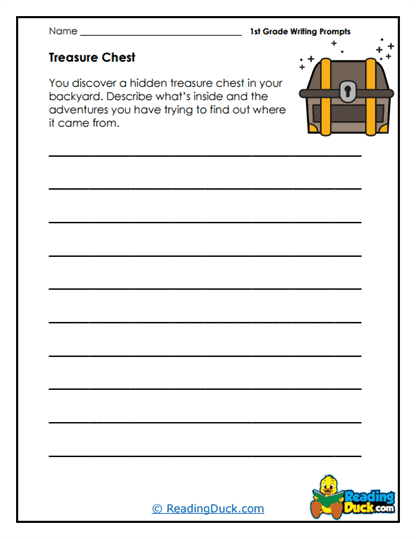
Treasure Hunt
Writers follow three simple clues to find treasure, using map words (under, behind, next to) and sequence. It's a natural fit for practicing prepositions and directional language in complete sentences. The pirate‑hat daydream keeps energy high without derailing structure. Use it with a classroom "map" to make writing tactile and fun. Bonus: finish with a one‑sentence "rule" for sharing the treasure using a comma in a list.
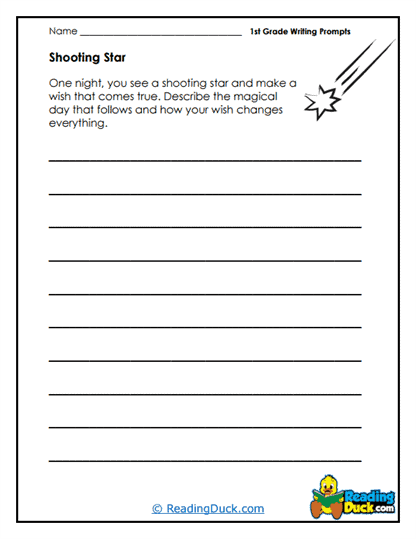
Wishing Star
Students make a wish, give a reason, and predict what would happen if it came true-opinion plus narrative in five tidy sentences. They practice adding detail with and while still keeping sentences clean and correct. The playful image of a star that answers with a wink helps kids add voice. Works well for growth‑mindset chats and goal setting. Bonus: require one but sentence to show a small challenge.
Zoo Adventure
A quick zoo visit prompt asks writers to choose an animal, describe movement and sound, and tell one mini‑event. It supports verbs, adjectives, and who/what/where details in simple sentences. The goofy mental picture of penguins doing a parade keeps smiles coming. Pair it with science vocabulary or a class book of pages. Bonus: end with one comparing sentence using like or as.
Make sure to bookmark our website now.
Enjoy all our free reading worksheets.
Our materials adhere to the principles of the Science of Reading.