About Our -ary Suffix Reading Comprehension Worksheets
The -ary suffix often turns nouns or verbs into adjectives or nouns that mean "relating to," "connected with," or "place of." Words like aviary (a place for birds), library (a place for books), imaginary, and planetary all feature this pattern. Recognizing the suffix helps students decode meaning and enrich their vocabulary by linking new words back to familiar roots. Learning -ary gives readers confidence when facing multisyllabic words they haven't seen before.
This collection presents imaginative and thematic reading passages-each with a lively visual-packed with -ary words woven seamlessly into the narrative. Each worksheet comes as a PDF complete with a reading passage, multiple-choice comprehension questions, and a downloadable answer key for convenient use by teachers and parents in classroom or home settings.
By exploring -ary words in meaningful contexts, students strengthen both morphological awareness (spotting suffix + base) and reading comprehension, building fluency and word consciousness that supports reading across subjects. This synergy of phonics and meaning-making is at the heart of effective literacy instruction.
Looking At Each Worksheet
Aviary Adventure
In this nature-themed story, readers explore a fantastical aviary filled with colorful birds making melodious music. The -ary suffix appears in words like aviary, imaginary, and visionary, enriching the setting. Comprehension focuses on setting and sensory details, prompting students to describe sounds and sights. Students underline -ary words and connect them to their base words to clarify meaning. This activity reinforces the link between suffix identification and descriptive comprehension. It's a great bridge between phonics awareness and visualization.
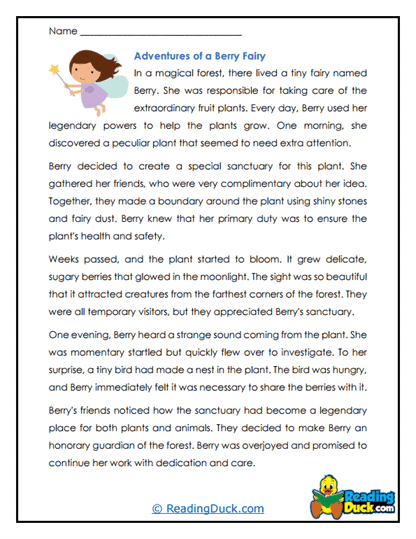
Berry's Quest
A young hero ventures through a berry patch searching for a legendary fruit with extraordinary powers. The -ary words heighten suspense. The comprehension aim is sequence and prediction, encouraging students to anticipate what the fruit might do. Readers highlight -ary vocabulary and analyze how it builds anticipation. This merges morphological decoding with storytelling insight to keep readers engaged.
Fairy Funfair
At a magical funfair, fairy lights glow in an airy tent full of mystary (mystery + -ary) games and performances. The passage uses -ary words to create whimsy and charm. Comprehension centers on tone and theme, asking students to explain how these terms shape atmosphere. Children underline the -ary words and interpret how each contributes to playful mood. This blends suffix recognition with appreciating tone in narrative.
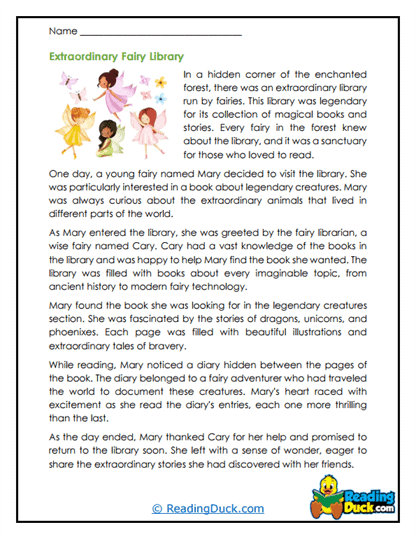
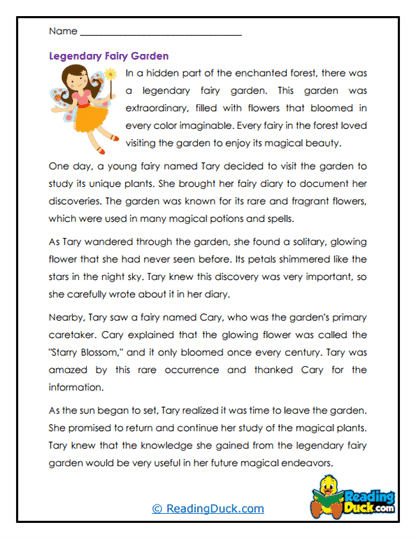
Fairy Library
Hidden in an ancient oak lies a fairy library filled with literary scrolls and vocabulary spells. The -ary words frame both place and purpose. Comprehension focuses on main idea and purpose, asking why the library matters to the characters. Students track -ary words and restate their meanings by breaking them into base + suffix. This worksheet deepens both vocabulary structure awareness and comprehension of narrative settings.
Galactic Discovery
Explorers visit a planetary system with extraordinary stars and discover a vocabulary of alien symbols. The -ary words emphasize science and wonder. Comprehension aims at concept and detail, asking readers to match descriptions to planets or symbols. Students spotlight -ary words and connect them to meaning. This worksheet blends morphology with science-based comprehension.
Garden of Wonders
In a dreamy garden of wonders, tertiary blossoms, imaginary butterflies, and secretary bees buzz among petals. The assortment of -ary words colors description and function. Comprehension emphasizes imagery and inference, prompting students to interpret the magical environment. Readers mark each -ary word and infer its effect. This supports visual and sensory reading grounded in morphological awareness.
Knight's Quest
A brave knight enters a victory dales, faces a legendary beast, and solves an ordinary riddle asking who is necessary to save the kingdom. -ary words tie to quest roles and mood. Comprehension centers on problem and solution, asking who steps up at key moments. Students highlight the -ary words, identify bases, and link them to the knight's journey. This combines suffix noticing with deductive comprehension.
Library Mysteries
Within dusty stacks, librarians use a special vocabulary potion and solve secretary puzzles to unlock a library's hidden vault. The -ary words span place, role, and action. Comprehension focuses on sequence and inference, guiding readers to piece together clues. Students underline the -ary vocabulary and discuss how each term adds to the mystery. It's a layered reading combining morphological decoding and narrative logic.
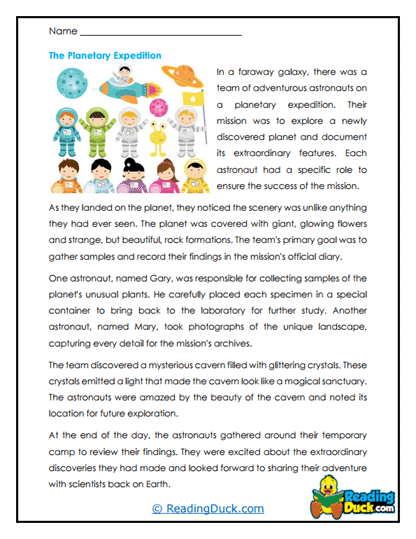
Planetary Wonders
This cosmic reading guides students through a world of planetary, stellar, and imaginary creatures across landscapes-and even ordinary human surprise. -ary words enrich both concept and comparison between worlds. Comprehension emphasizes contrast and detail, asking how described worlds differ. Learners mark the -ary terms and explain their impact on distinguishing settings. This worksheet merges morphological insight with comparative reading.
Secret Staircase
A hidden staircase leads to a legendary throne room where imaginary murals and stationary statues stand still in eternal watch. -ary words create mystery and stillness. Comprehension focuses on mood and setting, inviting students to describe atmosphere. Students highlight -ary vocabulary and reflect on how each shapes tone. This supports morphological remembering alongside poetic reading.
An Example -ary Reading Passage
In the aviary at the edge of the fairy's garden, an imaginary melody drifted through petals as a legendary bird perched by unnecessary thorns guarding a vocabulary of ancient secrets.
Where Is The -ary Pattern?
Look for words ending in -ary and think of the base word to help understand meaning-aviary from avi (bird) means "place for birds," and imaginary from imagine means "not real." These two examples show how the suffix adds clarity and context to help readers grasp meaning directly from word structure.
Make sure to bookmark our website now.
Enjoy all our free reading worksheets.
Our materials adhere to the principles of the Science of Reading.