The -est suffix is essential for forming superlative adjectives, like fastest or tallest, which express the highest degree of a quality when comparing three or more items. This phonics skill appears in words that often end with -est, helping students recognize how words change to show "the most" of something.
These worksheets present reading passages rich with -est words embedded in engaging stories, supported by vivid visuals and comprehension questions. As students read, they encounter superlative forms within meaningful sentences, guided to notice how the -estsuffix changes the meaning of base words.
Practicing with these passages strengthens students' ability to decode unfamiliar -est words while understanding their meaning in context. By seeing the suffix in action, they gain confidence reading complex words and boost comprehension by connecting the grammatical form to descriptive language.
Looking At Each Worksheet
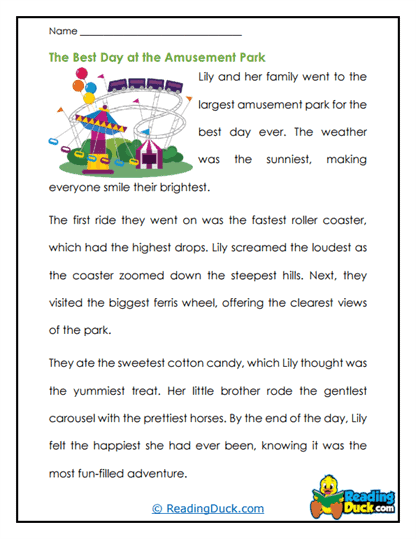
Amusement Park Day
This passage likely invites readers to a fun-filled day at an amusement park, emphasizing the excitement of the fastest ride or tallest roller coaster. It features -est words woven into the narrative, such as fastest or happiest, showing superlatives in action. The comprehension focus asks students to identify details and understand how these words compare attractions. As they read, students practice spotting -est forms and decoding them within smooth context. While solving questions, they integrate phonics recognition with meaning. Used in class or home, this worksheet solidifies both pronunciation of -est words and comprehension of descriptive language.
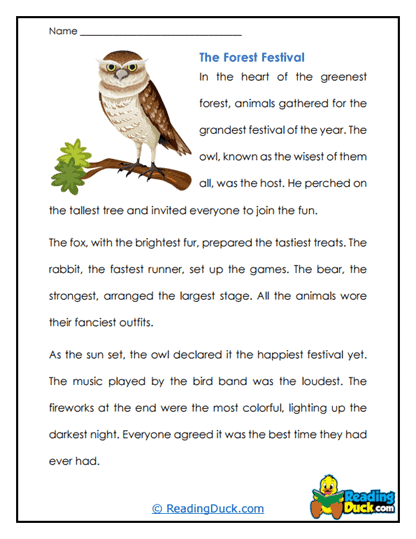
Forest Festival
In this worksheet, students read about a magical festival held in the heart of a forest, possibly mentioning the loudest music or brightest lights under towering trees. The story includes key -est words to highlight the superlative voice-kids might note that it was the biggest gathering of woodland creatures. Comprehension questions may ask them to compare and contrast experiences in the passage. The phonics skill emerges as students learn to recognize the "-est" ending and pronounce those words accurately. This strengthens their decoding alongside understanding the event details. It's a strong blend of imaginative reading with suffix practice.
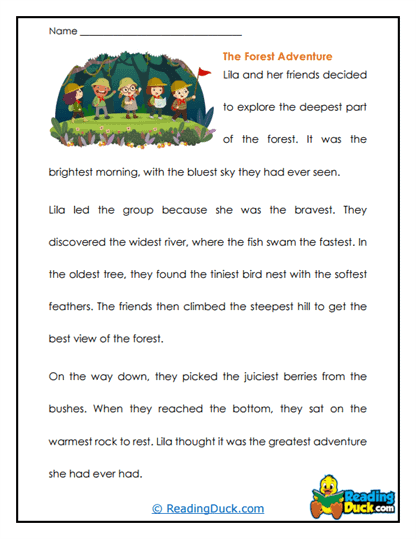
Forest Fun
This worksheet centers on a nature outing in the forest, where the quietest trail or brightest sunlight might be described using -est suffixes. It challenges students to notice those superlative forms amid sensory descriptions of leaves, animals, or forest sounds. Comprehension questions guide them to recall those details and understand comparisons. The phonics connection helps learners pay attention to how the suffix alters base words like bright or quiet. While reading, they hone both decoding and comprehension skills with practice spotting those patterns. Used flexibly, it boosts reading fluency through repeated exposure to -est words in engaging context.
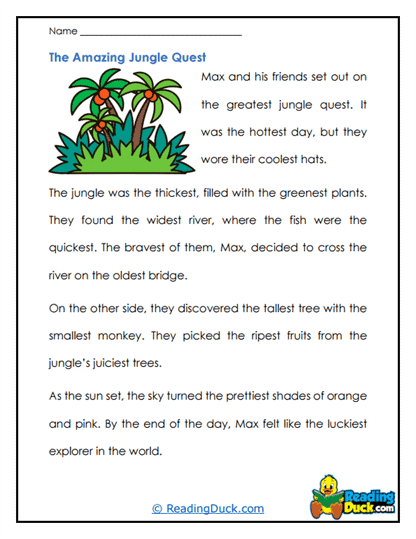
Jungle Quest
This passage probably takes readers on a daring jungle quest where explorers find the longest vine or tallest tree in the wild. It embeds -est adjectives within vivid imagery, prompting students to see how the suffix emphasizes extremes. The corresponding questions might ask what was the highest or fastest moment of the quest. This encourages comprehension of both narrative events and comparative language. Phonetically, recognizing the "-est" ending becomes a decoding exercise tied to meaning. As a tool, it builds fluency and suffix awareness in an adventure-themed reading context.
Science Fair Success
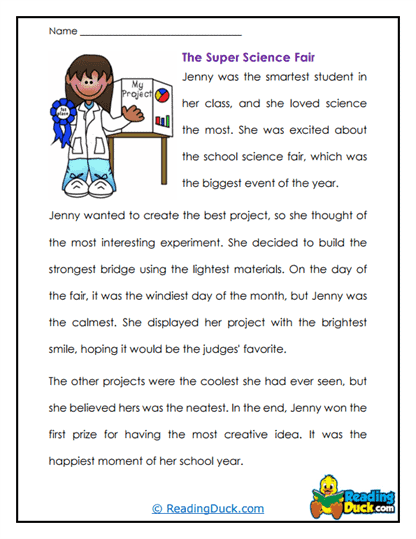
Here, the story likely portrays a student's science fair project, featuring the smartest invention or brightest idea that wins top honors. Superlative -est forms highlight outstanding qualities-like biggest volcano or most accurate measurement-helping convey academic achievement. The comprehension task may involve understanding cause and effect and noticing how these words contribute to the story. Students strengthen phonics skills by identifying and pronouncing -est adjectives correctly. This practice reinforces how suffixes build meaning in text. The worksheet effectively blends grammar practice with academic-themed reading.
Space Adventure
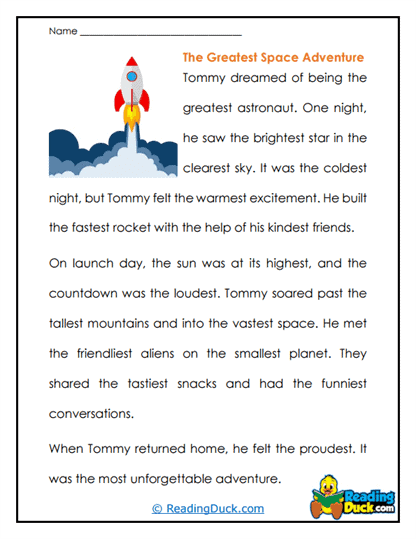
This imaginative passage probably describes a rocket soaring to the farthest planet or seeing the brightest star in outer space. As students explore cosmic scenes, they encounter -est words that capture the wonder of extremes in space. Questions focus on recall and understanding how these superlative adjectives enrich description. From a phonics perspective, learners engage with "-est" endings, decoding them as part of multisyllabic vocabulary. The combination of phonics and comprehension encourages fluent reading with expressive suffix recognition. It's a creative way to connect suffix mastery with story immersion.
Space Zoo
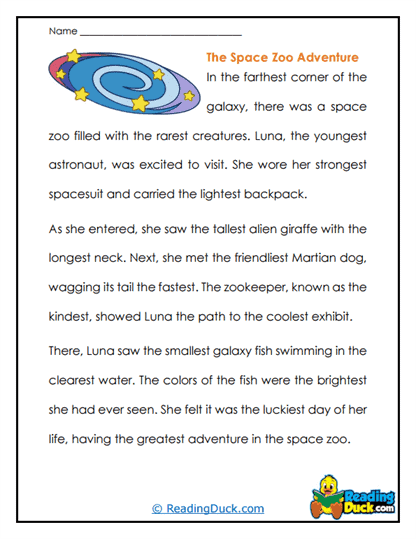
In this story, students may visit a zoo on another planet, seeing the strangest creature or largest alien among cosmic animals. Superlative adjectives like -est forms enrich the vivid descriptions of extraterrestrial exhibits. The comprehension questions likely ask readers to compare creatures and identify key details. Decoding "-est" words supports both pronunciation and understanding of heightened qualities. Through this mix of science fiction and suffix practice, children enhance both phonemic awareness and narrative comprehension. It's a playful worksheet that blends suffix learning with imaginative reading.
Star Quest
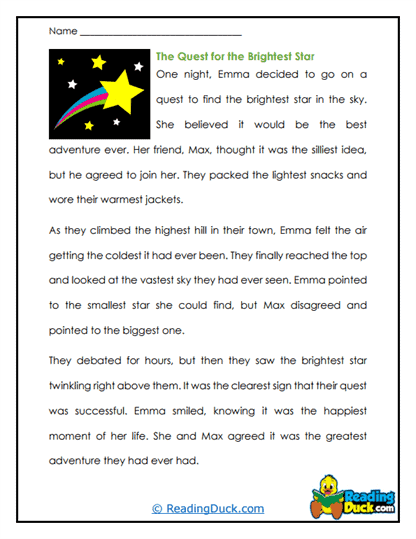
This passage might tell of an astronaut's quest for the brightest star or fastest spaceship in the galaxy, highlighting -est words. The superlatives lend excitement and help readers compare stellar adventures. Comprehension questions probably ask what was the most spectacular moment and why. From a phonics angle, recognizing "-est" endings boosts decoding accuracy for superlative adjectives. The context helps embed grammar skills within engaging narrative. Teachers and parents can use it to reinforce reading fluency and suffix knowledge together.
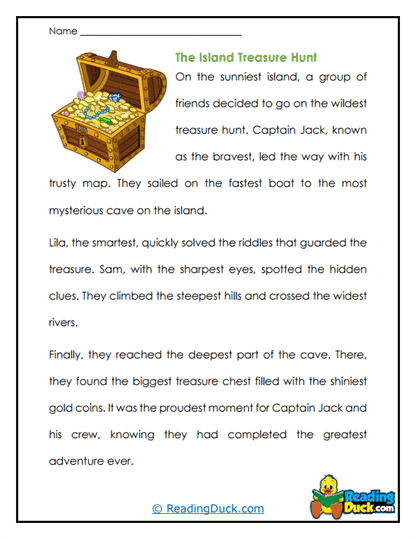
Treasure Hunt
In this exciting tale, students go on a treasure hunt to find the oldest map or deepest cave, using -est words to build suspense. Superlative adjectives emphasize extreme features of the hunt, drawing readers into the action. The comprehension focus might ask which discoveries were most surprising and why. By identifying "-est" endings like deepest, learners strengthen their phonics proficiency while connecting them to meaning. This repeated exposure supports fluent reading of complex words. It's ideal for blending suffix practice with adventure-story comprehension.
Zoo Adventure
This worksheet probably takes readers into a zoo full of loudest lions or longest giraffes-with -est words painting vivid images. These superlatives help children imagine extremes in the animal world. Comprehension questions might prompt students to identify the most notable animal and describe what made it stand out. Decoding words ending in "-est" helps solidify phonics skills as they read. The combination of story engagement and suffix recognition builds both vocabulary and comprehension. Perfect for animal lovers, this worksheet weaves grammar and narrative seamlessly.
An Example -est Reading Passage
On the tallest hill in the town, the smallest house stood quietly at dawn, its red roof glowing in the brightest sunrise. Inside, a kindest cat stretched lazily in the warmest patch of sunlight, while outside, the wisest owl hooted softly from the highest branch of a pine tree. The fastest breeze rustled the leaves, bringing the loudest morning chorus of birds right to the smallest window. It was the coldest dawn anyone could remember, but the warmest feeling filled the house. It was the happiest, most peaceful start to the day.
Where Is The -est Pattern?
You can spot the -est suffix by looking at words like tallest and smallest, which end in -est to show the highest or lowest degree of a quality. Two clear examples: brightest (shows the highest amount of brightness) and kindest (shows the highest level of kindness).
Make sure to bookmark our website now.
Enjoy all our free reading worksheets.
Our materials adhere to the principles of the Science of Reading.