Shakespeare's Macbeth is a thrilling story filled with mystery, ambition, and powerful lessons about choices and consequences. It introduces students to unforgettable characters like Macbeth, Lady Macbeth, the three witches, and Macduff, all set against the haunting backdrop of ancient Scotland. Our worksheet collection is designed to bring this classic play to life in an age-appropriate and engaging way for young readers.
Each worksheet focuses on building understanding through a variety of reading comprehension activities, including multiple-choice questions, vocabulary-in-context practice, short answer responses, and deeper character analysis prompts. Students are encouraged to make connections, draw inferences, and explore how the characters' decisions impact the story.
These resources help children explore the world of Shakespeare in a way that's fun and approachable. With illustrations, kid-friendly summaries, and thoughtful questions, these worksheets are perfect for guiding students through the dramatic twists and emotional turns of the story.
A Look At Each Worksheet
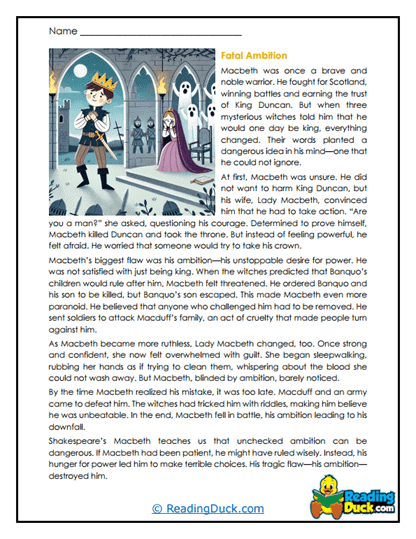
Ambition Trap
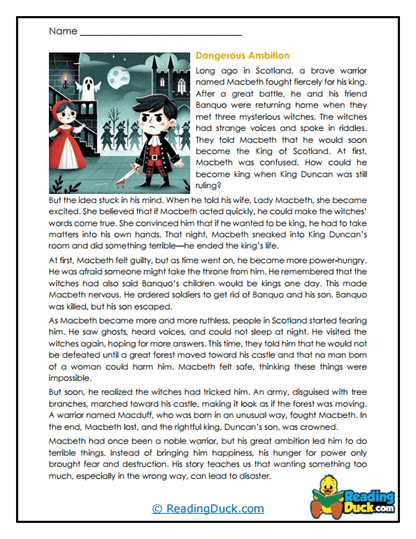
This worksheet invites students into the slippery slope of unchecked ambition, warning them that aspirations without conscience can ensnare even the noblest soul. With kid-friendly passages and thought-provoking questions-plus a smidge of dark humor-it prompts learners to consider: how far is too far? It's a subtle masterclass in cause-and-effect and moral reasoning.
Blood Symbol
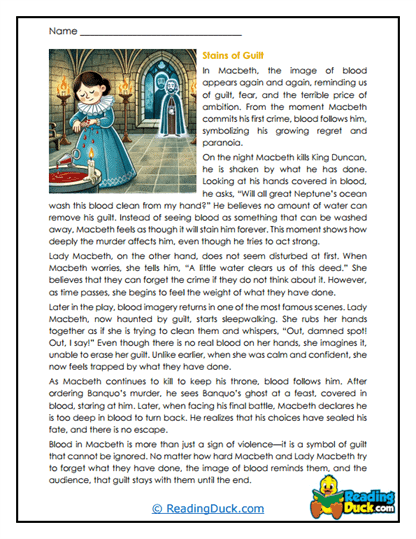
Here's where the literal and figurative collide as students hunt for what "blood" truly means in Macbeth's nightmarish world. Between the gooey visuals and metaphor-spotting prompts, they'll explore guilt, power, and consequences. It's equal parts detective work and poetic pondering.
Eternal Lesson
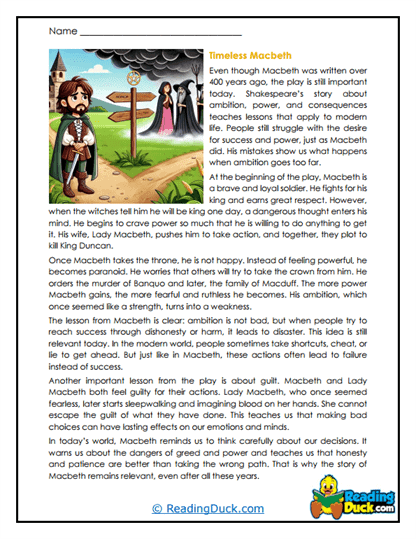
This one pivots to Macbeth's timeless warning: actions have echoes far beyond our own stage. Students reflect on the play's moral resonance in modern life, whether through social media slip-ups or small acts that ripple outward. It's curriculum with a conscience-and a wink.
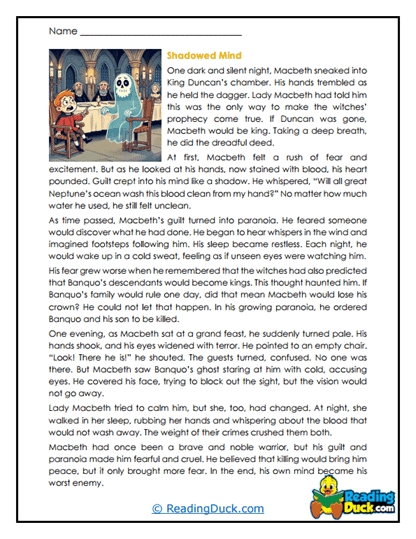
Guilt Games
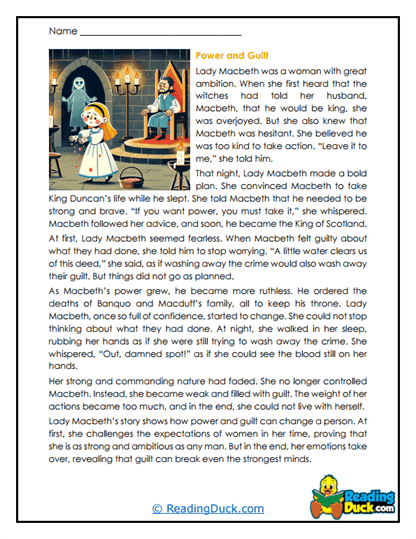
Want to see Guilt personified as a playground bully? This worksheet does just that, turning Lady Macbeth's hand-washing frenzy into an interactive labyrinth. It helps students dig into cause-and-effect, internal conflict, and how guilt can grow louder than ambition itself.
Haunted Heart
Anguish doesn't knock-it haunts. This worksheet explores how Macbeth and his wife become prisoners of their own emotions. Through scenario rewrites and empathetic prompts, students learn to map character arcs and emotional realism-without getting lost in thorny prose.
Just Revenge
Is revenge ever just? Students weigh Macbeth's actions versus moral philosophy in a clever debate-style format. With structured arguments and guided reflection, they build analytical muscles while navigating thorny ethical terrain. Fair-minded, fun, and fierce.
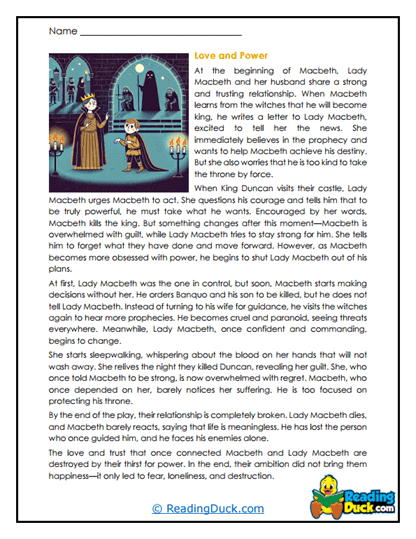
Love Unraveled
Shakespeare's tangled love gets a glow-up. Students untie the bonds between Macbeth and Lady Macbeth, exploring how affection mutates into manipulation-and what that looks like on the page. Ideal for discussions on relationships, power, and interpretation.
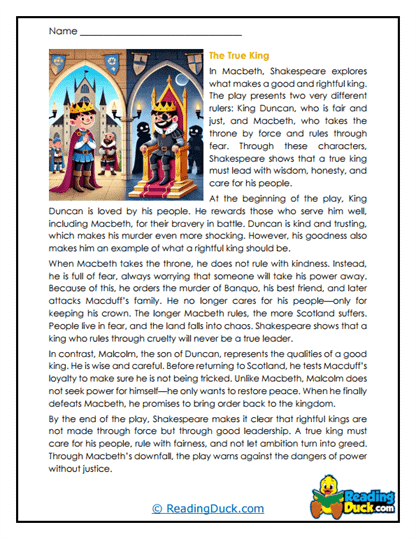
Noble Reign
This worksheet gives a throne-side glance at what makes a ruler-and how quickly "noble" can unravel. Students contrast Macbeth's heroic beginning with his tragic downfall, deepening their understanding of character development and irony in a digestible way.
Power's Price
What's the cost of power? This activity makes students calculate emotional, social, and moral currency. Through paired comparisons and real-world analogies, it brings abstract themes into sharp relief, while keeping it kid-friendly (and teacher-approved).
Vengeful Victory
Winning doesn't always feel like winning-just ask Macbeth. This worksheet invites students to examine hollow victories and their hidden costs, using text evidence and scenario analysis to reveal that triumph often carries a toll. Dramatic, insightful, and text-rooted.
Whispered Fate
The witches didn't shout-they whispered-and that changed everything. Students analyze foreshadowing and prophecy in a playful "what happens next?" narrative game. It's suspenseful fun with a dash of literary technique and big thinking.
Witchy Words
Language with a cauldron of magic: this worksheet spotlights Shakespeare's scariest vocabulary from the weird sisters' scenes. Students decode archaic language and create modern equivalents-blending word-skill building with a spellbinding twist.
How the Worksheets Connect to the Novel
Each worksheet in this collection is carefully crafted to reflect key moments, characters, and themes in Macbeth. From Macbeth's first encounter with the witches to Lady Macbeth's haunting guilt, students are guided through the plot while reflecting on the emotions and decisions that shape the story.
Activities ask students to explore how literary devices like symbolism (e.g., blood and darkness), foreshadowing, and character development deepen the meaning of the text. Themes such as ambition, power, guilt, and fate versus free will are woven into the questions and writing prompts, helping students make meaningful connections.
By using these worksheets, students gain a richer, more thoughtful understanding of Macbeth. The goal is not just to understand what happened, but to ask why it happened-and how those choices speak to us today.
Summary of Macbeth for Young Readers
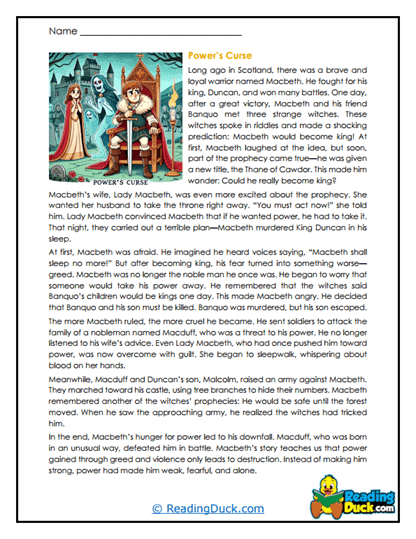
Once upon a time, in the magical land of Scotland, there was a brave and strong soldier named Macbeth. He was known for being a hero in battle and helping the king win wars. Everyone thought he was loyal and good. Macbeth had a best friend named Banquo. Together, they were powerful warriors and helped keep the kingdom safe.
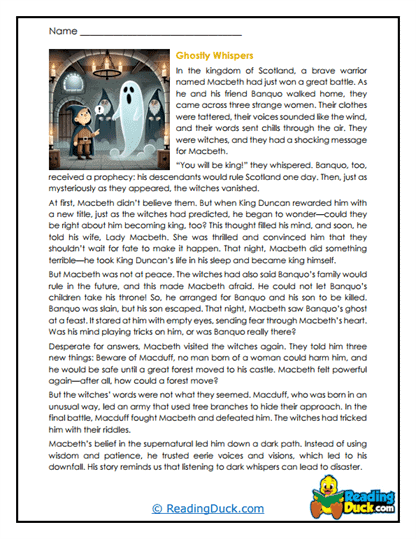
One day, after a big battle, Macbeth and Banquo were walking through a forest when they met three strange women. These women were witches! The witches spoke in a spooky way and gave Macbeth a surprise message. They told him that he would become the king someday. Then they told Banquo that his children would be kings, even though he wouldn't be one himself. Before Macbeth and Banquo could ask more, the witches disappeared like smoke in the wind.
At first, Macbeth didn't believe them. But then something strange happened. Right after they left the forest, a messenger told Macbeth that he had been given a new, more important title by the king-just like the witches said! That made Macbeth wonder… Could he really become king?
When Macbeth got home, he told his wife, Lady Macbeth, about the witches. Lady Macbeth was very excited and wanted him to become king fast. She had a sneaky idea. She told Macbeth they should get rid of the king right away, so Macbeth could take the crown for himself. At first, Macbeth didn't want to do something so wrong. But Lady Macbeth kept pushing him. She said he wasn't brave if he didn't follow through. So finally, Macbeth agreed.
Late one night, Macbeth did something terrible-he snuck into the king's room and hurt him while he was sleeping. When everyone found out the king had died, they were sad and shocked. Macbeth pretended to be upset too. Soon, Macbeth became the new king of Scotland.
But after that, things didn't go well. Macbeth couldn't stop worrying. He was scared someone would find out what he had done. He also remembered the witches' words-that Banquo's children would be kings. Macbeth got so worried that he decided to stop Banquo and his son, just to be safe. He planned another awful trick to try to keep his crown.
Even though he tried to hide everything, people started to notice that Macbeth was acting strangely. His wife, Lady Macbeth, also felt very guilty. She couldn't sleep, and she kept washing her hands as if she were trying to clean away her sadness and shame. Eventually, her sadness grew so big that she died of a broken heart.
Meanwhile, a noble man named Macduff knew something wasn't right. He worked with another leader named Malcolm (who was the king's son) to stop Macbeth. They gathered soldiers and went to fight him.
In the final battle, Macbeth still believed he couldn't lose because the witches had told him he would only be defeated when a forest walked and a man not born of a woman fought him. That sounded impossible! But guess what? Macduff's army used branches from the forest to hide themselves-so it looked like the forest was moving! Then Macduff told Macbeth he had been born by surgery, not in the usual way, so he wasn't "born of a woman" in the way Macbeth thought.
In the end, Macbeth was defeated. Malcolm became the new king, and peace came back to the land.
The Lesson
Macbeth teaches us that it's important to be honest and kind. Wanting power too much can lead people to make bad choices. Sometimes when people do something wrong, they keep doing more bad things to cover it up. But the truth has a way of coming out. Macbeth's story shows that being greedy or hurting others just to get ahead will never lead to true happiness. It's better to be brave, fair, and do what's right-even when it's hard.
Make sure to bookmark our website now.
Enjoy all our free reading worksheets.
Our materials adhere to the principles of the Science of Reading.