Our Stargirl reading comprehension worksheets are printable, classroom-ready resources designed to enhance students' understanding of Jerry Spinelli's novel Stargirl-a story often mistakenly attributed to Mark Twain. These carefully curated worksheets feature a range of question types following each reading passage: multiple-choice questions that assess basic comprehension, short-answer questions that test inference and vocabulary, and open-response prompts that encourage deeper literary analysis and personal connection to the text. Each worksheet is designed to align with core English Language Arts objectives, including identifying central themes, analyzing character motivation, interpreting figurative language, and evaluating the author's purpose and style. With clear formatting and thoughtful scaffolding, these worksheets are ideal for middle-grade students, supporting both independent reading and teacher-led instruction. Whether used in whole-class discussions, small-group analysis, or individual practice, these resources offer a structured yet flexible tool for literary learning.
Spinelli gifts readers with a narrative that's at once gentle and rich with emotional undercurrents. His prose is as lyrical as it is accessible-like a conversation with your favorite aunt, but with metaphors. Through the spiral of Stargirl's rise, fall, and mysterious departure, readers learn that being different can be dazzling-and lonely. Yet the novel refuses to shy away from complexity: it invites young minds to weigh the bravery in kindness, the pain of fitting in, and the courage of shining alone.
A Look At Each Worksheet
Caring Counts
This worksheet invites students to reflect on the small, heartfelt acts that define Stargirl's character and spark community-wide curiosity. In three sentences, I'd say it encourages pupils to pinpoint those gestures of kindness, analyze their ripple effect, and connect to empathy-while smiling at the sheer brilliance of being unabashedly kind.
Hot Seat Heat
Here, students get to imagine themselves in the hot seat-perhaps as Stargirl or Leo-and answer probing questions that fire up both introspection and character understanding. It's all about stepping into other people's shoes (or cosmic costumes) in just three sizzling sentences.
Kindness Power
Kindness isn't always loud-but this worksheet helps students recognize its quiet-but mighty-force in the story's turning points. It asks readers to tease out those moments, explore motivations, and consider how kindness shapes identity and relationships.
Kindness Spark
This one zooms in on the tiny sparks-glances, actions, or words-that ignite kindness in the characters or readers. Students analyze those moments and reflect on how little things can lead to big emotional shifts.
Leo's Lens
By offering Leo's viewpoint, this worksheet encourages students to sift through his biases, emotions, and evolving perceptions of Stargirl. In three sentences, it's a pathway for analyzing narrator reliability, empathy, and the power of perspective.
Memory Lane
This worksheet walks students (quite literally) through the memories that shape characters' choices and the novel's tone. It prompts them to examine how flashbacks and reflections deepen emotional connection and understanding.
Silent Exclusion
Here, students unpack the quiet cruelty-and subtle consequences-of excluding someone for being different. Deep analysis: that's the order of the day, with soft yet powerful writing that's both analytical and compassionate.
Symbol Sense
Time to train detective vision-this one encourages learners to spot metaphors and symbols that glitter beneath the surface of Spinelli's prose. Students practice interpreting those shimmering connections in a way that's analytic, playful, and inspired.
Torn Between
As Leo wrestles with fitting in or staying true, this worksheet nudges students to explore that internal tug-of-war. It's three sentences of dramatic tension and empathy wrapped into learning how to handle literary dilemmas.
True Colors
Students study what characters-especially Stargirl and Leo-reveal when masks drop and eyes open. This worksheet explores authenticity, societal pressure, and the beauty of staying true to oneself.
Unique Voice
This activity invites students to appreciate-or even mimic-the novel's lyrical, off-beat voice, pushing them to consider how narrative style brings characters to life. Three sentences of encouragement to wield words with originality.
Wise Words
Here, learners analyze quotations or passages that carry emotional or philosophical weight-those nuggets that stay with you long after the book closes. It prompts reflection on meaning, memory, and the author's quiet wisdom.
A Brief Summary of Stargirl
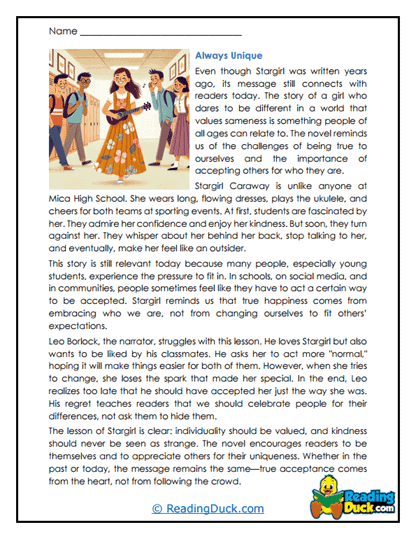
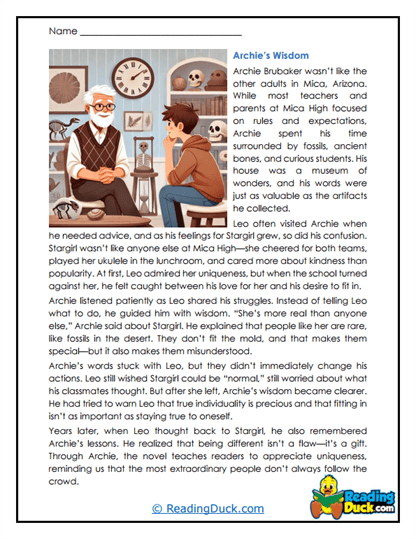
Stargirl tells the story of Susan "Stargirl" Caraway, a free-spirited and eccentric new student at Mica High School in Arizona. Narrated by her classmate Leo Borlock, the novel follows how Stargirl's unconventional behavior-singing to classmates on their birthdays, cheering for both teams at sporting events, and carrying a pet rat-initially fascinates and charms the student body. But as her popularity fades and her nonconformity makes others uncomfortable, Stargirl becomes a target of social exclusion. Leo, who begins to fall in love with her, struggles between his admiration for her uniqueness and his desire to fit in with the crowd. When he asks her to act more "normal," Stargirl tries to conform-but it doesn't last. Ultimately, she disappears from Mica as mysteriously as she arrived, leaving behind a lasting impact on those who knew her, especially Leo, who continues to reflect on the lessons she taught him about individuality and courage.
Message and Themes of Stargirl
Stargirl is a heartfelt exploration of individuality, nonconformity, and the pressure to fit in. One of the central themes is the tension between being true to oneself and the fear of social rejection. Stargirl represents the pure, uninhibited self-kind, creative, and unconcerned with popularity. Her presence challenges everyone around her, especially Leo, to consider what it means to live authentically. Leo's internal conflict-choosing between his affection for Stargirl and his need to be accepted-mirrors a universal adolescent dilemma: the risk of standing out versus the comfort of belonging.
Another important theme is the power and cost of kindness. Stargirl's acts of generosity are genuine and frequent, yet they're often misunderstood or seen as strange. Spinelli uses this to show how society can resist goodness when it doesn't come in expected forms. Her story encourages readers to reflect on the meaning of compassion and to consider whether they would have the courage to be kind, even when it's unpopular.
The novel also critiques the rigid expectations of high school social life, illustrating how quickly admiration can turn into alienation. Spinelli doesn't offer easy answers-Stargirl's disappearance suggests that living authentically can be lonely-but he does leave readers with a hopeful message: being yourself may not always be easy, but it can leave a lasting, positive impact on the world around you.
Through its simple prose and deep emotional insight, Stargirl invites readers of all ages to embrace their own uniqueness and to recognize the quiet strength in those who refuse to follow the crowd.
Make sure to bookmark our website now.
Enjoy all our free reading worksheets.
Our materials adhere to the principles of the Science of Reading.