Bastille Day is France's fireworks-filled celebration of liberty-a day that marks the storming of the Bastille in 1789, the spark of a revolution that changed nations. Picture classrooms dressing up, flags unfurling, and stories bursting with revolutionary spirit-minus the muskets, of course. These worksheets deliver that drama through reading passages, vivid visuals, and thoughtful prompts that weave history, culture, and critical thinking into a festive package. It's where joy, inquiry, and historical awareness come marching together.
This national holiday is more than fireworks; it honors ideals of freedom, equality, and the courage to demand change. Through engaging stories, readers explore empathy, societal shifts, and the power of collective voice. The worksheets connect this legacy to modern values, inviting students to see themselves as part of a continuing narrative. Each page adds a spark, turning history into a kind of classroom celebration-not just a lesson.
Each worksheet begins with an inviting image-bunting, parades, or symbolic monuments-then unfurls a narrative that engages the mind and the heart. Multiple-choice and short-answer questions test comprehension, while open-ended prompts encourage deeper thinking: How did people feel in that moment? What would you have done if you were there? These sheets are catalysts for conversation, insight, and a dash of classroom revolution.
A Look At Each Worksheet
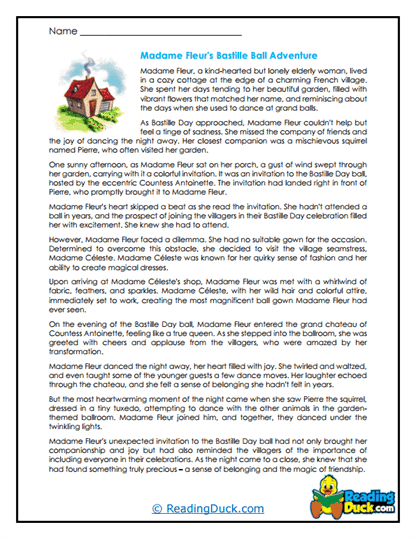
Ballroom Surprise
A lavish dance turns dramatic when revolutionaries interrupt with important news. Students explore surprise, tone, and character reactions. The worksheet checks comprehension of setting and suspense. If you could deliver world-changing news mid-party, how would you do it?
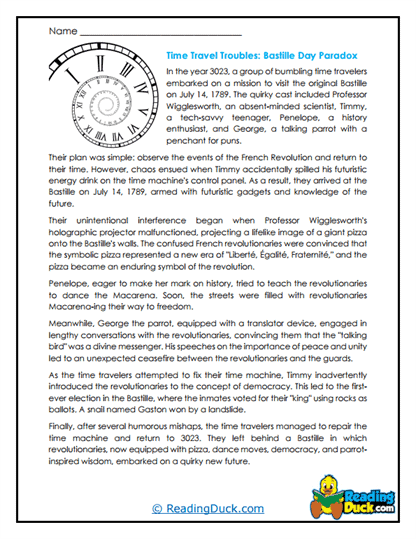
Bastille Time Travel Paradox
Students travel back to the storming of the Bastille-until a twist questions what "history" really is. Readers juggle timeline, cause-and-effect, and narrative ambiguity. Questions encourage critical analysis of perspective and alternate outcomes. If you could visit a pivotal day in history, what detail would you hold onto-and why?
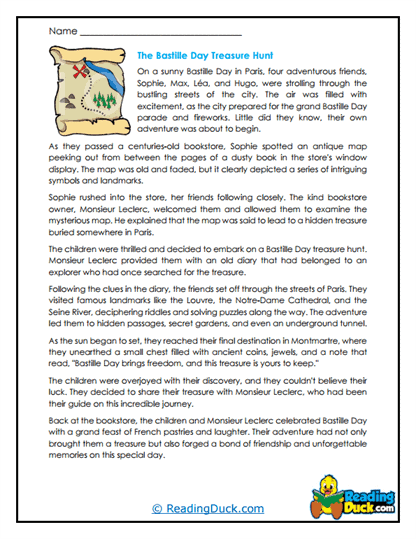
Bastille Treasure Hunt
Clues lead students on a search around a revolutionary-era Paris plaza. Readers practice following directions and making inferences. The task emphasizes logical thinking and sequencing. What hidden treasure might modern students discover in your school?
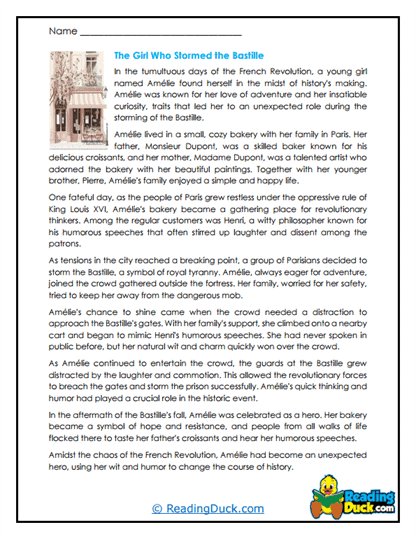
Brave Amélie
A young girl bravely defends her family's home against looming upheaval. Readers trace courage, emotion, and historical detail. Items focus on theme and character development. What small act of bravery would you imagine yourself doing in her shoes?
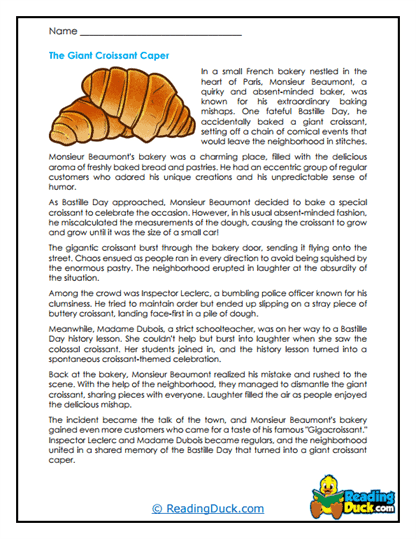
Croissant Chaos
A bakery prank sends croissants flying-literally-through a street full of shoppers. Readers identify cause-and-effect and vivid imagery. The worksheet draws attention to humor and descriptive writing. What delicious chaos would you create if you could?
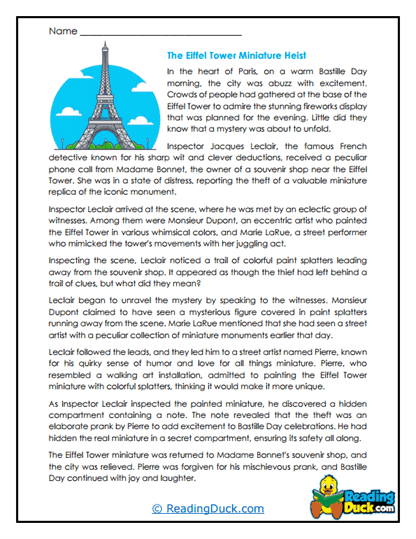
Eiffel Tower Miniature Heist
A model of the Eiffel Tower vanishes under comic circumstances. Students sift red herrings and clues. Comprehension targets inference and detail tracking. If you had to solve a mystery with only miniature props, what trick would you suspect?
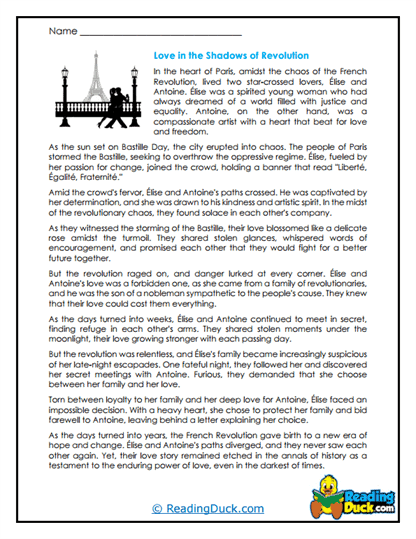
Love in Revolutionary Paris
Two pen pals exchange clandestine letters amid rising tension. Readers explore tone, theme, and historical context. Questions prompt empathy and perspective-taking. If you were writing to someone during a moment of upheaval, what hope would your letter carry?
Magical Bastille Bakery
A bakery's magical baguettes grant secrets when eaten. Students interpret symbolism and narrative structure. Items guide exploration of theme, cause, and effect. What secret would you hope to unwrap in a storybook treat?
Mime's Mischief
A mischievous mime plays faceless pranks around a public square. Readers infer humor, tone, and setting. Questions focus on character motivation and narrative flow. If you could prank with silence instead of sound, what would you mimic?
Picnic Parade
A peaceful picnic erupts into a spontaneous Revolutionary parade. Readers note transitions, tone shifts, and community spirit. Worksheets emphasize narrative sequence and theme. What everyday moment in your life could ignite a celebration?
Pierre's Poodle Adventure
A pampered poodle ends up chasing liberty's ideas through Parisian streets. Students follow the journey and explore metaphor. Comprehension targets plot structure and symbolic reading. If your pet could lead you somewhere meaningful, where would it go?
Super Bastille Blaze
A small spark in a historic building spreads, setting off a heroic rescue mission. Readers explore danger, action, and motivation. Questions target inference and cause-effect. If you could be part of a real-life rescue, what would you save first?
Underwater Bastille Adventures
A submerged Bastille discovery sends students into an undersea history quest. Readers imagine setting shifts and historical revelations. The worksheet encourages visualization and inference. If your school had a secret underwater wing, what wonders might you find?
Whiskers' Adventure
A revolutionary-era cat named Whiskers prowls through secrets and sans-culottes. Readers follow feline antics and symbolism. Items focus on viewpoint and theme. What would your cat's diary entry look like during a revolution?
Wizard's Time-Traveling Parade
A magical parade teleports participants across iconic revolutionary moments. Readers juggle tone, pacing, and narrative location. Questions encourage thematic analysis and creative connection. If you rode a time-traveling float, where and when would your parade stop?
A Deep Look At Bastille Day
Every year on July 14th, France comes alive with parades, fireworks, and music-it's a national block party that echoes liberty's ideals. The day marks the dramatic storming of the Bastille prison in 1789, a symbolic strike against tyranny and a call for a republic. From Paris to small towns and even French schools abroad, classrooms become miniature celebration zones-flag-making, song-singing, and reflections on freedom.
The event traces its roots to revolutionary fervor: with the fall of the Bastille, long-standing grievances against an absolute monarchy erupted in collective action, marking a turning point in history. Over time, what was once a tense uprising transformed into a celebration of enduring democratic values. Today, it's a day of remembering how ordinary people changed their world-and inviting new generations to consider what change they might spark.
Traditionally, the morning kicks off with France's oldest military parade, where bands and soldiers march down the Champs-Élysées, followed by dazzling fireworks over the Eiffel Tower. Many schools pair reading about those events with hands-on projects-students craft mini-banners, debate revolution-era choices, or compose poems about freedom. It's instruction intertwined with celebration.
Yet Bastille Day isn't just pageantry-it's a chance to reflect on what liberty means today. Students might compare modern scenes of unity to revolutionary ones, think about how nations commemorate their histories, or connect the day's ideals to causes like fairness or inclusion. In a single day, they step onto history's stage-not as observers, but as thinkers poised to write the next act.
Make sure to bookmark our website now.
Enjoy all our free reading worksheets.
Our materials adhere to the principles of the Science of Reading.