Thanksgiving is the holiday where gratitude meets gravy in one glorious feast. Imagine a day dedicated to eating more than your stretchy pants can handle, watching parades with enormous cartoon balloons, and debating which relative makes the best pie - all under the warm glow of autumn leaves. If you've never heard of it before, think of it as a cozy mash-up between a family reunion, a food festival, and a brief pause before the madness of holiday shopping season.
This day is celebrated in the United States (and a few other places in their own style) as a time to give thanks for the harvest and the year's blessings. It's rooted in centuries-old traditions, dating back to early settlers and their shared feasts with Native Americans, but has evolved into a celebration of togetherness, generosity, and reflection. Beyond the historical roots, it's a cultural moment that reinforces values of gratitude, hospitality, and community.
Our Thanksgiving Passages worksheets capture all that charm and chaos in story form, letting students dive into turkey chases, mashed potato mysteries, and parade-day adventures. Through reading, comprehension, and just the right amount of humor, these passages help learners explore the holiday's traditions, history, and quirks while sharpening their reading skills. It's learning that's as flavorful as pumpkin pie and twice as engaging.
A Look At Each Worksheet
Black Friday Fun
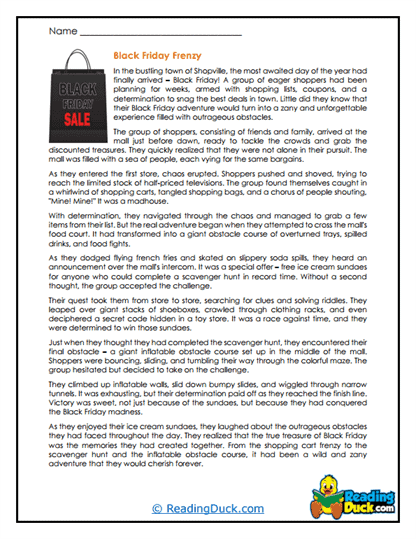
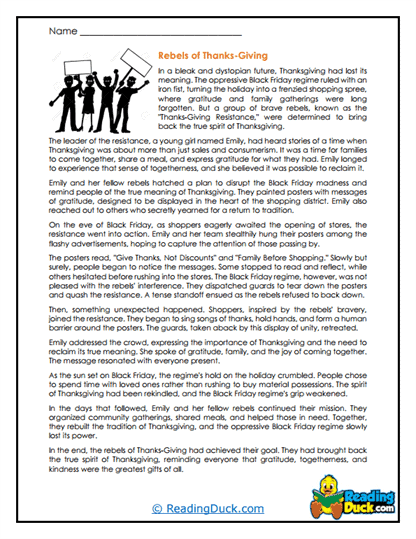
This passage plunges students into the whirlwind that is the day after Thanksgiving - a shopping frenzy that feels part treasure hunt, part obstacle course. Readers follow a character navigating early-morning crowds, doorbuster deals, and the occasional stampede for discounted TVs. It's packed with humor and relatable moments for anyone who's braved the sales. Did you know "Black Friday" got its name from Philadelphia police in the 1960s to describe the traffic chaos?
Cornucopia Heist
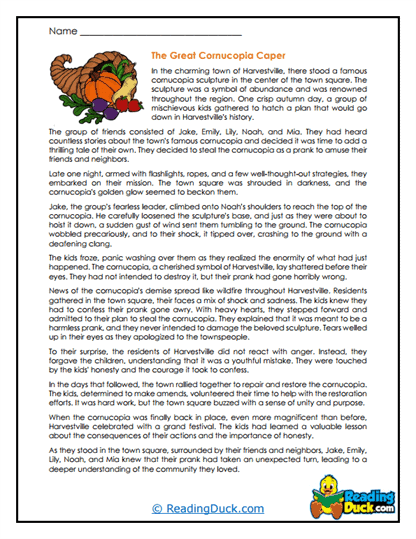
Here's a mystery where the iconic cornucopia - a horn of plenty - goes missing right before the holiday feast. Students will piece together clues from quirky suspects, from the mischievous neighbor to a suspicious squirrel. The fun lies in balancing suspense with silly antics. Cornucopias, by the way, have been symbols of abundance since ancient Greek times.
Gobble Talk Show
A turkey talk show host interviews a parade of feathered guests about their holiday plans. Each "gobble" is translated into witty banter that makes reading aloud a hoot. The passage combines humor with listening comprehension challenges. Fun fact: wild turkeys can make over 20 distinct vocalizations - though none have been recorded hosting a talk show... yet.
Gravy Expertise
In this story, the town's annual gravy contest draws chefs, home cooks, and a few unexpected entrants. Students will learn the drama of a cooking competition alongside descriptive vocabulary. Expect secret recipes, taste tests, and the occasional gravy spill. And yes - there's a real "National Gravy Day" on December 2.
Gravy Feud
Two rival families battle it out over whose gravy reigns supreme, sparking a food fight for the ages. The narrative blends humor, sensory details, and a dash of absurdity. Students will enjoy the playful rivalry while practicing inference skills. Imagine if Shakespeare wrote a play about mashed potatoes - that's the vibe.
Gravy Wishes
A magical gravy boat grants one wish per scoop, leading to a wild series of events. The main character quickly learns that "be careful what you wish for" applies to side dishes too. Great for encouraging predictions and cause-and-effect thinking. Question: if you could wish for anything via gravy, would you go for dessert or world peace?
Mashed Mischief
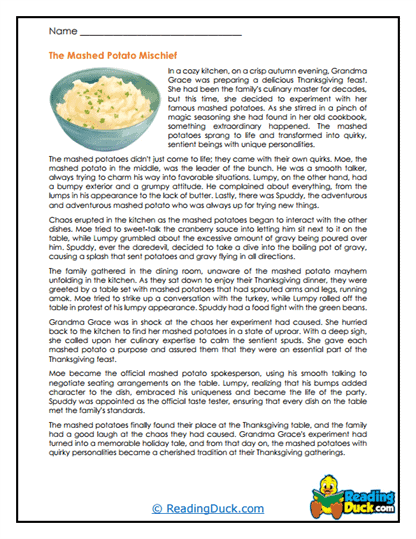
When the mashed potatoes mysteriously vanish, everyone becomes a suspect - even Grandma. Students read through humorous alibis and red herrings while solving the mystery. The text invites critical thinking and close reading. Mashed potatoes were first introduced to the U.S. by Irish immigrants in the 1700s.
Pilgrim Pranks
A mischievous Pilgrim decides to spice up the first Thanksgiving with practical jokes. The result? Confused settlers, amused guests, and some very surprised turkeys. The playful tone makes history approachable for young readers. Pilgrim clothing wasn't as drab as we often imagine - they actually liked colorful garments.
Potato Mischief
In this tale, potatoes take center stage in a kitchen comedy of errors. Readers will giggle at the slapstick humor while learning sequencing skills. Expect a few potato puns along the way. Fun fact: potatoes are the most-consumed vegetable in the U.S.
Stuffing Secrets
The town's famous stuffing recipe is under lock and key - until a curious kid stumbles upon it. The story combines culinary tradition with a detective twist. Students will identify key details and follow clues to the tasty conclusion. Did you know stuffing dates back to ancient Rome?
Thanksgiving Resistance
A group of turkeys forms a resistance movement to avoid becoming dinner. The plot mixes adventure with clever problem-solving strategies. Readers will root for the feathered underdogs. Turkey footprints have been found in fossils dating back over 100 million years.
Time Travel Play
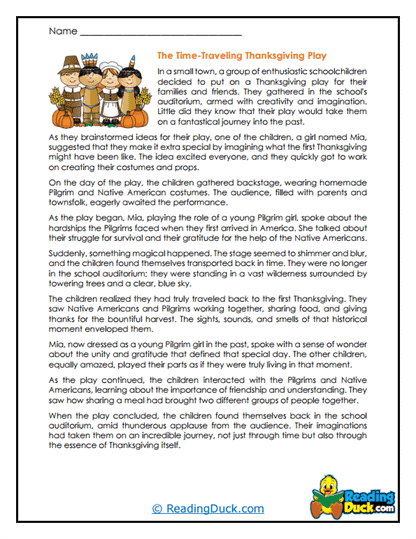
A school play accidentally sends its actors back to the first Thanksgiving. Students must navigate the past without messing up history. The mix of time travel and holiday setting sparks creativity and imaginative thinking. It's a great reminder that history is full of unexpected twists.
Turkey Comedy
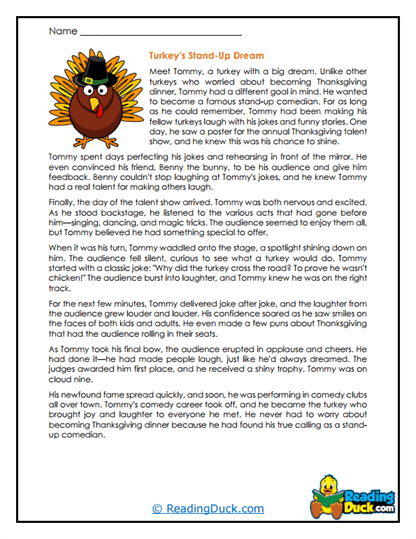
A turkey comedian cracks jokes to lighten the mood before the big feast. Readers will practice comprehension through puns and playful one-liners. The humor makes it especially fun for reluctant readers. Did you know a turkey's snood (the dangly bit on its face) changes color depending on its mood?
Turkey Talk
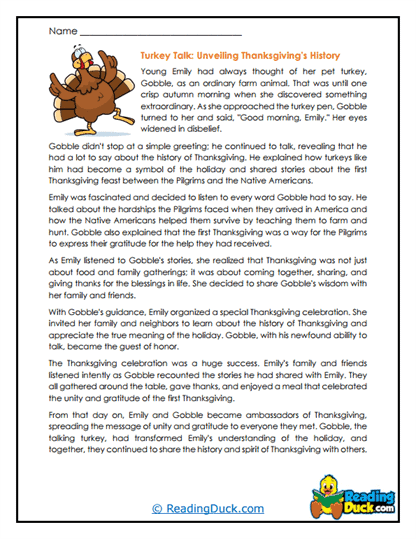
Here, a turkey tells its side of the Thanksgiving story directly to the reader. The monologue format helps students understand voice and perspective. It's funny, insightful, and a little persuasive. In 1989, President George H. W. Bush made turkey pardoning a national tradition.
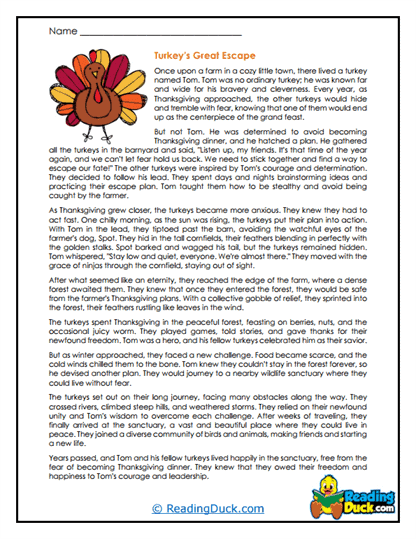
Turkey's Escape
The ultimate turkey getaway adventure - complete with disguises, decoys, and daring dashes. Students follow the high-energy plot while practicing sequencing and prediction. The ending will leave them guessing. Turkeys can run up to 20 miles per hour - not bad for a bird that prefers walking.
A Deep Look At Thanksgiving
Thanksgiving is celebrated on the fourth Thursday in November in the United States, a tradition set by President Franklin D. Roosevelt in 1941. In Canada, it's observed earlier, on the second Monday of October, reflecting a different harvest season. While it's generally a one-day event, its preparations - and leftovers - often stretch the celebration into a long weekend. Across both countries, the spirit remains the same: a time to gather and give thanks.
The origins of Thanksgiving in the U.S. are tied to early 17th-century feasts shared by English Pilgrims and the Wampanoag people. While that first gathering was likely more about survival and alliance than turkey and pie, it set the tone for a holiday centered on gratitude and sharing. Over time, it became a national tradition, shaped by historical proclamations, cultural storytelling, and evolving menus.
On Thanksgiving, families and friends gather for a meal that usually features roast turkey, stuffing, mashed potatoes, cranberry sauce, and pumpkin pie. Many also watch the Macy's Thanksgiving Day Parade, tune into football games, or volunteer at community kitchens. Some households have unique traditions, like making everyone share something they're grateful for before eating.
Beyond the food and formalities, Thanksgiving offers some quirky and heartwarming events. Cities host turkey trots (fun runs in festive gear), communities organize pie-baking contests, and presidential turkey pardons get live TV coverage. Decorations feature autumn leaves, cornucopias, and warm earth tones, while the kitchen buzzes with scents that can stop you mid-sentence. And if you've never experienced post-dinner drowsiness from "too much turkey," science says it's probably more about the sheer amount of food than the tryptophan.
Make sure to bookmark our website now.
Enjoy all our free reading worksheets.
Our materials adhere to the principles of the Science of Reading.