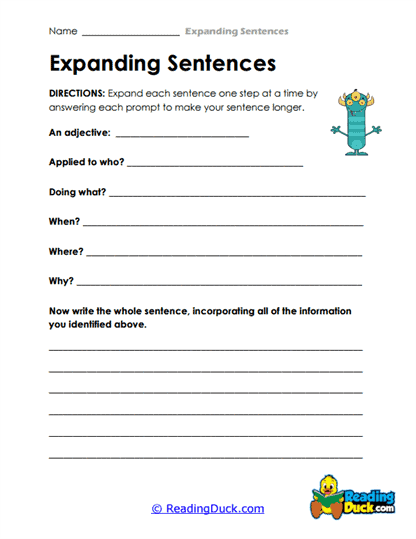
Expanding Sentences worksheets teach students how to take short, simple sentences and turn them into more detailed and engaging ones by adding description, structure, and meaning. Students learn to use adjectives, adverbs, and phrases to build stronger sentences, and they also practice conjunctions sentence building to connect ideas smoothly. These skills help learners move from basic writing to more expressive and complete sentences. The worksheets are ideal for elementary and middle school students in classrooms, homeschool settings, or independent practice.
The structured design helps students build confidence step by step-from adding one or two descriptive words to combining ideas in compound or complex forms. It strengthens writing fluency, making students more comfortable using richer language and varied structures. By working through these activities, learners develop a stronger feel for how sentences can grow and evolve. Instructors can use the worksheets as warm-ups, guided lessons, or independent exercises tailored to each student's growth. Ultimately, these tools help young writers build sentences that convey more meaning and captivate readers.
This collection is flexible and creative, allowing teachers or parents to adjust for different skill levels or writing goals. Beginners might start with simple "The dog ran" expansions, while more advanced learners can work on adding clauses like "The dog ran across the yard because it was excited." The clear formatting and progressive difficulty ensure that learners stay engaged as they grow. With downloadable PDFs and answer keys, it's easy for educators to implement and assess progress. Through consistent practice, students become more expressive, accurate, and confident in expanding their writing.
Looking At Each Worksheet
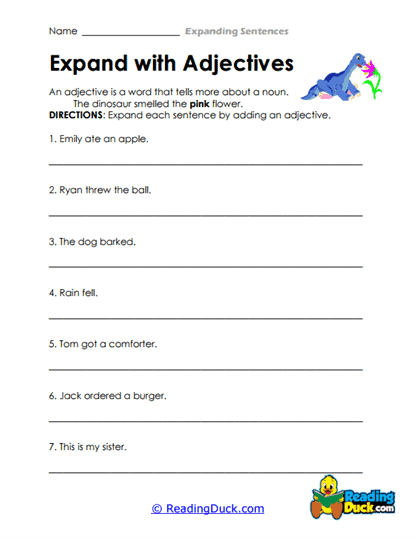
Adjective Add-On
Students begin with a basic sentence and add one or more adjectives to make it more descriptive, like turning "The cat slept" into "The sleepy, gray cat slept." They learn how adjectives enrich writing by painting clearer mental pictures. This builds awareness of how detail enhances the reader's experience. It's great for early practice and boosting vocabulary. Students develop confidence in selecting precise descriptive words.
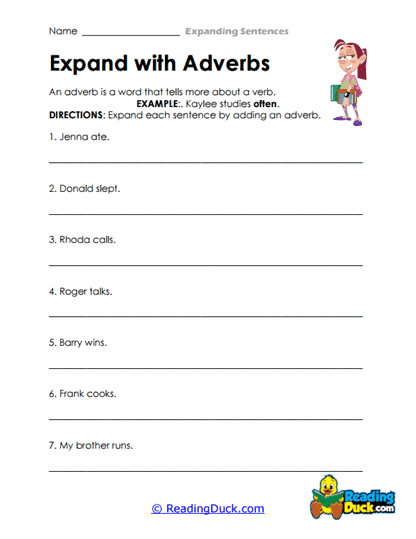
Adverb Adventure
Learners practice including adverbs in sentences to explain how actions happen, such as changing "He ran" into "He ran quickly toward the finish line." They discover the power of adverbs in adding movement and mood. The worksheet emphasizes adverb placement and nuance. Ideal for teaching word choice and syntactic flexibility. Students grow their sense of action detail.
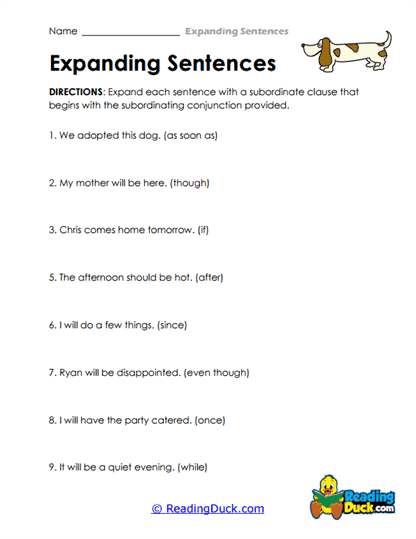
Clause Connection
Students expand sentences by connecting ideas with subordinate clauses, transforming "The bird sang" into "The bird sang when the sun rose." They grasp how clauses add context or reason without making sentences choppy. This activity bridges simple and complex sentence structures. Useful for advancing grammatical skill. Writers gain tools for nuance and variation.
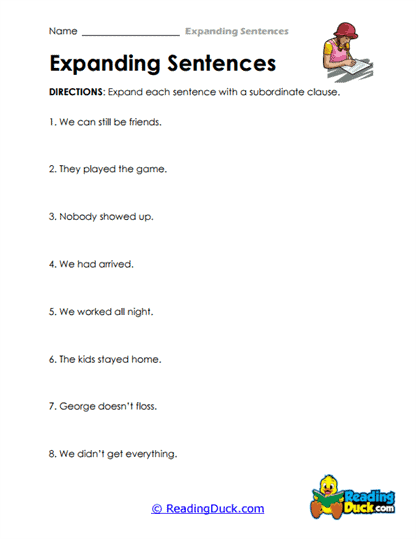
Clause Crafter
Here, students combine multiple clauses-dependent or independent-to build longer, richer sentences, like "The dog barked, and the cat hissed when the door opened." It teaches how to structure layered ideas smoothly. It's a hands-on way to build compound or complex sentences. Excellent for writing transition lessons. Students strengthen fluency and clarity.
Complex Creations
This worksheet challenges learners to transform simple sentences into complex ones with modifiers and clauses, such as turning "Rain fell" into "Rain fell softly as clouds gathered overhead." It encourages precise language and layered thinking. Students practice varying sentence rhythm and structure. Great for creative or descriptive writing. It refines their ability to add depth and style.
Compound Craze
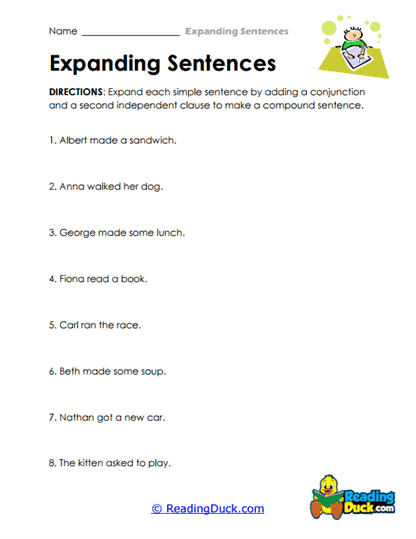
Students learn to combine two independent thoughts using coordinating conjunctions, like changing "She smiled. He waved." into "She smiled, and he waved." It shows how related ideas can live together in one sentence. The activity supports logical flow and variety. Perfect for early expansion lessons. It reinforces understanding of coordination.
Conjunction Junction
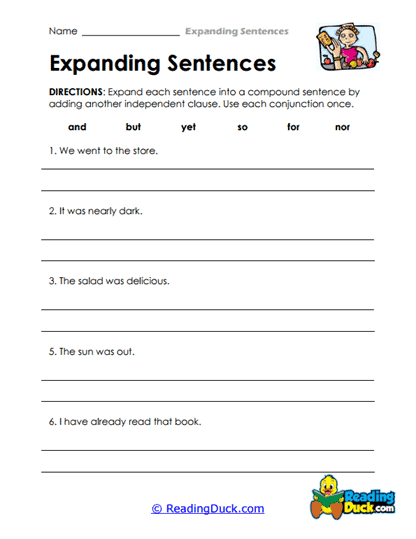
Here, the focus is on choosing appropriate conjunctions-"for," "and," "nor," "but," "or," "yet," "so"-to join sentences effectively. Students see how each word shifts meaning and emphasis. It's a subtle but powerful sentence-building skill. Ideal for vocabulary and nuance lessons. Learners gain control over tone and connection.
Double Subjects
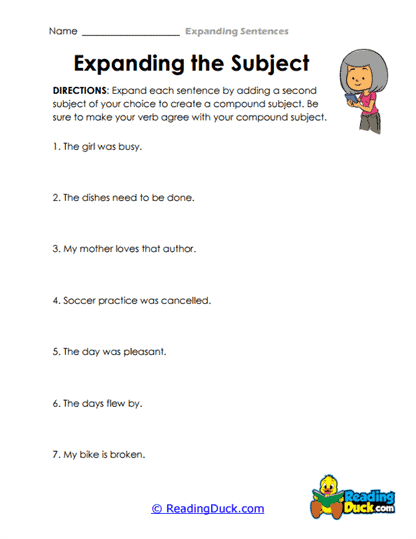
Students experiment with using two subjects in one sentence, like "The teacher and the student laughed together." They explore how combining actors enriches expression. This builds grammatical variety and clarity. Good for subject and agreement lessons. Writers learn to craft more interesting sentences.
Location Layers
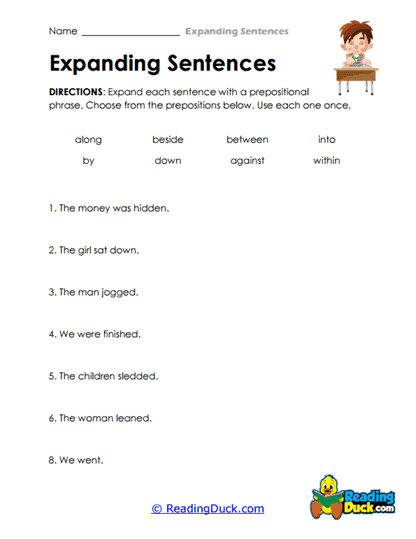
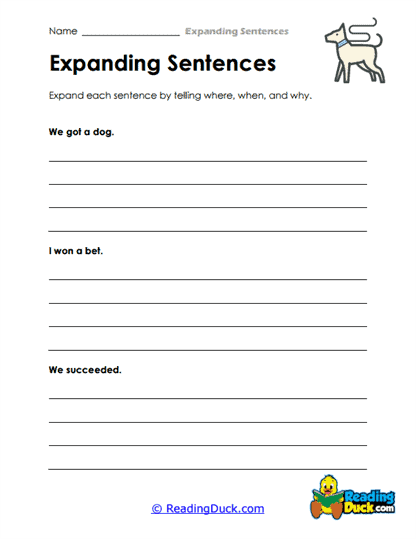
This worksheet teaches students to add prepositional phrases to describe location, turning "Birds flew" into "Birds flew above the treetops at dawn." It helps learners place actions in space and time. It enhances vividness and detail. Great for sensory or setting-focused writing. Students practice anchoring actions in context.
Phrase Maze
Learners add or reorder phrases to make sentences richer and more engaging, weaving elements like "with a grin," "under the bright sky," into the flow. This puzzles builders and sentence artists alike. It broadens sentences without clutter. Excellent for creative variation practice. Students learn flexible syntax.
Prepositional Power-Up
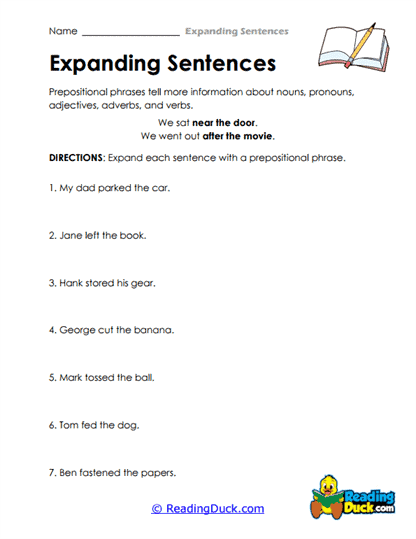
Students boost sentences with prepositional phrases that add depth-such as turning "She danced" into "She danced in the moonlight with grace." They learn how small changes can paint bigger pictures. It supports atmosphere and descriptive writing. Ideal for style workshops. Learners gain tools for vivid imagery.
Prompted Expansions
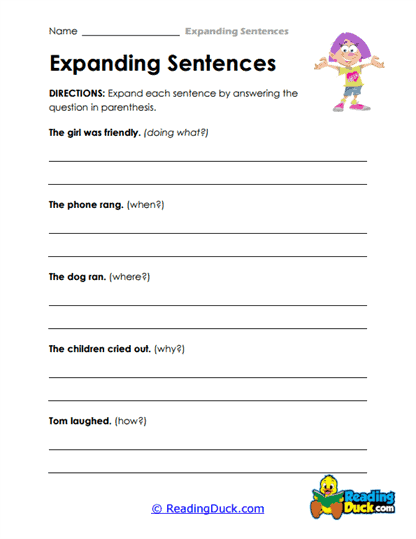
Here, students receive prompts that guide them to expand sentences in specific ways, such as "Add an emotion word" or "Describe the weather." The scaffolding encourages focused creativity. It builds both structure and freedom. Great for scaffolded writing time. Students feel supported while expanding.
Reasoning Expansions
In this worksheet, learners practice adding cause-effect clauses, e.g., "She smiled because she was happy," to simple sentences. It sharpens understanding of logic and connection. This boosts reasoned writing and clarity. Perfect for persuasive or explanatory tasks. Students strengthen coherence and detail.
Speedy Sentence
Students work under time limits to expand sentences quickly, training them to think on the fly. It's fun, engaging, and builds writing reflexes. The pressure helps develop automatic use of descriptive strategies. Great for warm-ups or fluency drills. Students improve agility in sentence growth.
Step-by-Step Sentences
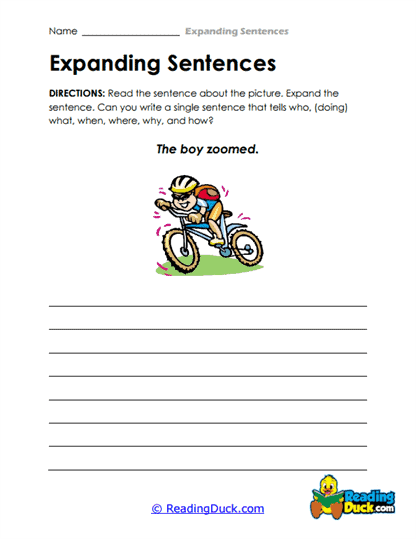
This worksheet walks learners through multiple stages of expansion-adding an adjective, then a prepositional phrase, then a clause-to gradually build complexity. It's like leveling up sentence structure in stages. It supports scaffolded learning and self-assessment. Especially effective for gradual instruction. Students see clear progression and build confidence.
What Is Expanding Sentences?
Expanding sentences means taking a short, simple sentence-such as "The bird sang"-and making it richer by adding descriptive details, adverbs, prepositional phrases, conjunctions, or clauses. This technique allows writers to clarify meaning, add interest, or show setting, mood, or reason. It transforms writing from plain to expressive, drawing readers in with imagery, rhythm, and precision.
Students use sentence expansion in all kinds of writing-from vivid stories and creative descriptions to stronger academic responses or persuasive pieces. It gives their work variety and helps avoid repetitive, choppy phrasing. By practicing expansion, learners cultivate a toolset for showing rather than telling, and for adding depth without losing clarity.
Mastering expansion also reinforces grammar skills, such as understanding modifiers, clause structure, and sentence variety. It encourages conscious language choices and offers a creative way to revise and polish writing. Ultimately, expanding sentences helps students become more confident, intentional writers who can craft sentences that inform, engage, and delight.
Example Uses of Expanding Sentences
Example 1
Sentence: The dog barked.
Expanded: The small, brown dog barked loudly at the passing car.
Explanation: This version adds size, color, and sound to make the scene more vivid and informative.
Example 2
Sentence: The sun rose.
Expanded: The golden sun rose slowly over the misty hills, casting warm light on the quiet valley below.
Explanation: By adding imagery, setting, and movement, this sentence becomes immersive and descriptive.
Make sure to bookmark our website now.
Enjoy all our free reading worksheets.
Our materials adhere to the principles of the Science of Reading.