Sentence Writing Worksheets focus on helping students learn how to craft clear, well‑structured sentences from scratch-building from the basics of subject, verb, and object to richer, more varied expressions. These activities nurture writing fluency and confidence by guiding learners to organize their thoughts into full, grammatically correct sentences. Available as downloadable PDFs with answer keys, they're wonderfully suited for classrooms, homeschooling environments, and independent learning. Engaging prompts and structured support empower students to practice writing with purpose and precision.
The collection encompasses a delightful variety of tasks that blend writing practice with meaningful contexts, such as personal descriptions, creative storytelling, and visual prompts. Each worksheet is designed to guide students gently-from forming simple statements to crafting sentences that respond to questions, pictures, or word banks. Teachers and parents will appreciate their versatility: they work well as journal activities, writing center stations, or lesson warm-ups. Regular use fosters independence, thoughtful expression, and comfort with writing in learners at different levels.
As students work through these activities, they build essential writing skills like organizing ideas, choosing the right words, and forming complete thoughts. The step-by-step support helps them move from simple sentence starters to creating their own original sentences. Along the way, they also strengthen paraphrasing sentence ideas, learning how to express the same meaning in different ways. These practice sessions become stepping stones toward stronger paragraph writing and more confident self-expression.
Looking At Each Worksheet
About Me
Students write a sentence or two introducing themselves, using prompts like "My favorite color is ___." They practice writing about themselves with clarity and confidence. This activity builds personal expression within a structured form. Great for back‑to‑school introductions or warm‑up writing. Learners develop voice and sentence fluency.
Animal Descriptions
Learners compose sentences that describe animals based on given prompts or pictures. They exercise vocabulary and descriptive clarity within sentence form. It helps tie observation to written expression. Ideal for science or creative writing boosts. Students strengthen detail in sentence writing.
Climb, Wear, Plant
Here, students craft sentences using one of the verbs: climb, wear, or plant, in a meaningful context-such as "I plant seeds." This practice builds verb usage and syntax accuracy. It's a playful and focused vocabulary guide. Useful in themed writing or vocabulary lessons. Learners reinforce action word usage in sentences.
Desk Orders
Students write directions or commands someone would follow at a desk-like "Open your book." They practice imperative sentence structure clearly. This links writing to everyday settings. Great for classroom routines or syntax lessons. Writers gain confidence in instructional writing.
Dog Story Tracing
Learners trace or write sentences that describe a dog in action or emotion. It reinforces subject-verb structure and descriptive phrasing. The dog theme adds familiarity and fun. Perfect as a transitional link between tracing and independent sentence writing. Students practice tone and grammar together.
Everyday Actions
Students write a sentence about a routine action-such as "I brush my teeth." This supports clarity and sequence in expression. It also reinforces verb usage and personal routines. Ideal for daily journaling or literacy warm-ups. Learners tie daily life to writing structure.
Keys & Drums
Here, students write sentences referencing keys or drums-such as "The drum beats loudly." The props give tangible context to writing practice. It blends concrete imagery with sentence mechanics. Great for music-themed or object-based prompts. Learners harness sensory language within sentence form.
Picture Description
Learners view an image and write a simple sentence describing it-such as "The cat sleeps on the mat." This aligns visual observation with sentence creation. It supports comprehension and expressive clarity. Excellent for cross-curricular integration. Writing becomes vivid and connected to imagery.
Playground Objects
Students use prompts or pictures of playground items to write descriptive or action sentences-like "The swing moves high." It connects setting to writing content. Encourages imaginative yet structured sentence building. Useful in descriptive writing lessons. Learners write with context and coherence.
Question Prompts
Here, students answer question starters to form full sentences-e.g., "What are you doing? I am ___." This supports interrogative and declarative sentence fluency. It helps combine question comprehension with response construction. Great for speaking-to-writing bridges. Writers build both question handling and sentence accuracy.
Sentence Detail
Learners begin with a basic sentence and add one detail to make it more vivid-e.g., "The bird chirps" becomes "The small bird chirps loudly." It teaches how embellishment enhances meaning. This scaffold supports descriptive growth. Useful for revision exercises. Students learn to build richer sentences.
Sentence Order Practice
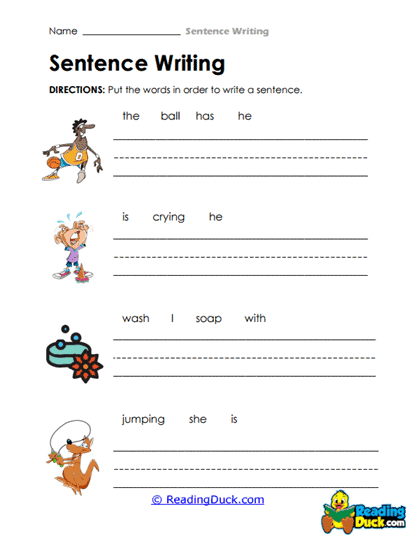
Students rearrange words into the correct sentence order to form a clear thought. It strengthens syntax and word-placement awareness. Especially helpful for ELL or early writers. It feels like solving a fun puzzle. Learners reinforce structure through ordering.
Sentence Types
This worksheet prompts students to write one or more sentence types (statement, question, command) as a practice in form and purpose. It reinforces tone and structure variety. It's flexible for creative or grammar lessons. Learners explore multiple sentence uses intentionally.
Tree & Flowers Sentences
Students write sentences that include tree or flower imagery-such as "The flower blooms in spring." It blends nature vocabulary with sentence practice. Alternative is seasonal or nature-based writing prompts. Excellent for science integration. Learners knit imagery with structure.
Word Bank Fill-In
Learners are given a bank of words to choose from to write complete sentences. This scaffolds vocabulary and sentence structure choice. It balances support with creativity. Useful for targeted grammar or theme practice. Writers learn word choice within sentence crafting.
Strong Foundations With Complete Sentences
Writing in complete sentences is an essential skill because it ensures that your ideas are communicated clearly. A complete sentence always has two key parts: a subject (who or what the sentence is about) and a predicate (what the subject is doing or what is being said about it). Without both of these, the sentence is incomplete and can leave the reader confused.
To strengthen your writing, it helps to pause and check whether each sentence expresses a full thought. Ask yourself: does this sentence make sense on its own, or does it feel like something is missing? Reading your work aloud is another effective strategy-when a sentence is incomplete, it often sounds unfinished or abrupt. These small habits help you catch fragments and turn them into strong, complete statements.
Practicing with examples is also valuable. Try writing short sentences and identifying their subjects and predicates. Then, gradually expand by adding descriptive words, details, or clauses. This practice not only helps you avoid fragments but also improves the variety and richness of your writing. By making sure every sentence has both a subject and a predicate, you build writing that is clear, complete, and effective.
Example of an incomplete sentence (fragment): "Running through the park."
This is incomplete because it tells us an action but does not tell us who is doing it.
Example of a complete sentence: "She was running through the park."
This is complete because it has a subject (she) and a predicate (was running through the park), forming a full thought.
Make sure to bookmark our website now.
Enjoy all our free reading worksheets.
Our materials adhere to the principles of the Science of Reading.