Sentence Structure Worksheets are designed to build strong writing foundations by teaching students how sentences fit together-from recognizing subjects and predicates to crafting compound or complex constructions. These materials guide learners through sentence types, word order, clause relationships, and variety, equipping them to write with clarity and rhythm. Available in downloadable PDF format, each worksheet includes answer keys-making them ideal for classrooms, homeschool settings, or independent learning. The interactive exercises turn abstract grammar into active exploration, helping students see how building blocks of language create meaning. Practicing with these resources ultimately gives students control over their writing flow and variety, setting them up for expressive, effective communication.
This collection offers a wide array of themes and skills, such as Action Sentences, Complex Connections, Sentence Variety, Subject-Predicate Practice, and Sentence Types, ensuring learners encounter both foundational and advanced structures. From mixing simple and compound sentences to experimenting with lively, "Silly Sentences," the variety keeps practice engaging and meaningful. Teachers and parents can adapt worksheets for warm-ups, differentiated instruction, or focused grammar coaching. Across levels, students develop both awareness and flexibility in constructing sentences that sound right and flow well. The result is writing that communicates ideas clearly, elegantly, and with purpose.
By working consistently through these worksheets, learners gain not just technical grammar skills but also a feel for writing style and tone. Mastery of sentence structure enhances reading comprehension too, as students recognize patterns authors use to build meaning. As students progress, they begin to compose complex ideas with confidence-whether through compound-complex sentences, varied length, or stylistic choice-without losing clarity. These Sentence Structure tools really serve as stepping stones toward advanced writing fluency.
Looking At Each Worksheet
Action Sentences
Students write sentences focused on action verbs-like "The dog sprinted"-to reinforce how dynamic language shapes meaning. They gain awareness of subject-verb structure and vivid verb usage. It supports concise and lively writing. Ideal for narrative or writing warm-ups. Learners build strength in clear, action-focused sentence construction.
Add-On Sentences
Here, learners practice adding descriptive phrases or clauses to a base sentence, such as turning "The girl laughs" into "The girl, who loves dancing, laughs joyfully." This approach focuses on expanding sentence details, helping students see how adding just a few words can make ideas clearer and more engaging. It teaches them how to build richer sentences while keeping grammar and flow intact.
Complex Connections
This worksheet guides learners in connecting independent and dependent clauses using subordinating conjunctions-creating complex sentences like "Because it rained, we stayed inside." It shows how to combine ideas thoughtfully. Students practice clarity and nuance. Useful for advancing sentence sophistication. Writers learn to express reasoning and timing within one sentence.
Compound or Complex
Learners identify whether sentences are compound or complex, then write their own examples of each type. They develop understanding of sentence variety. It supports both comprehension and creation. Excellent for reinforcing flexibility in writing. Students internalize the tools of structure variation.
Detailed Expansion
Students take a simple sentence and build it up with modifiers, phrases, or clauses-creating richer, more detailed versions. It encourages thoughtful elaboration. This supports descriptive and technical writing. Ideal for revision practice. Learners refine both detail and structural precision.
Missing Pieces
This activity gives students incomplete sentences-missing subject, verb, or phrase-and challenges them to fill in the right elements. It fosters sentence completeness awareness. Great for diagnosis and repair practice. Supports foundational sentence integrity. Students reinforce structural grammar understanding.
Picture Pals
Students view an illustration and write a clear, structured sentence describing what's happening in the picture. It connects visual cues to sentence building. Works well for visual and descriptive practice. Enhances both observation and grammatical clarity. Learners practice concrete and correct expression.
Question Quest
Here, students rewrite statements into proper questions, adjusting word order and punctuation-for example, changing "You like soccer" to "Do you like soccer?" It emphasizes syntax and tone. Great for learning interrogatives. Students sharpen grammatical adaptability. Writing becomes question-savvy.
Sentence or Fragment
Learners determine whether given lines are complete sentences or fragments and then correct fragments. This reinforces understanding of full-thought expression. Great for foundational grammar clarity. Helps identify missing parts. Students build critical editing and structural awareness.
Sentence Variety
This worksheet encourages students to create sentences of varying length and style-simple, compound, and complex-to improve rhythm and readability. It fosters flowing, engaging writing. Excellent for refining writing voice. Students become adept at sentence pacing. Writing gains variety and interest.
Silly Sentences
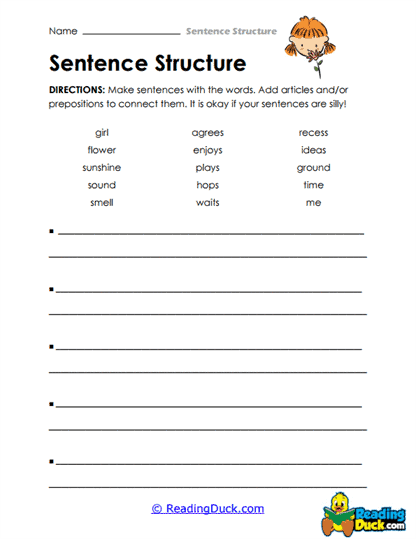
Students unscramble and correct humorously twisted or nonsensical sentences, learning structure with a smile. It teaches grammar through fun. Perfect for lower-pressure learning. Helps concepts stick with joy. Students learn structure playfully and memorably.
Simple or Compound
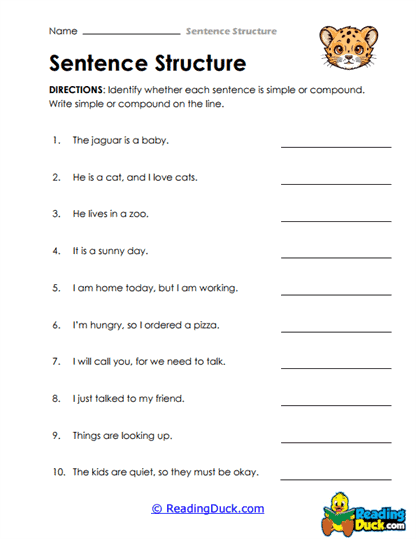
Learners sort sentences into simple or compound examples and practice writing each type correctly. It reinforces recognition of structure differences. Useful in introduction or review lessons. Students sharpen genre-specific phrasing. Writing becomes varied and balanced.
Sleepy Sloth
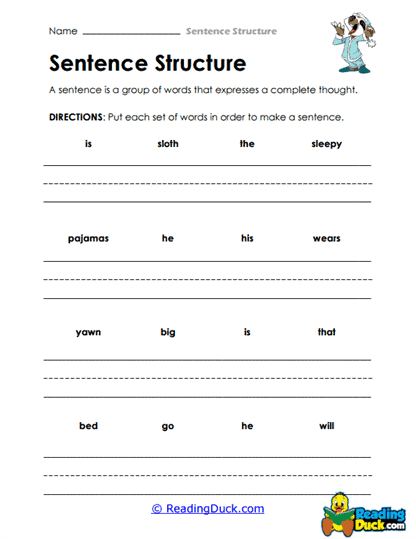
This themed activity uses slow-motion imagery-e.g. "The sloth sleeps slowly"-to reinforce proper sentence formation through content and clarity. It supports both style and structure awareness. Fun and memorable. Great for descriptive or animal-themed units. Students remember structure through quirky images.
Subject-Predicate Practice
Students identify and label the subject and predicate in multiple sentences, reinforcing the core mechanics of sentence structure. It anchors writing in fundamental grammar. Ideal for early instruction. Helps writers build complete thought awareness. Students establish strong sentence scaffolding.
Tortoise Tales
Learners write well-constructed sentences about tortoises, emphasizing slow action, clear verbs, and correct structure. It combines theme and grammatical accuracy. Great for storytelling or science contexts. Blends curiosity with clarity. Students write nameable, structured, and memorable sentences.
What Is Sentence Structure?
Sentence structure refers to how words, phrases, and clauses are arranged to express clear and complete thoughts. Mastering sentence structure includes understanding parts like the subject and predicate, differentiating between simple, compound, complex, and compound-complex sentences, and using modifiers or clauses with precision. Effective control of structure enhances clarity, improves flow, and gives the writer control over style-from concise statements to rich, layered expression.
These worksheets encourage students to refine their ability to structure ideas across sentence types-whether they're writing basic facts, combining ideas logically, or weaving detail for depth. Temporal ideas, reasoning, descriptive language, questions, and commands all follow structural rules the learner must understand and apply. As students gain command of structure, they write more confidently, selecting patterns that match their purpose, tone, and audience.
Strong sentence structure also boosts reading comprehension, as students recognize how sentences are built in texts they read. Over time, writing becomes more fluent and stylistically nimble when sentence structures are used intentionally. These tools support both the building and analysis of language, enabling learners to think and write with clarity and control.
Make sure to bookmark our website now.
Enjoy all our free reading worksheets.
Our materials adhere to the principles of the Science of Reading.