About Our Layers of the Atmosphere Reading Comprehension Worksheets
Earth is surrounded by an invisible blanket of gases called the atmosphere, and each layer plays an important role in making life possible. From the weather-filled troposphere to the distant exosphere where many satellites orbit, every layer has unique characteristics and responsibilities. These worksheets introduce students to the five main layers of the atmosphere while exploring fascinating topics such as weather, airplanes, meteors, auroras, satellites, and space. Along the way, children discover how Earth's atmosphere protects our planet and supports everyday life.
Our Layers of the Atmosphere Reading Comprehension Worksheets help students strengthen nonfiction reading skills while building a solid foundation in Earth science. As they read, students practice identifying main ideas, following scientific explanations, recognizing cause-and-effect relationships, expanding academic vocabulary, and comparing different parts of Earth's atmosphere. The passages also encourage critical thinking by helping readers connect scientific concepts to familiar experiences like watching the weather, flying on airplanes, or seeing a shooting star. These skills support success in science, reading, and STEM learning.
Learning about the atmosphere encourages children to look up at the sky with greater curiosity and understanding. They discover how scientists study the air above us, how Earth's protective layers make life possible, and how technology depends on different regions of the atmosphere every day. As students become more confident readers, they also develop a deeper appreciation for the amazing systems that surround our planet. We hope these worksheets inspire a lifelong interest in Earth science and the wonders of the world above us.
Meet the Worksheets
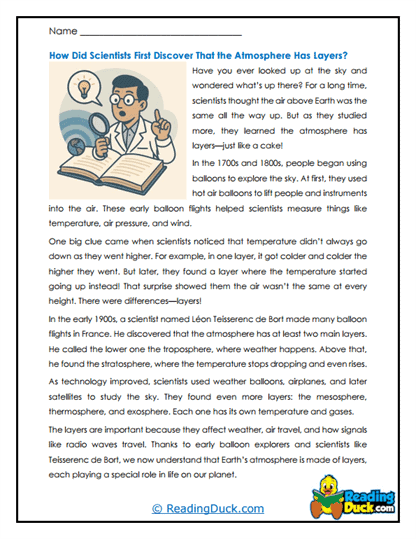
Atmosphere Discovery
Students explore how scientists gradually discovered that Earth's atmosphere is made of several distinct layers. They learn how weather balloons, airplanes, rockets, and satellites helped reveal the structure of the skies above us. This worksheet strengthens chronological thinking and scientific reasoning. Readers discover how curiosity and careful observations led to important discoveries.
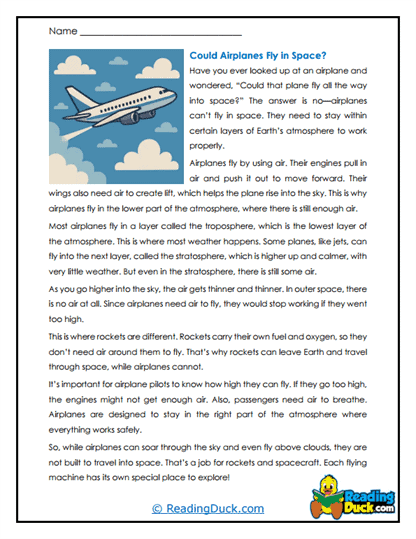
Flight Limits
Students investigate why airplanes cannot simply fly into space. They learn how wings, engines, and oxygen depend on Earth's atmosphere while comparing airplanes with rockets. This worksheet strengthens comparison and cause-and-effect skills through real-world examples. Readers gain a better understanding of how different flying machines work.
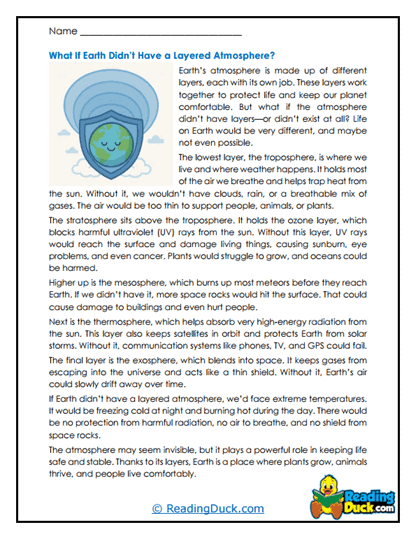
Life Shield
Students imagine what Earth would be like without its protective atmosphere. They explore how each atmospheric layer helps support life by providing breathable air, blocking harmful radiation, burning up meteors, and regulating temperature. This worksheet strengthens systems thinking and informational reading skills. Readers discover why the atmosphere is one of Earth's greatest natural defenses.
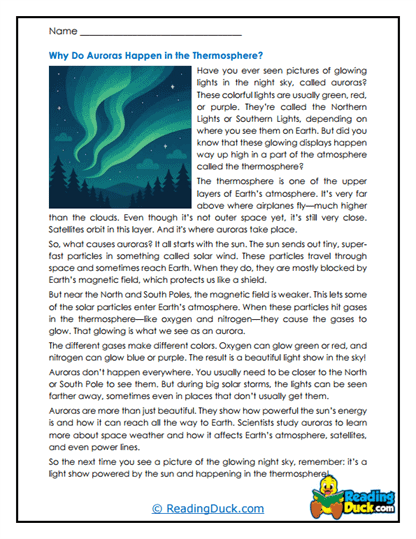
Northern Lights
Students discover how colorful auroras form high above Earth. They learn how charged particles from the Sun interact with gases in the thermosphere to create brilliant displays of light near the poles. This worksheet strengthens sequencing and cause-and-effect understanding through an exciting natural phenomenon. Readers gain a greater appreciation for one of nature's most spectacular light shows.
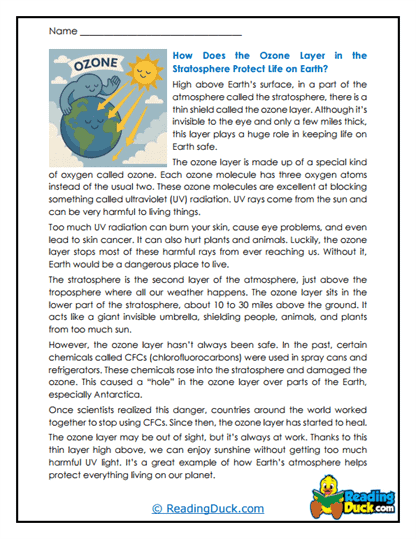
Ozone Shield
Students explore the ozone layer and its important role in protecting life from harmful ultraviolet radiation. They learn how ozone absorbs UV rays, how scientists discovered ozone depletion, and how countries worked together to reduce harmful chemicals. This worksheet builds comprehension through a problem-and-solution structure. Readers see how science and cooperation helped protect Earth's atmosphere.
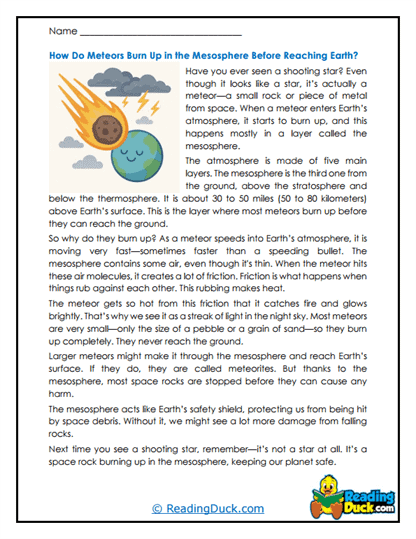
Shooting Stars
Students discover that a shooting star is actually a meteor burning up in Earth's atmosphere. They learn how friction in the mesosphere causes meteors to glow brightly before most of them completely burn away. This worksheet strengthens sequencing skills while explaining a familiar nighttime sight. Readers learn how the atmosphere helps protect Earth from space debris.
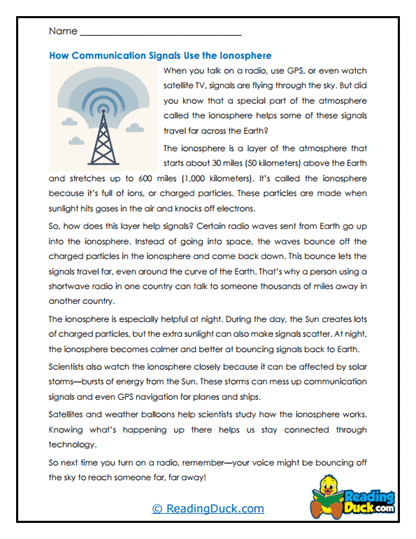
Signal Highway
Students investigate the ionosphere and its role in modern communication. They learn how radio waves, GPS signals, and satellite communications depend on this remarkable part of the upper atmosphere. This worksheet strengthens comprehension by connecting science to everyday technology. Readers discover how invisible layers of air help keep the world connected.
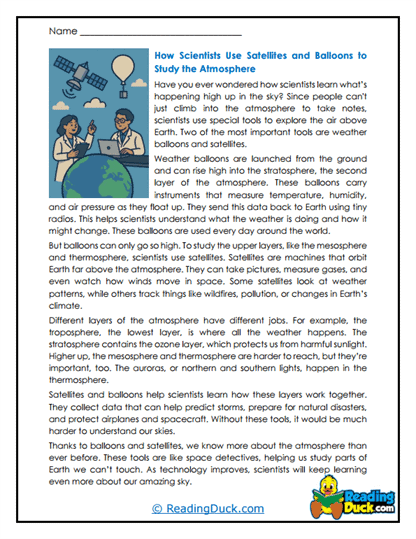
Sky Detectives
Students learn how scientists study the atmosphere using weather balloons and satellites. They discover how these tools measure temperature, humidity, air pressure, storms, pollution, and climate. This worksheet develops comparison and evidence-based thinking skills. Readers see how technology helps scientists better understand Earth's atmosphere.
Sky Layers
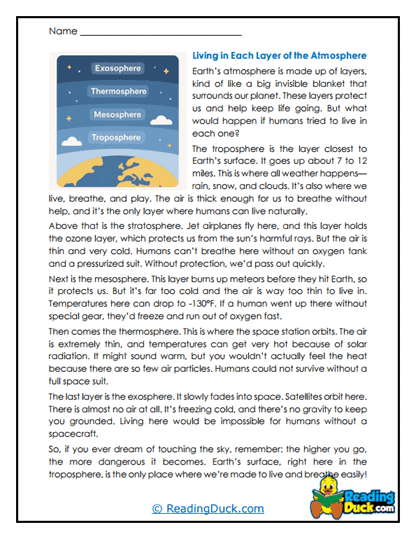
Students are introduced to the five major layers of Earth's atmosphere. They learn where weather occurs, where airplanes fly, where meteors burn up, and where many satellites orbit. This worksheet builds a strong foundation for understanding atmospheric science. Readers quickly see how each layer has its own important job.
Space Shield
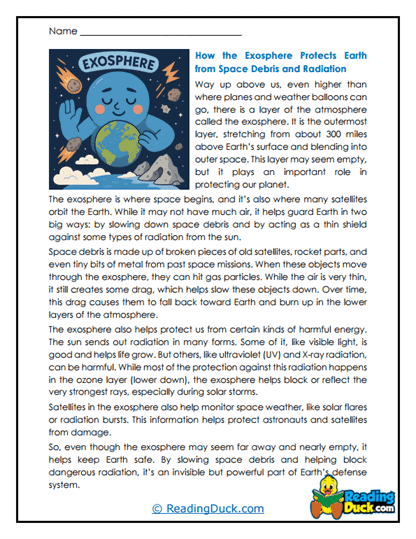
Students explore the exosphere, the outermost layer of Earth's atmosphere. They learn how this thin region helps protect Earth from some space debris and provides the area where many satellites orbit. This worksheet strengthens understanding of Earth's connection to space. Readers discover that even the atmosphere's thinnest layer plays an important role.
Temperature Zones
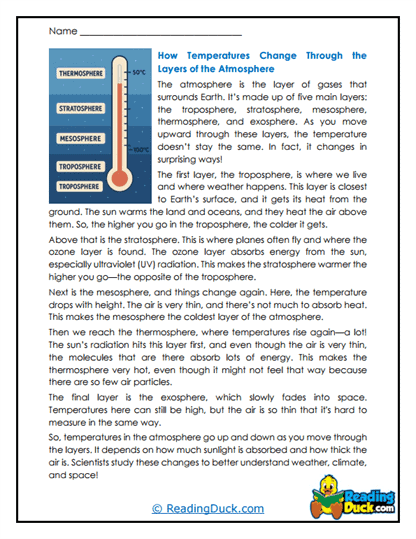
Students investigate why temperatures change in surprising ways throughout the atmosphere. They learn why some layers become colder while others become warmer as altitude increases. This worksheet develops comparison skills through clear scientific explanations. Readers discover that Earth's atmosphere is much more complex than it first appears.
Weather Zone
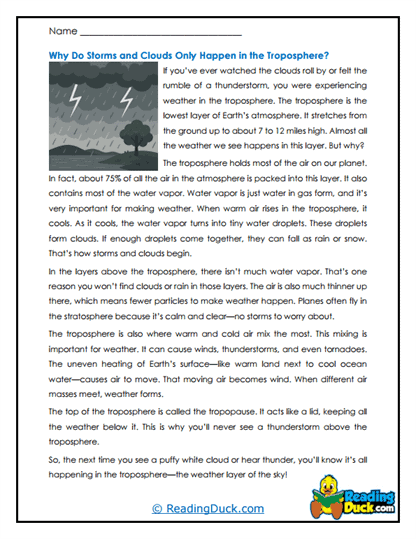
Students explore the troposphere, where nearly all of Earth's weather takes place. They learn how warm and cool air, water vapor, and air pressure work together to create clouds, rain, snow, and storms. This worksheet strengthens cause-and-effect thinking while connecting science to everyday observations. Readers discover why weather happens in only one layer of the atmosphere.
A Better Look At the Layers of the Atmosphere
Earth's atmosphere is much more than the air we breathe. Each of its layers serves a unique purpose, from creating weather and protecting us from harmful radiation to burning up meteors and supporting satellites that help people communicate around the world. Scientists continue studying the atmosphere to better understand weather, climate, aviation, and space. Learning about these layers helps students see how many natural systems work together to make life on Earth possible.
Reading about the layers of the atmosphere also helps students become stronger readers and scientific thinkers. They practice following scientific explanations, comparing different atmospheric layers, building academic vocabulary, and connecting ideas across informational texts. These skills support learning in Earth science, weather, astronomy, and many other subjects. With every passage, students gain confidence while discovering the remarkable invisible world that surrounds our planet.
Make sure to bookmark our website now.
Enjoy all our free reading worksheets.
Our materials adhere to the principles of the Science of Reading.