About Our Geological Time and Dating Methods Reading Comprehension Worksheets
Earth has an incredible story that stretches back more than 4.5 billion years. Although no one was there to witness its earliest days, scientists have discovered many ways to uncover clues about the past. These worksheets introduce students to the tools geologists use to study ancient rocks, fossils, volcanic ash, and radioactive elements to piece together Earth's long history. Along the way, children learn how evidence helps scientists understand when major events happened and how our planet has changed over time.
Our Geological Time and Dating Methods Reading Comprehension Worksheets help students strengthen nonfiction reading skills while exploring fascinating Earth science concepts. As they read, students practice identifying main ideas, following sequences, comparing scientific methods, expanding academic vocabulary, and using evidence to support conclusions. The passages also encourage critical thinking by showing how scientists combine different kinds of clues to solve mysteries about Earth's past. These skills support success in science, reading, and analytical thinking across many subjects.
Learning about geological time and dating methods encourages children to think like scientists and investigators. They discover that careful observations, accurate measurements, and multiple sources of evidence are essential for understanding the natural world. As students grow more confident reading informational texts, they also gain a deeper appreciation for the remarkable history preserved beneath their feet. We hope these worksheets inspire curiosity about Earth, science, and the exciting discoveries still waiting to be made.
Meet the Worksheets
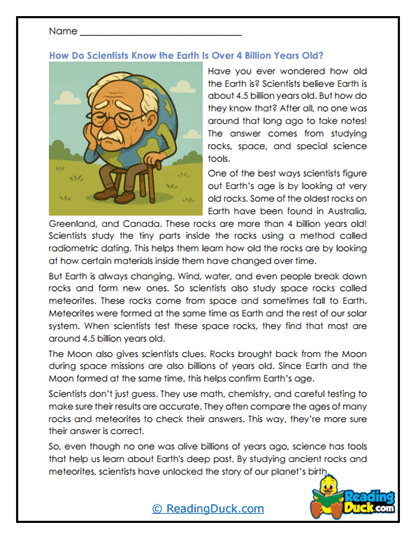
Ancient Clues
Students discover how scientists estimate Earth's age using evidence from rocks, minerals, and meteorites. They learn how radioactive elements act as natural clocks that reveal events from billions of years ago. This worksheet strengthens evidence-based thinking while introducing the foundations of geologic dating. Readers see how careful observations can unlock the secrets of Earth's earliest history.
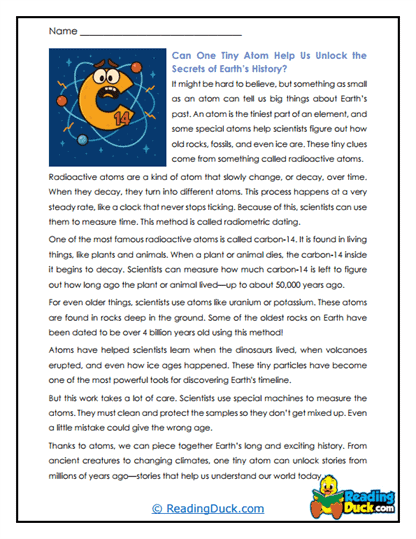
Atomic Clocks
Students explore how radioactive atoms help scientists measure the ages of rocks and fossils. They learn about radioactive decay, half-lives, and why multiple dating methods are often used together. This worksheet builds comprehension by explaining an important scientific process step by step. Readers discover how tiny atoms can reveal enormous stories about the past.
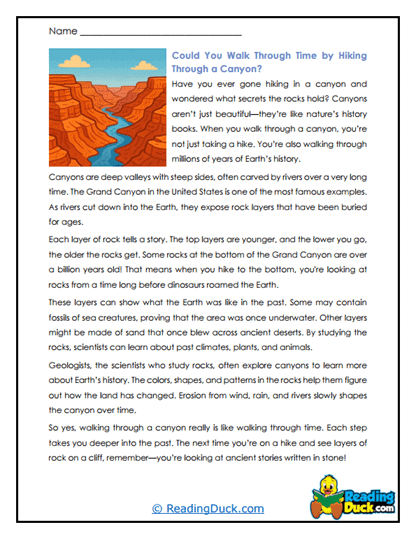
Canyon History
Students investigate how rivers carve canyons that expose layers of Earth's history. They learn how geologists study these rock layers to understand ancient environments, climates, and life forms. This worksheet strengthens sequencing and cause-and-effect skills through vivid natural examples. Readers discover why canyons are often called Earth's history books.
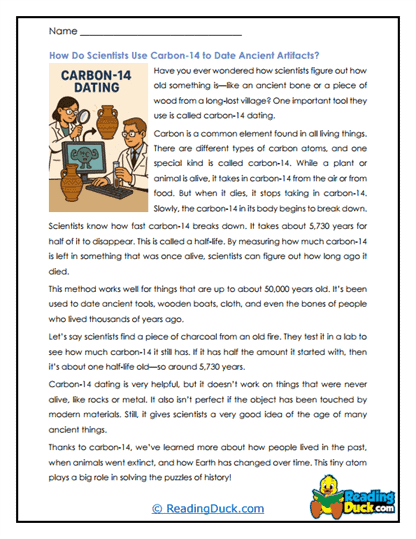
Carbon Dating
Students learn how carbon-14 helps scientists estimate the ages of materials that were once living. They explore how radioactive decay provides a reliable way to date artifacts, ancient wood, and other organic remains. This worksheet strengthens scientific reasoning while introducing an important dating technique. Readers gain a better understanding of how chemistry and archaeology work together.
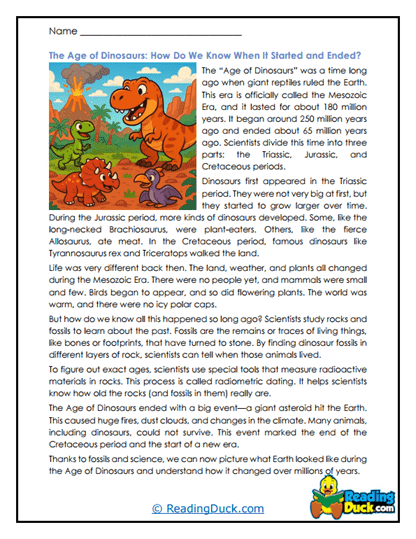
Dinosaur Era
Students explore how scientists determine when dinosaurs lived by studying fossils, rock layers, and radiometric dating. They learn about the Triassic, Jurassic, and Cretaceous periods while following Earth's changing history. This worksheet strengthens chronological thinking and comparison skills. Readers see how multiple pieces of evidence help build the dinosaur timeline.
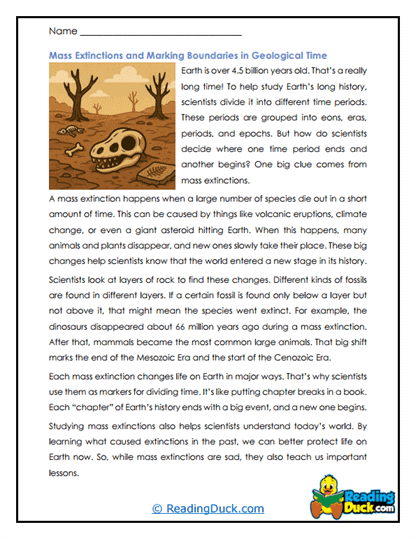
Extinction Markers
Students discover how mass extinctions help scientists divide Earth's history into major chapters. They learn how fossil evidence reveals important turning points in the geologic time scale. This worksheet strengthens comprehension by connecting cause-and-effect relationships across long periods of time. Readers see how Earth's greatest challenges also became valuable scientific clues.
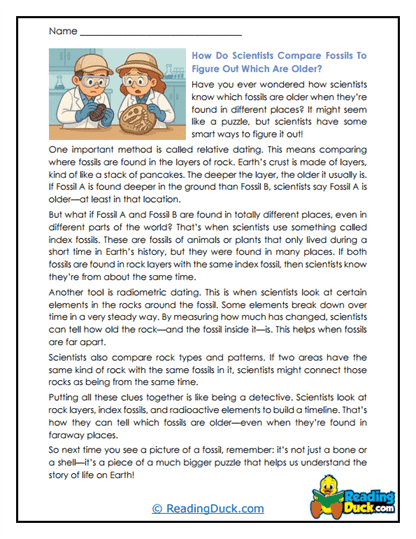
Fossil Detective
Students step into the role of a scientist solving mysteries from the distant past. They learn how index fossils, rock layers, and radiometric dating work together to determine the relative ages of fossils. This worksheet develops observation and evidence-based reasoning skills. Readers discover that scientific investigations often rely on multiple clues instead of just one.
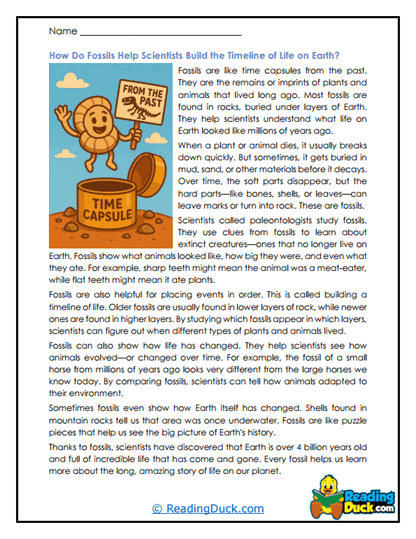
Fossil Records
Students learn how fossils preserve evidence of plants and animals that lived millions of years ago. They explore how fossils form and how scientists use them to reconstruct Earth's history. This worksheet strengthens nonfiction reading while introducing the fossil record as an important scientific tool. Readers discover that every fossil adds another page to Earth's story.
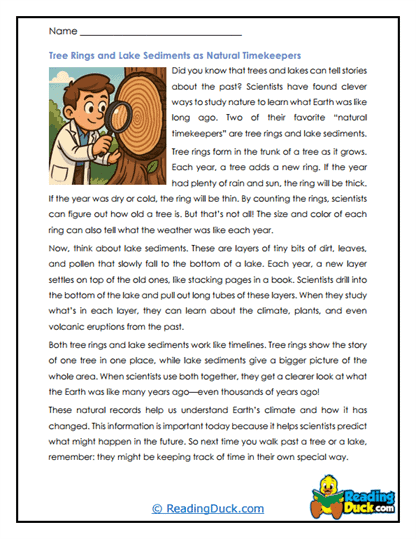
Nature's Timekeepers
Students investigate how tree rings and lake sediments record changes in Earth's environment over time. They learn how scientists study these natural timelines to understand climate, rainfall, and volcanic activity. This worksheet strengthens sequencing and observation skills through familiar natural examples. Readers discover that nature quietly keeps detailed records year after year.
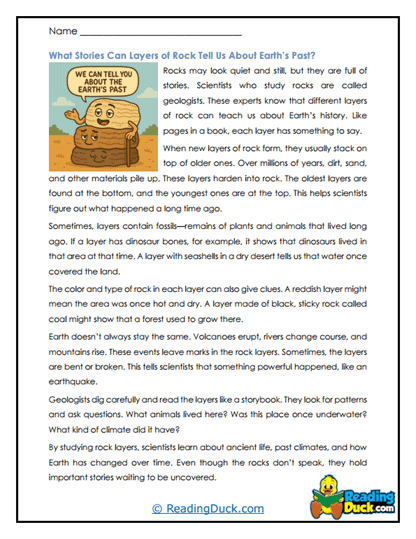
Rock Layers
Students learn how layers of rock reveal the order of events throughout Earth's history. They discover how sediment, erosion, and fossil evidence help geologists interpret ancient environments. This worksheet builds chronological thinking while strengthening comprehension skills. Readers see how even an ordinary cliff can tell an extraordinary story.
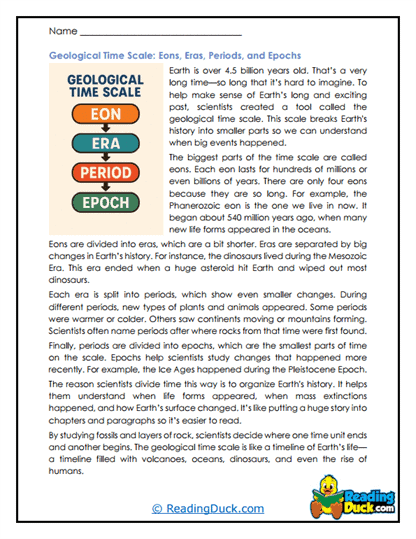
Time Scales
Students explore the geologic time scale and discover how scientists organize Earth's 4.5-billion-year history into eons, eras, periods, and epochs. They learn how major events help define each chapter of Earth's story. This worksheet strengthens organizational thinking and scientific vocabulary. Readers gain a clearer understanding of the "big picture" of Earth's past.
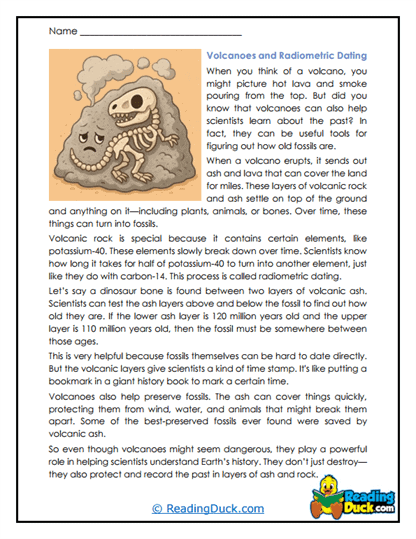
Volcanic Clocks
Students discover how volcanic eruptions help scientists measure the ages of rocks and fossils. They learn how volcanic ash and radioactive elements provide valuable dating clues long after eruptions have ended. This worksheet strengthens problem-solving and scientific reasoning skills. Readers see how dramatic natural events become powerful tools for understanding Earth's history.
A Better Look At Geological Time and Dating Methods
Understanding Earth's history requires much more than simply finding old rocks or fossils. Scientists combine information from rock layers, radioactive elements, fossils, volcanic ash, tree rings, and many other natural records to build a timeline stretching back billions of years. Each discovery adds another piece to the puzzle, helping researchers understand how continents, climates, plants, animals, and life itself have changed over time. Studying geological time shows students that Earth's story is still being uncovered through careful investigation and evidence.
Reading about geological time and dating methods also helps students become stronger readers and critical thinkers. They practice following scientific explanations, comparing different methods, building academic vocabulary, and evaluating evidence before reaching conclusions. These skills support learning in Earth science, biology, chemistry, and many other subjects. With every passage, students gain confidence while discovering how scientists uncover the remarkable history of our planet.
Make sure to bookmark our website now.
Enjoy all our free reading worksheets.
Our materials adhere to the principles of the Science of Reading.