If your students are using words like "good," "bad," or "big" for everything, you're not alone. Many students understand basic vocabulary, but struggle to choose the right word that truly fits what they want to say.
That's where understanding nuances comes in. Nuance refers to the subtle differences in meaning, tone, or intensity between similar words. It's the difference between "happy," "excited," and "ecstatic"-and why those differences matter.
Students often don't realize that word choice can completely change how a sentence sounds or feels. Without practice, they tend to stick with familiar, simple words instead of more precise ones.
This worksheet collection helps students explore those small but powerful differences. Through sorting, comparing, rewriting, and analyzing, they build a stronger, more flexible vocabulary and learn how to choose words with purpose.
Key Language Arts Concepts Covered
Understanding Nuance in Vocabulary
Students learn that words with similar meanings are not always interchangeable. Even synonyms can carry different levels of intensity, emotion, or formality.
This foundational understanding helps students move beyond basic definitions and start thinking more deeply about how language works.
Comparing Degrees of Meaning
Students explore how words exist on a spectrum rather than in fixed categories. Activities like ranking and scaling help them see differences between mild and strong word choices.
This builds a more precise understanding of vocabulary and supports clearer communication.
Analyzing Tone and Word Choice
Students begin to notice how word choice affects tone. A single word change can make writing feel more serious, playful, or dramatic.
This awareness strengthens both reading comprehension and writing skills.
Over time, they begin to naturally select words that better match their intended meaning.
Context-Based Meaning
Students learn that meaning depends on how a word is used in a sentence. Context clues help them determine which word fits best.
This strengthens reading comprehension and supports more accurate vocabulary use.
Exploring the Worksheet Collection
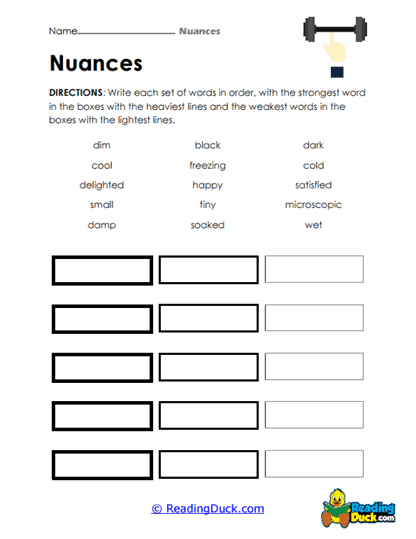
Building the Foundation - Strength Scale, Intensity Ladder, Order Up
These worksheets introduce students to the idea that words vary in strength and intensity. By organizing words along a scale, students visually see how meaning shifts from weak to strong.
This helps them understand that vocabulary is not just about definitions, but about degrees of meaning. It lays the groundwork for more advanced thinking about word choice.
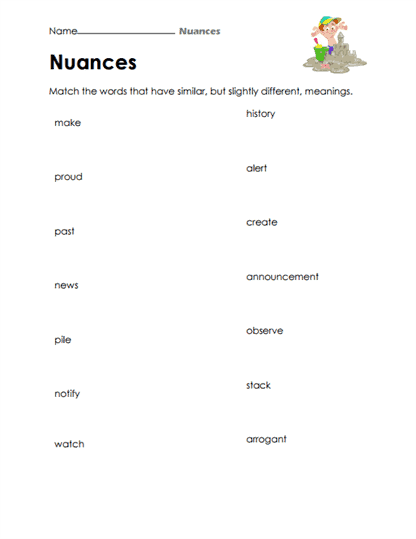
Hands-On Vocabulary Sorting - Sort & Decide, Word Match, Meaning Match
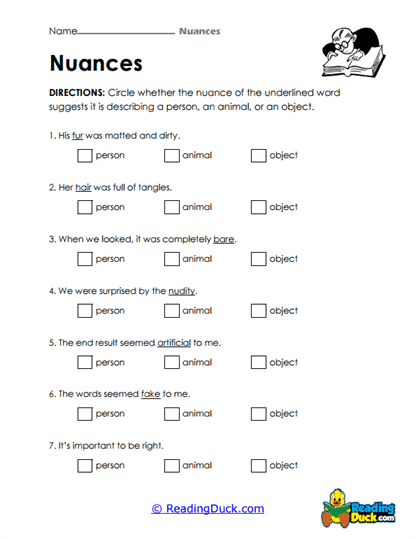
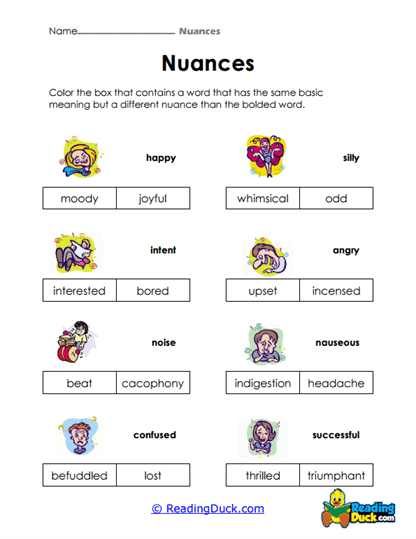
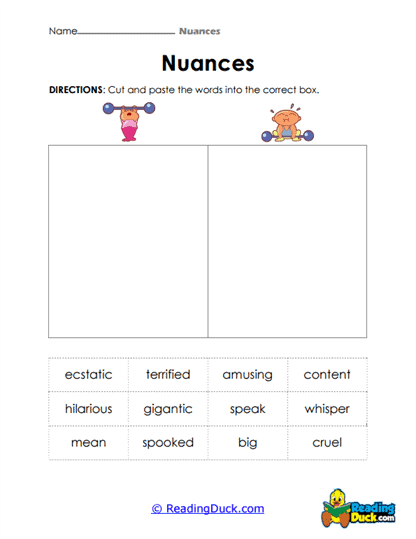
In this group, students actively sort and match words based on meaning and nuance. The hands-on approach keeps engagement high while reinforcing key concepts.
As students compare words, they begin to notice subtle differences in tone and usage. This strengthens both vocabulary and critical thinking skills.
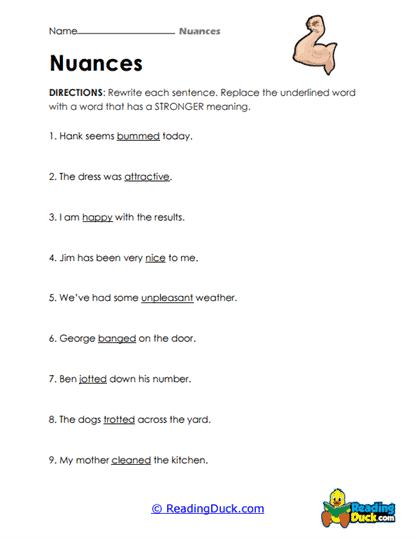
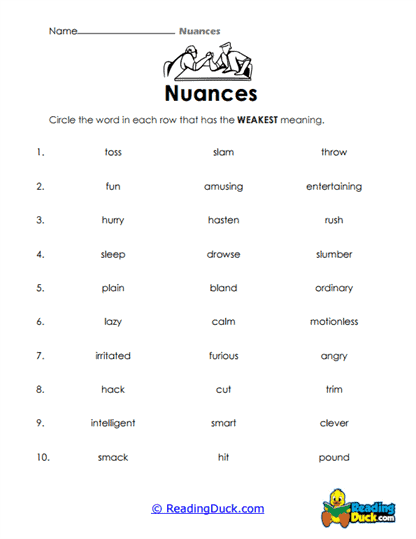
Strengthening Word Choice - Stronger Words, Weakest Pick, Nuance Shift
These worksheets focus on improving writing through better word selection. Students identify weak words and replace them with stronger, more precise alternatives.
This process helps them see how word choice affects clarity and impact. It also builds confidence in revising and improving their own writing.
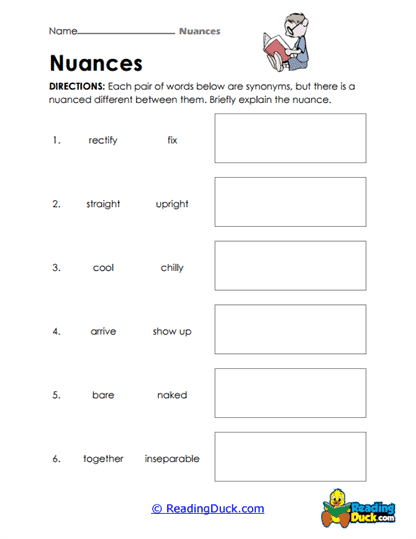
Deep Thinking and Analysis - Subtle Differences, Context Clues
Here, students take a closer look at how similar words differ and how context shapes meaning. They explain differences and determine correct usage based on sentence clues.
This encourages deeper thinking and helps students become more thoughtful readers and writers.
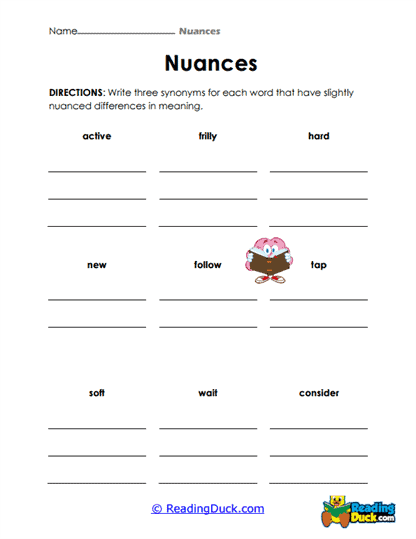
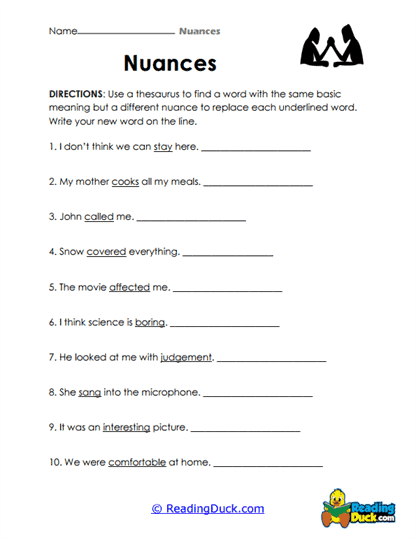
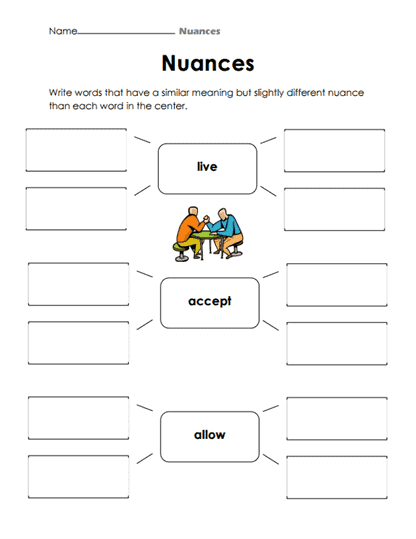
Vocabulary Expansion and Creativity - Word Swap, Synonym Builder, Word Web, Thesaurus Hunt
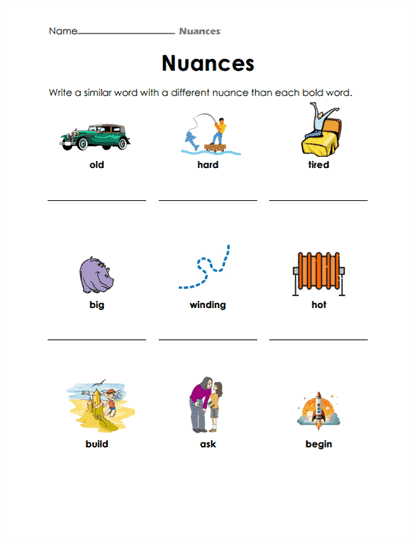
These activities expand vocabulary by encouraging exploration and creativity. Students generate their own synonyms, build word networks, and use tools like a thesaurus.
This strengthens word recall and flexibility, helping students develop a richer vocabulary they can use in real writing situations.
Instructional Tips for Teachers & Homeschool Parents
The "Volume Dial" Trick
Explain nuance as a volume dial for words. Some words are turned up high, while others are softer. This simple visual helps students quickly understand differences in intensity.
Common Student Mistakes
Students often assume all synonyms mean exactly the same thing. They may also choose words that are too weak or slightly off in tone. Another common issue is picking a word that technically fits but doesn't match the context.
Encouraging students to test words in a sentence can quickly reveal these issues.
Quick Classroom Activity
Try a "Word Upgrade Challenge." Give students a basic sentence and ask them to replace one word with a stronger or more precise option. Then have them share and compare how the meaning changes.
This simple activity builds awareness fast and keeps students engaged.
Grade Levels and Standards Alignment
These nuance worksheets strongly support vocabulary development, word choice, and language analysis skills across upper elementary and middle school grades.
Common Core State Standards (CCSS)
CCSS.ELA-LITERACY.L.4.5.C focuses on distinguishing among related words that describe similar states of mind or degrees of certainty.