If you've ever asked your students to "make their writing more powerful," you've probably seen them struggle with how to actually do that. They know what they want to say-but not how to say it in a way that sticks. That's where literary techniques like epiphora come in.
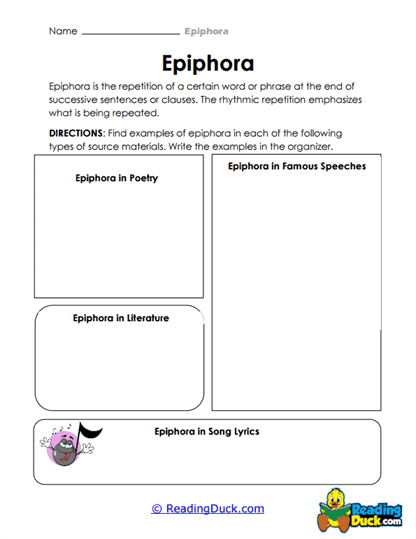
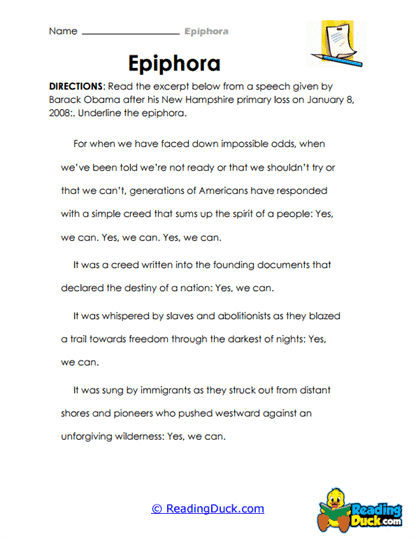
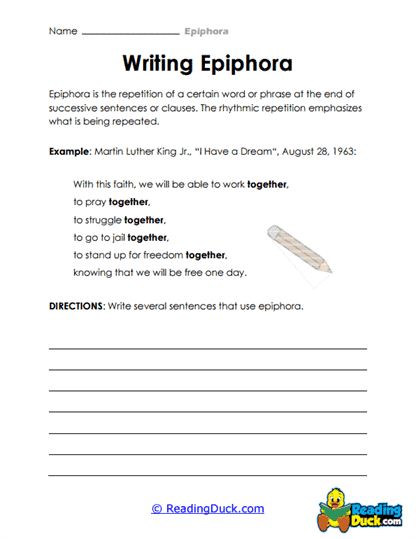
Epiphora is the repetition of words or phrases at the end of sentences or clauses. It's a simple idea, but it can make writing more rhythmic, persuasive, and memorable-especially in speeches, poetry, and strong opinion writing.
The challenge? Students often recognize repetition when they hear it, but they don't always understand how to identify it in text or use it effectively in their own writing. It can feel abstract without structured practice.
This worksheet collection breaks that barrier down step-by-step. Students move from spotting patterns to analyzing real examples-and eventually to confidently using epiphora in their own writing and speech.
Key Language Arts Concepts Covered
Understanding Epiphora
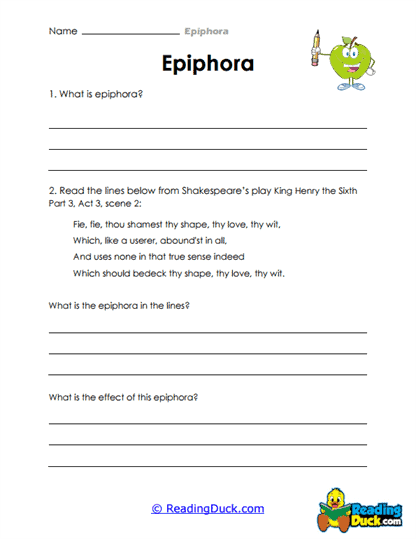
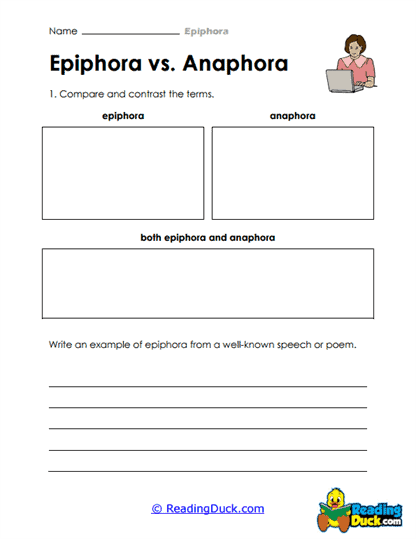
Students learn that epiphora is the repetition of the same word or phrase at the end of multiple sentences or clauses. This foundational understanding helps them distinguish it from other types of repetition, like anaphora.
Through clear examples and structured practice, students begin to see how this technique creates emphasis and strengthens meaning. It becomes less of a definition to memorize and more of a pattern they can recognize naturally.
Identifying Repetition in Text
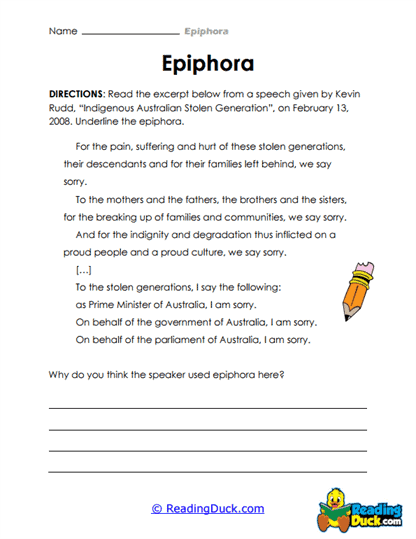
Students practice spotting repeated ending phrases in sentences, passages, and real-world examples like speeches and poetry. This builds careful reading habits and attention to detail.
As they work through examples, they begin to notice how repetition shapes tone and reinforces key ideas. This strengthens both comprehension and analytical thinking.
Analyzing Author's Purpose
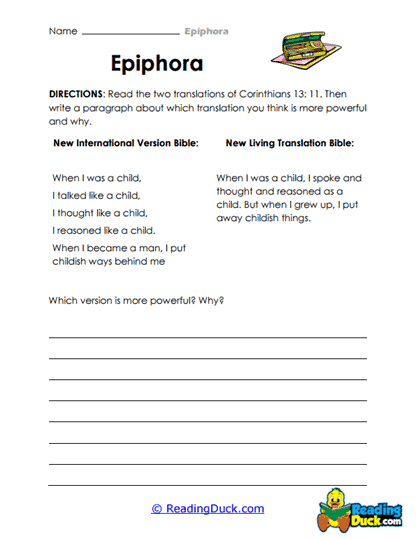
Students move beyond identification to ask: Why did the author repeat this phrase? This is where deeper thinking begins.
They explore how epiphora can create emotion, emphasize key ideas, or make a message more memorable-especially in persuasive writing and speeches.
Writing with Epiphora
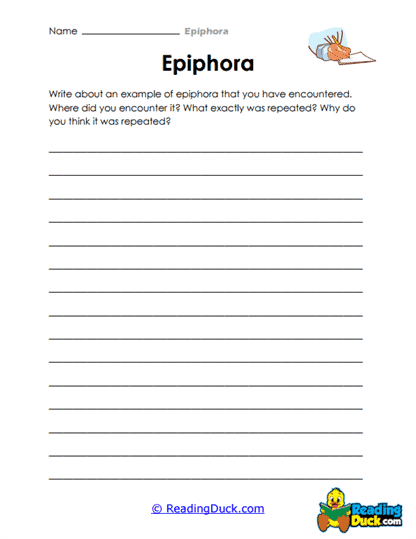
Students practice creating their own sentences using repeated ending phrases. This is where the concept really clicks.
By experimenting with their own ideas, they learn how repetition can add rhythm, clarity, and impact to their writing. It also builds confidence in using literary techniques independently.
Connecting Structure to Meaning
Students learn how repetition supports the main idea of a text. Instead of seeing it as just a pattern, they begin to understand it as a purposeful writing choice.
This helps them become stronger readers and more intentional writers.
Exploring the Worksheet Collection
Getting Started - Sentence Patterns, Writing Practice, Quick Check
These worksheets introduce epiphora in the simplest, most approachable way. Students complete sentences and practice repeating phrases at the end, helping them clearly see the pattern.
This structured approach removes confusion and builds confidence early. Students begin to hear the rhythm of repetition and understand how it strengthens ideas.
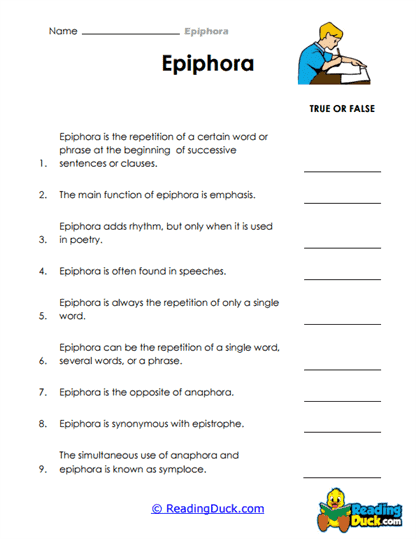
By the time they reach the quick check, they're not just guessing-they're recognizing and applying the concept with clarity.
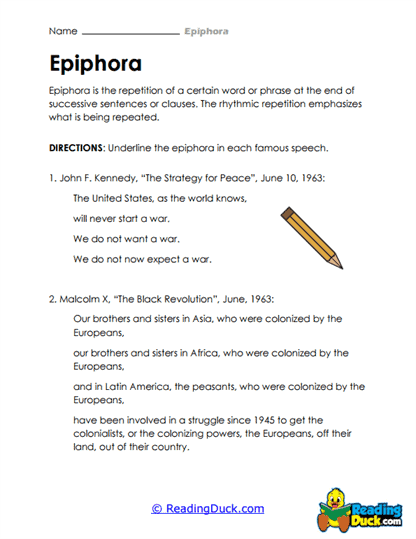
Here's where things get exciting. Students explore epiphora in speeches, poetry, and classic literature.
They analyze how powerful speakers and writers use repetition to persuade, inspire, and create mood. Activities like tracking repetition in poems or analyzing The Raven help students see how intentional and effective this technique can be.
This section builds both literary appreciation and analytical thinking skills.
Deep Thinking - Text Analysis, Author Purpose, Close Reading, Main Idea
These worksheets push students into higher-level thinking. They're no longer just finding repetition-they're explaining its purpose and impact.
Students connect repetition to tone, message, and overall meaning. They learn how epiphora supports the main idea and guides the reader's attention.
This is where reading comprehension and writing analysis truly come together.
They compare writing, evaluate effectiveness, and even plan their own speeches using repetition. Activities like pattern hunts and comparisons make learning interactive and engaging.
By the end, students aren't just recognizing epiphora-they're using it intentionally to make their own writing stronger and more memorable.
Reflection & Mastery - Final Reflection
This final step allows students to process what they've learned and explain it in their own words.
Reflection strengthens understanding and helps students internalize the purpose of repetition. It's also a great way for teachers to assess true comprehension.
Instructional Tips for Teachers & Homeschool Parents
The "Echo Effect" Trick
Tell students epiphora is like an echo at the end of a sentence. Whatever word they repeat should "echo" in the reader's mind. This simple image makes the concept click instantly.
Common Student Mistakes
Repeating words at the beginning instead of the end (mixing it up with anaphora)
Changing the repeated phrase slightly (losing the effect)
Overusing repetition so it feels forced instead of meaningful
A quick fix? Have students read their sentences out loud-it usually reveals what works.
Quick Classroom Activity
Try a "Speech Power-Up" game:
Give students a basic sentence
Ask them to rewrite it using epiphora
Share aloud and vote on the most powerful version
It's fast, engaging, and surprisingly effective.
Grade Levels and Standards Alignment
These epiphora worksheets support key language arts standards related to craft, structure, and writing techniques.
Common Core State Standards (CCSS)
CCSS.ELA-LITERACY.RL.4.4 - RL.6.4
Determine the meaning of words and phrases, including figurative and rhetorical devices like repetition
CCSS.ELA-LITERACY.RI.5.6 - RI.7.6
Analyze how authors use language to influence meaning and tone
CCSS.ELA-LITERACY.W.4.3 - W.7.3
Use effective technique and descriptive details in writing
CCSS.ELA-LITERACY.SL.5.4 - SL.8.4
Present claims and ideas using appropriate speaking techniques
TEKS (Texas Essential Knowledge and Skills)
TEKS ELA.5.10 & 6.10
Analyze literary elements and author's craft, including repetition
TEKS ELA.6.12
Compose texts using literary devices to enhance meaning
Florida B.E.S.T. Standards
ELA.5.R.3.1 / ELA.6.R.3.1
Analyze how figurative language and literary techniques impact meaning
Virginia SOL
5.5 & 6.5 Reading
Analyze author's use of language and text structure
Make sure to bookmark our website now.
Enjoy all our free reading worksheets.
Our materials adhere to the principles of the Science of Reading.