If your students tend to go big with their writing-dramatic, exaggerated, and over-the-top-they're not alone. Many students naturally lean toward exaggeration, but struggle with the opposite skill: saying less while meaning more.
That's where understatement comes in. Understatement is when a speaker or writer intentionally downplays something instead of exaggerating it. It's often used for humor, politeness, irony, or subtle emphasis.
The tricky part is that students don't always recognize tone right away. They may understand the words in a sentence, but miss the intention behind them. Without practice, understatement can feel confusing or even go unnoticed.
This worksheet collection helps students build that awareness step by step. They learn to recognize understatement, understand its purpose, and use it effectively in both writing and conversation.
Key Language Arts Concepts Covered
Understanding Understatement
Students learn that understatement is the opposite of exaggeration. Instead of making something seem bigger or more dramatic, it intentionally reduces the intensity of a situation.
This concept helps students expand their understanding of figurative language and recognize how meaning can be shaped through tone.
Recognizing Tone and Intent
Students explore how understatement can sound humorous, polite, ironic, or modest depending on the situation. They begin to see that tone plays a major role in communication.
This builds awareness of how meaning is not always stated directly, but implied through language choices.
Making these comparisons strengthens their overall grasp of figurative language.
Using Understatement in Writing
Students practice rewriting sentences and creating their own examples using understatement. This moves them from recognition to application.
Over time, they become more confident using tone intentionally in their own writing.
Analyzing Author's Purpose
Students examine why a writer might choose understatement instead of exaggeration. They consider how it can soften a statement, add humor, or create subtle emphasis.
This builds deeper comprehension and encourages critical thinking about language.
Exploring the Worksheet Collection
Getting Started with Tone - Soft Replies, Quick Responses
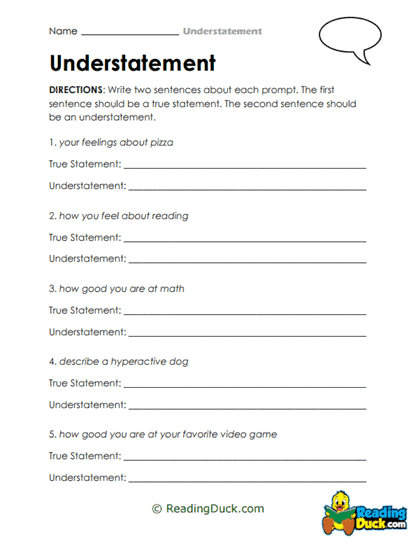
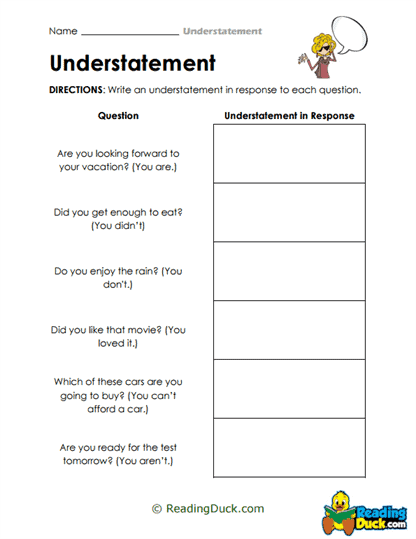
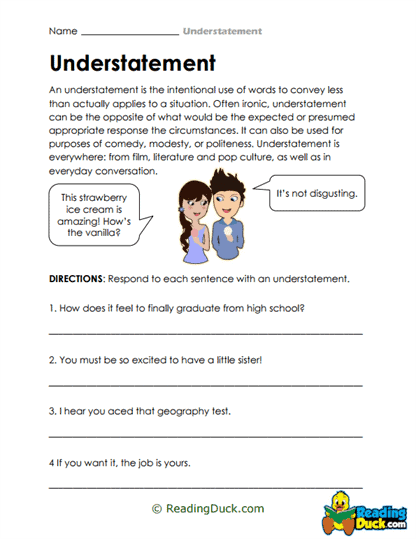
These worksheets introduce understatement in a simple and approachable way. Students respond to prompts using toned-down language, helping them understand the core idea of saying less than expected.
This early practice builds confidence and helps students hear the difference between direct and understated responses. It also strengthens everyday communication skills.
Understanding Purpose - Hidden Feelings, Purpose Practice
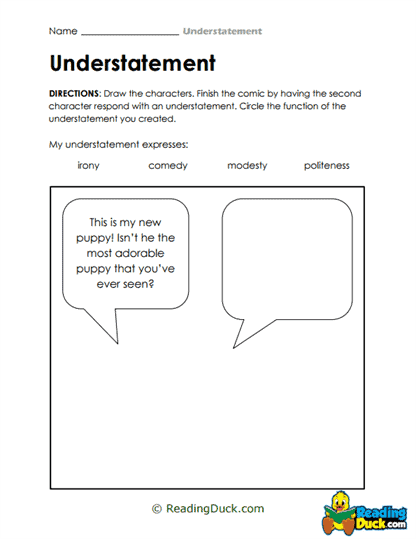
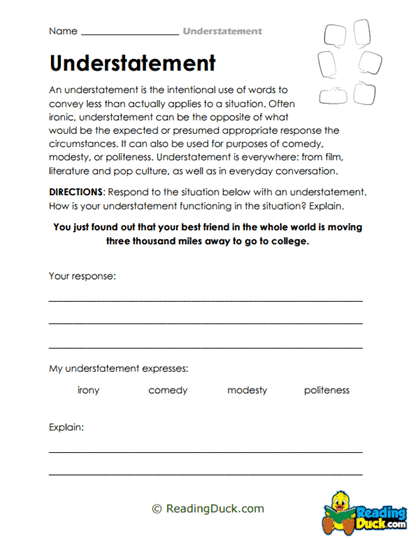
In this group, students explore why understatement is used. They identify whether it shows humor, irony, politeness, or modesty.
This helps them move beyond surface-level understanding and begin thinking about how language choices affect meaning and audience.
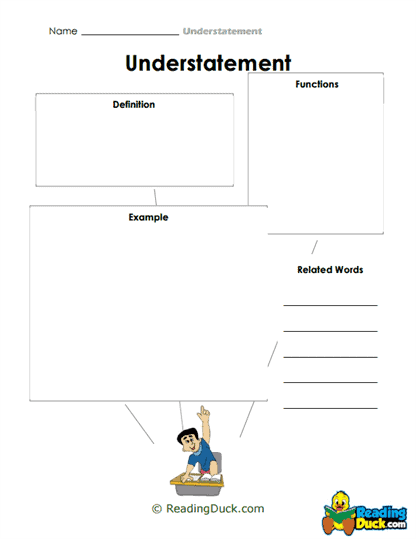
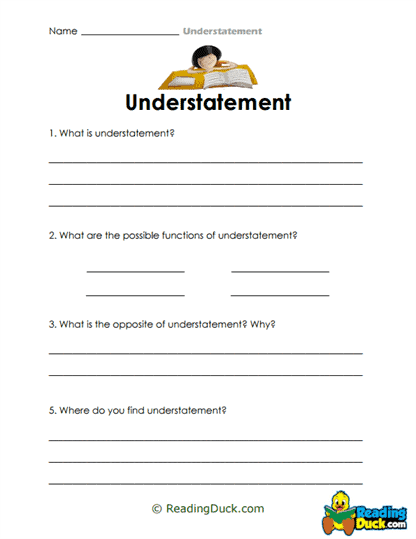
Building Core Knowledge - Core Concepts, True Check, Concept Map
These worksheets focus on defining and reinforcing key ideas. Students explain understatement in their own words, review concepts, and organize their understanding visually.
This strengthens retention and ensures students have a solid grasp of the concept before moving into more complex tasks.
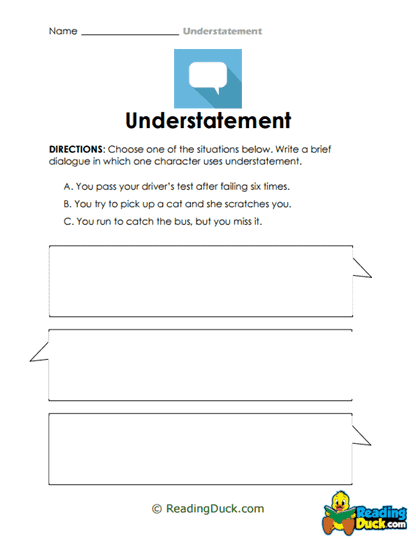
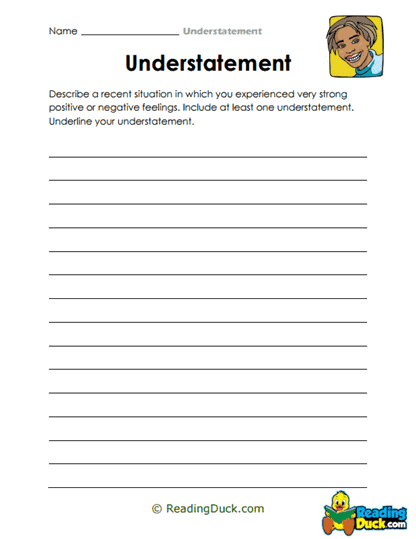
Here, students apply understatement in creative and real-life contexts. They write dialogue, respond to images, and reflect on personal experiences.
These activities make the concept more meaningful and engaging. Students begin to see how understatement works naturally in conversation and storytelling.
Reading and Analysis - Text Clues, Compare Contrast
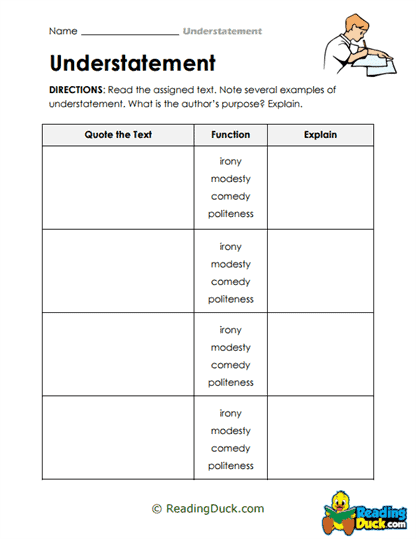
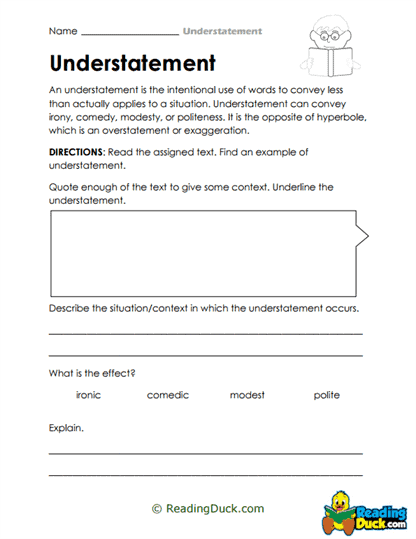
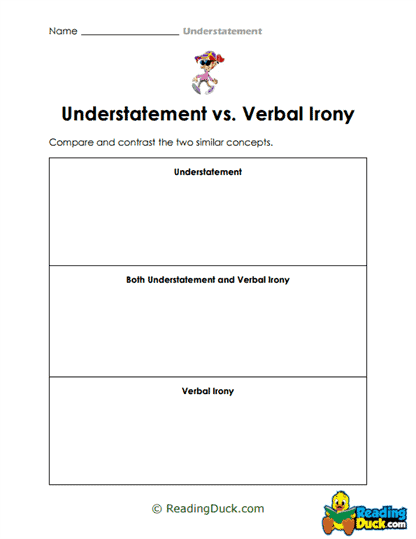
Students analyze understatement in written texts and compare it to similar concepts like verbal irony. They identify examples, explain context, and evaluate purpose.
This builds strong reading comprehension and analytical skills, helping students think like both readers and writers.
Revising and Transforming Language - Double Voice, Tone Shift
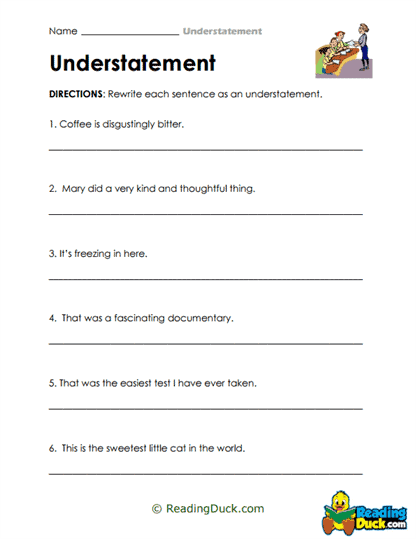
These worksheets focus on transforming language. Students compare direct statements with understated ones and rewrite exaggerated sentences.
This helps them clearly see how tone changes meaning and builds important revision skills.
Instructional Tips for Teachers & Homeschool Parents
The "Turn the Volume Down" Trick
Explain understatement as turning the volume down on a sentence. The idea is still there, but it's quieter and more controlled. This simple analogy helps students immediately understand the concept.
Common Student Mistakes
Students often confuse understatement with simply being vague. Others may accidentally exaggerate instead of tone things down. Some also struggle to keep the meaning clear while reducing intensity.
Encouraging students to compare a direct sentence with an understated version can quickly clear this up.
Quick Classroom Activity
Try a "Say It Smaller" activity. Give students a dramatic sentence and ask them to rewrite it using understatement. Then discuss how the tone changes and what effect it creates.
This quick exercise builds understanding fast and keeps students engaged.
Grade Levels and Standards Alignment
These understatement worksheets support tone analysis, figurative language, and writing development across upper elementary and middle school grades.
Common Core State Standards (CCSS)
CCSS.ELA-LITERACY.RL.4.4 through RL.7.4 focus on determining the meaning of words and phrases, including figurative language and tone.
CCSS.ELA-LITERACY.RI.5.6 and RI.6.6 emphasize analyzing how authors use language to convey meaning and perspective.
CCSS.ELA-LITERACY.W.4.3 and W.5.3 support using effective techniques and descriptive details in writing.
CCSS.ELA-LITERACY.SL.6.1 and SL.7.1 strengthen understanding of tone in spoken communication.
TEKS (Texas Essential Knowledge and Skills)
TEKS ELA.5.10 and 6.10 focus on analyzing literary elements and author's craft.
TEKS ELA.6.12 supports using literary devices, including tone, in writing.
Florida B.E.S.T. Standards
ELA.5.R.3.1 and ELA.6.R.3.1 emphasize analyzing how figurative language impacts meaning and tone.
Virginia SOL
5.5 and 6.5 focus on analyzing author's use of language and figurative techniques.
Make sure to bookmark our website now.
Enjoy all our free reading worksheets.
Our materials adhere to the principles of the Science of Reading.