
Missing Auxiliary
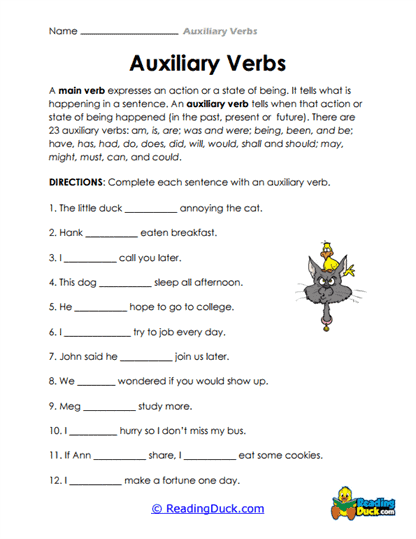
This worksheet explains auxiliary verbs, which help main verbs express time or state in sentences. It offers 12 sentences where students are tasked to fill in the blanks with the appropriate auxiliary verb (like “is,” “are,” or “has”). The examples are simple and use everyday scenarios to keep the content relatable to young learners. The activity emphasizes verbs like “am,” “is,” “have,” and “does” to reinforce understanding of verb tenses and forms.
Worksheets like this help students improve their grammar proficiency by focusing on auxiliary verbs, which are essential for proper verb conjugation and tense formation. The exercise aids in comprehension skills as students must understand the context of each sentence to choose the right verb. The repetition of common auxiliary verbs expands their vocabulary and familiarizes them with sentence structure. Overall, the task promotes critical thinking as students decide the most appropriate verb to complete each sentence.