Students often learn basic adverbs early on, but relative adverbs introduce a new layer of sentence complexity. Many students struggle to understand how words like where, when, and why connect additional information to a noun within a sentence.
Relative adverbs are used to introduce adjective clauses-groups of words that describe a noun. These clauses help writers explain place, time, or reason while keeping sentences smooth and connected.
When students learn how relative adverbs work, they gain the ability to create more detailed and sophisticated sentences. This improves both reading comprehension and writing because students can better understand how ideas are expanded and connected in complex sentences. As they refine these skills, they also improve in using articles correctly, ensuring that nouns are clearly introduced and referenced within their writing.
These Relative Adverbs Worksheets guide students through identifying relative adverbs, recognizing the clauses they introduce, combining sentences, and writing their own descriptive clauses. Through analysis and creative writing activities, students develop stronger grammar awareness and sentence-building skills.
Exploring the Worksheet Collection
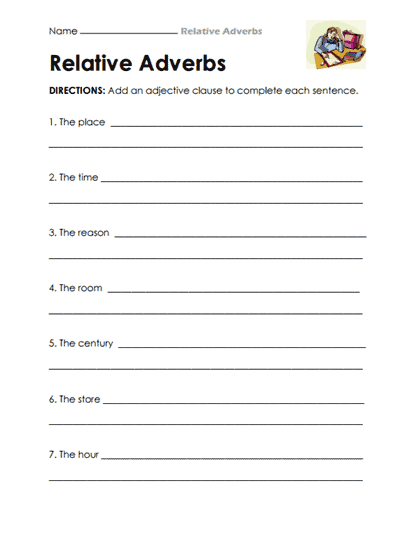
Adjective Clause Builder
Focus: Building adjective clauses with relative adverbs
Skill: Expanding sentences by adding descriptive details
Students complete sentences by adding adjective clauses introduced by relative adverbs such as where, when, or why. The worksheet strengthens sentence construction by helping students see how added clauses describe nouns like place, time, or reason. It also supports more detailed and complex writing.
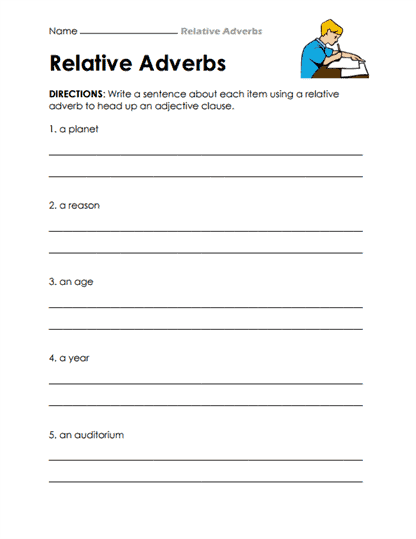
Adverb Sentence Creator
Focus: Writing sentences with relative adverbs
Skill: Using where, when, and why in original writing
Students create sentences about different people, places, times, and reasons using relative adverbs to introduce adjective clauses. The worksheet builds grammar understanding by helping students connect ideas clearly and meaningfully. It also strengthens sentence fluency and descriptive writing.
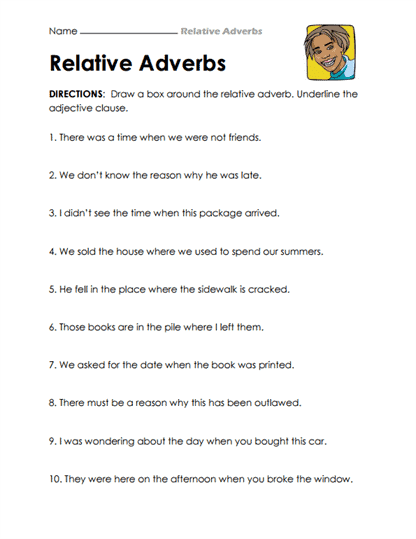
Clause Identifier
Focus: Identifying relative adverbs and adjective clauses
Skill: Recognizing how clauses are introduced in a sentence
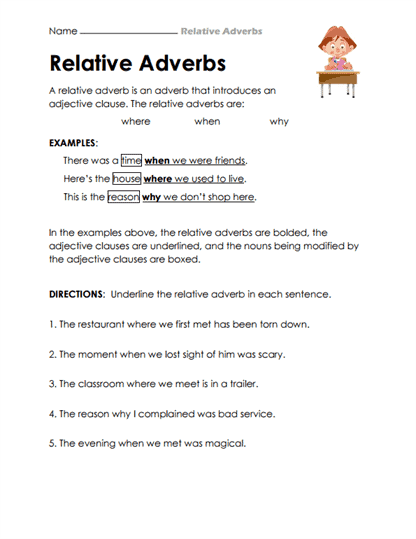
Students locate the relative adverb in each sentence and underline the adjective clause it begins. The worksheet strengthens grammar awareness by helping students see how clauses attach to nouns and add important detail. It also supports close reading and sentence analysis skills.
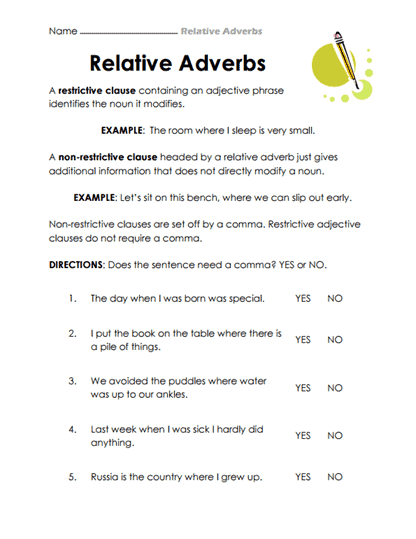
Comma Check
Focus: Punctuation with adjective clauses
Skill: Distinguishing between restrictive and nonrestrictive clauses
Students decide whether a comma is needed based on whether the clause gives essential information or extra detail. The worksheet strengthens punctuation skills and helps students understand how clause type affects sentence meaning. It also supports clearer reading and more accurate writing.
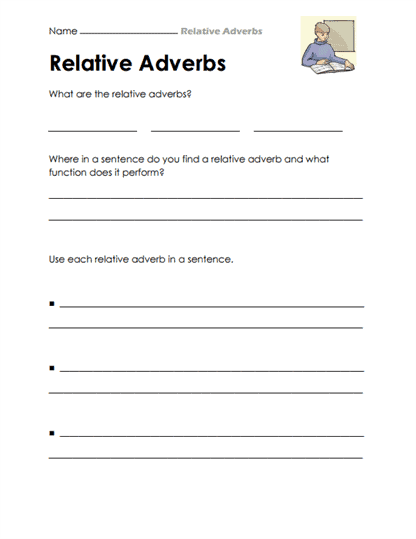
Concept Check
Focus: Understanding relative adverbs
Skill: Explaining and applying grammar concepts
Students review the three main relative adverbs and describe where they appear in a sentence and what they do. The worksheet deepens understanding by asking students to explain the rules and then use each adverb in their own sentences. It also supports grammar retention and clear written expression.
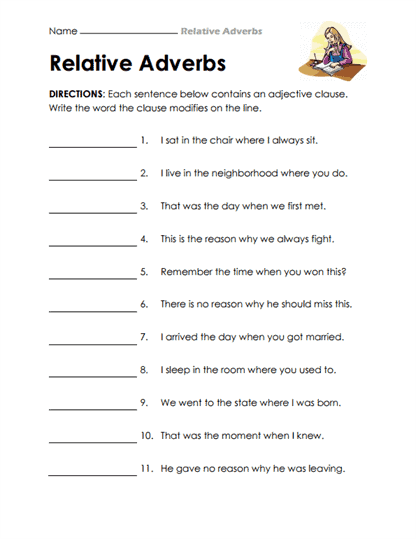
Modifier Match
Focus: Identifying what a clause describes
Skill: Matching adjective clauses to the nouns they modify
Students read sentences with relative adverb clauses and identify the noun each clause describes. The worksheet strengthens sentence analysis by helping students understand how clauses function as modifiers. It also supports clearer writing and stronger grammar comprehension.
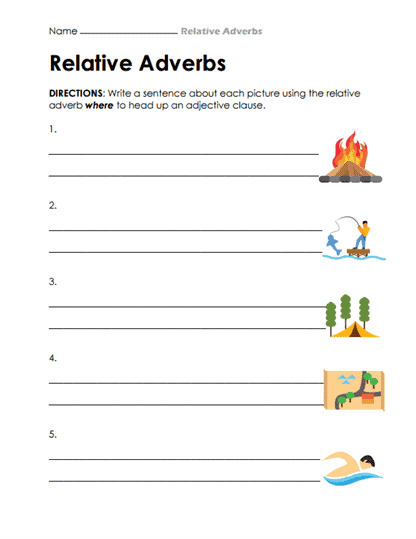
Place Sentence Creator
Focus: Using where in adjective clauses
Skill: Writing descriptive sentences about locations
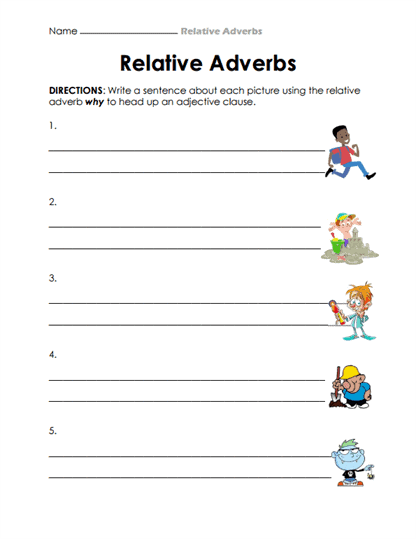
Students write sentences about pictures using where to introduce adjective clauses that describe places. The worksheet strengthens understanding of how relative adverbs connect locations with added detail. It also supports descriptive writing and grammar practice in context.
Reason Sentence Creator
Focus: Using why in adjective clauses
Skill: Explaining reasons through sentence construction
Students write sentences about pictures using why to introduce clauses that explain reasons. The worksheet helps students practice expressing cause and explanation clearly. It also strengthens grammar accuracy and supports more thoughtful writing.
Relative Adverb Finder
Focus: Recognizing relative adverbs
Skill: Identifying where, when, and why in context
Students read sentences and underline the relative adverb used in each one. The worksheet strengthens grammar awareness by helping students recognize how these words introduce adjective clauses. It also improves comprehension of more complex sentence structures.
Relative Adverb Review
Focus: Reviewing rules about relative adverbs
Skill: Evaluating true and false grammar statements
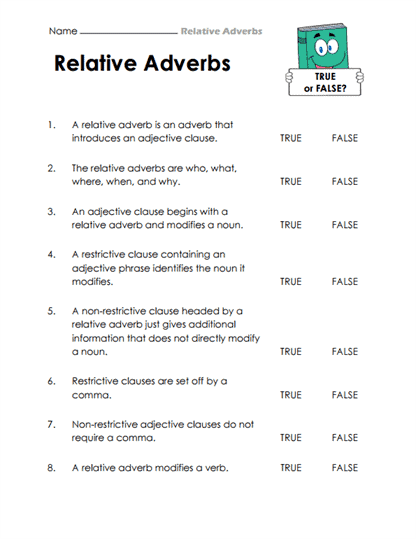
Students decide whether statements about relative adverbs are true or false. The worksheet reinforces understanding by encouraging careful analysis of grammar rules and sentence structure. It also helps students recognize how relative adverbs work in both restrictive and nonrestrictive clauses.
Sentence Combiner
Focus: Joining ideas with relative adverbs
Skill: Combining related sentences into one smoother sentence
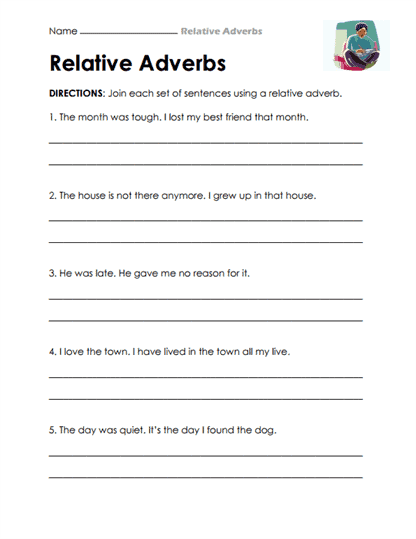
Students merge two connected sentences using where, when, or why. The worksheet strengthens writing fluency by helping students avoid repetition and connect ideas more efficiently. It also builds confidence in constructing complex sentences.
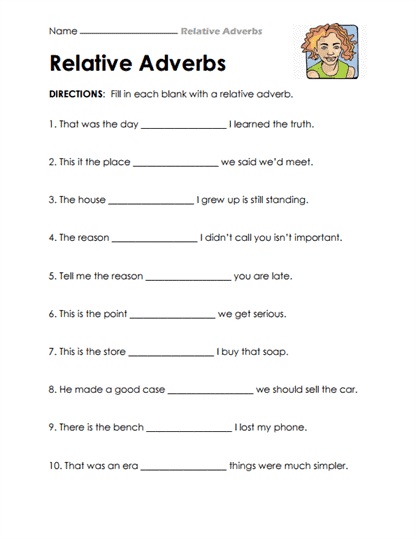
Sentence Completer
Focus: Choosing the correct relative adverb
Skill: Using context clues to select where, when, or why
Students fill in blanks with the relative adverb that best fits the meaning of the sentence. The worksheet strengthens grammar accuracy by helping students connect nouns with the correct type of descriptive clause. It also supports understanding of time, place, and reason relationships.
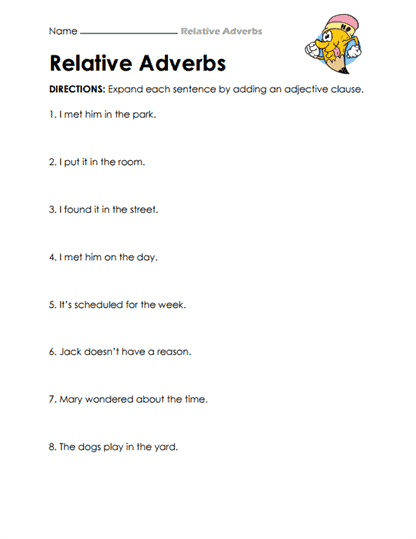
Sentence Expander
Focus: Expanding simple sentences
Skill: Adding adjective clauses with relative adverbs
Students take basic sentences and add adjective clauses beginning with where, when, or why. The worksheet helps students practice writing more detailed and precise sentences. It also strengthens understanding of how relative adverbs connect clauses to nouns.
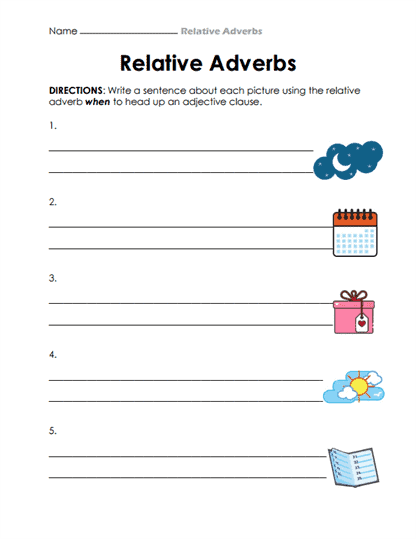
Time Sentence Creator
Focus: Using when in adjective clauses
Skill: Writing descriptive sentences about time
Students write sentences about pictures using when to introduce adjective clauses that describe moments or times. The worksheet strengthens grammar understanding by helping students express time relationships clearly. It also supports descriptive writing and sentence variety.
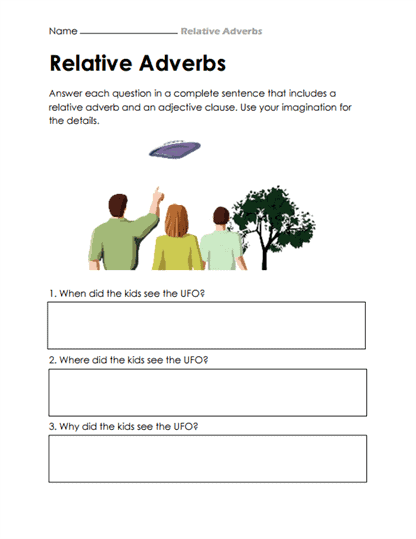
UFO Question Responses
Focus: Using relative adverbs in complete responses
Skill: Explaining time, place, and reason in imaginative writing
Students answer questions about a UFO sighting using sentences that include relative adverbs and adjective clauses. The worksheet blends grammar with creativity by asking students to describe when, where, and why events happened. It also strengthens sentence structure, storytelling, and detailed written responses.
Instructional Tips for Teachers & Homeschool Parents
The "Place, Time, Reason" Shortcut
A simple way to teach relative adverbs is to connect each one to a question:
Where → place
When → time
Why → reason
When students remember these relationships, they can quickly choose the correct relative adverb when writing or combining sentences.
Common Student Mistakes
Students learning relative adverbs often:
Confuse relative adverbs with relative pronouns like who or which
Misplace commas when working with adjective clauses
Repeated sentence analysis helps students clearly see how clauses connect to the nouns they describe.
Quick Classroom Activity
Try a "Finish the Story" activity.
Start a sentence like: This is the park where...
Students must complete the sentence with a relative clause. Then repeat with when and why.
This quick activity helps students practice building adjective clauses while strengthening descriptive writing skills.
Grade Levels and Standards Alignment
Relative adverbs and adjective clauses are typically taught and practiced in Grades 4-6, when students begin writing more complex sentences and analyzing sentence structure.
CCSS.ELA-LITERACY.L.4.1.A
CCSS.ELA-LITERACY.L.4.1.B
CCSS.ELA-LITERACY.L.5.1
TEKS ELAR 4.11.D.i
TEKS ELAR 5.11.D.i
ELA.4.C.3.1
ELA.5.C.3.1
Make sure to bookmark our website now.
Enjoy all our free reading worksheets.
Our materials adhere to the principles of the Science of Reading.