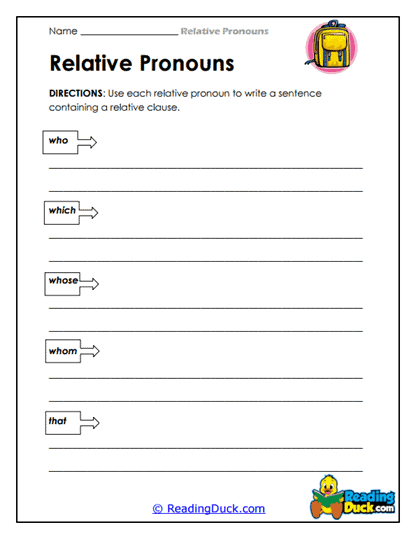
Students usually learn basic pronouns early in their grammar studies, but relative pronouns introduce a more advanced layer of sentence structure. Many learners find it confusing to understand how words like who, which, whose, whom, and that connect clauses within a sentence.
Relative pronouns introduce relative clauses (also called adjective clauses) that provide more information about a noun. For example: The student who won the award is my friend. These clauses allow writers to add details without creating multiple short sentences.
When students understand how relative pronouns work, their writing becomes clearer, smoother, and more detailed. Instead of repeating nouns or writing choppy sentences, they can connect ideas efficiently.
These Relative Pronouns Worksheets help students learn how to identify relative pronouns, build relative clauses, combine sentences, and apply pronoun rules in their own writing. Through sentence analysis, fill-in exercises, and creative writing activities, students gain confidence using these important grammar structures.
Key Language Arts Concepts Covered
Understanding Relative Pronouns
Relative pronouns are words that introduce relative clauses and connect those clauses to a noun in the sentence. The most common relative pronouns include who, whom, whose, which, and that.
For example: The teacher who helped me explained the lesson clearly.
In this sentence, who introduces the clause who helped me, which describes the noun teacher.
Learning how relative pronouns function helps students understand how complex sentences are formed and how additional details can be attached to nouns.
Relative Clauses and Sentence Expansion
Relative pronouns introduce relative clauses, which add descriptive information about a noun without starting a completely new sentence.
For example: The book that I borrowed is fascinating.
The clause that I borrowed provides more information about the book. Practicing with these structures helps students expand simple sentences into more detailed and interesting ones.
Choosing the Correct Relative Pronoun
Different relative pronouns serve different purposes.
Who / whom refer to people
Whose shows possession
Which refers to things or animals
That can refer to people or things in restrictive clauses
Understanding these distinctions helps students choose the most appropriate pronoun and avoid grammatical errors.
Reducing Repetition in Writing
Relative pronouns allow writers to combine sentences and avoid repeating nouns.
For example:
The boy is my neighbor. The boy rides a bike every day.
can become
The boy who rides a bike every day is my neighbor.
Learning to combine sentences this way helps students improve sentence flow, clarity, and writing variety.
These worksheets introduce students to the most common relative pronouns and explain how they function in sentences.
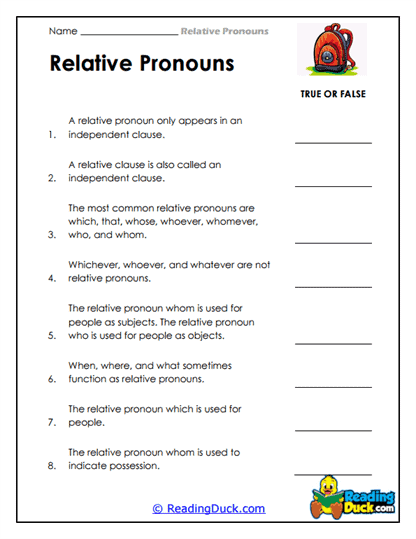
Students begin by matching pronouns with their definitions and identifying relative pronouns within sentences. Review exercises reinforce key grammar rules and help students develop a clear understanding of how these pronouns connect clauses to nouns.
This foundational practice strengthens grammar recognition skills and sentence structure awareness, preparing students for more advanced sentence construction activities.
Identifying Relative Clauses - Clause Identifier, Pronoun Function Finder
In this group of worksheets, students focus on analyzing sentence structure by identifying relative clauses and understanding how they connect to nouns.
Students underline clauses introduced by relative pronouns and determine when certain words function as relative pronouns within sentences. Comparing sentence pairs helps learners recognize subtle differences in grammar usage.
These exercises strengthen sentence analysis skills and reading comprehension, helping students recognize how clauses function in complex sentences.
Building & Completing Relative Clauses - Clause Builder, Pronoun Completion, Pronoun Fill-In, Pronoun Practice Fill-In, Multiple Choice Practice, Clause Completion
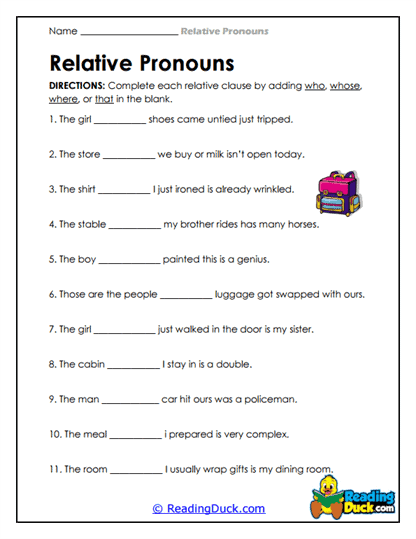
These worksheets give students extensive practice using relative pronouns to complete and construct relative clauses.
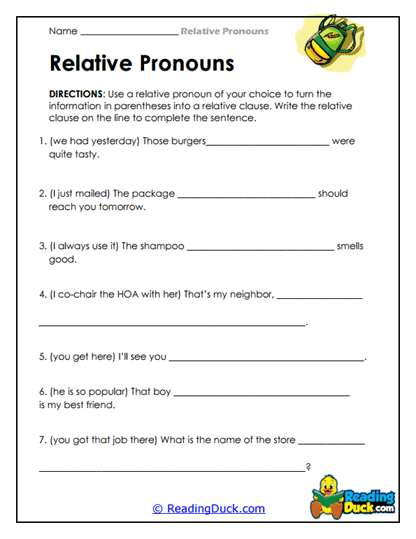
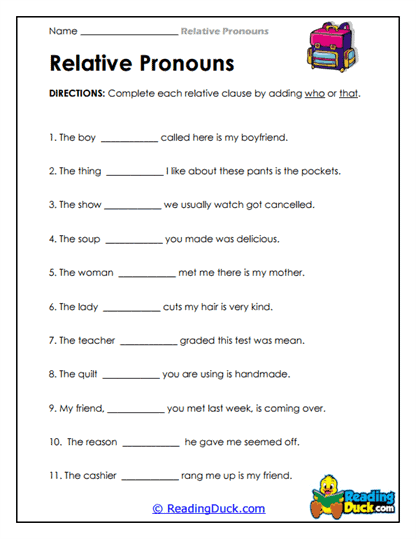
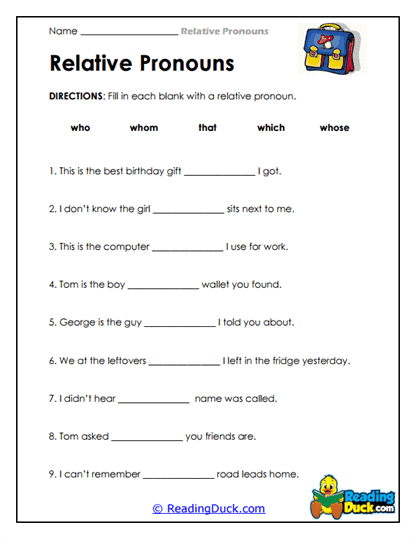
Students fill in missing pronouns, choose the correct pronoun from multiple options, and transform phrases into relative clauses within sentences. Word banks and contextual clues guide students toward the correct grammatical choices.
Through repeated practice, students learn how relative pronouns connect clauses smoothly while maintaining grammatical accuracy.
Sentence Construction & Writing Practice - Sentence Combiner, Sentence Creator
This group of worksheets encourages students to actively apply their grammar knowledge in writing.
Students combine pairs of sentences into one using relative pronouns and write original sentences that include clauses with who, whom, whose, which, and that.
These activities help students develop stronger writing skills by improving sentence flow, clarity, and descriptive detail.
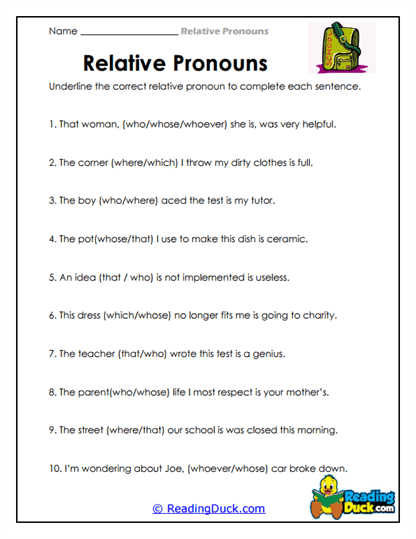
These worksheets help students strengthen their editing and proofreading skills.
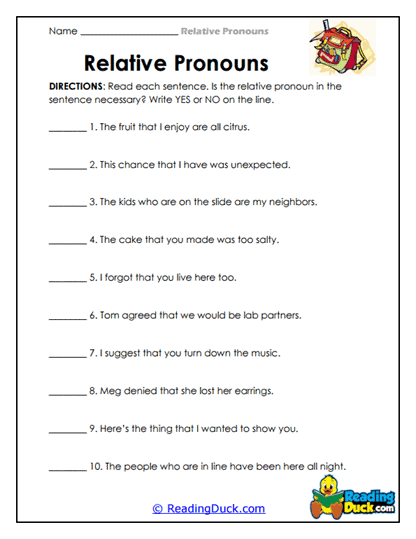
Students choose the correct pronoun from similar options and determine whether a relative pronoun is necessary within a sentence. These exercises encourage careful reading and help students recognize when words can be removed for clearer, more concise writing.
By analyzing sentence structure closely, students gain greater control over grammar and sentence efficiency.
Instructional Tips for Teachers & Homeschool Parents
The "Person or Thing?" Shortcut
When students are unsure which relative pronoun to use, teach them to ask a quick question:
Is the noun a person? → Use who / whom
Is it a thing or object? → Use which or that
This quick decision-making strategy helps students choose the correct pronoun more confidently.
Common Student Mistakes
Students learning relative pronouns often struggle with:
Confusing who and whom
Using which when that might be more appropriate
Forgetting that whose indicates possession
Practicing sentence combining and clause building helps students master these distinctions.
Quick Classroom Activity
Try a "Sentence Detective" activity.
Write a simple sentence on the board such as: The dog barked loudly.
Ask students to add a relative clause using a pronoun:
The dog that lives next door barked loudly.
Students enjoy inventing creative clauses, and the activity reinforces how relative pronouns expand sentences.
Grade Levels and Standards Alignment
Relative pronouns and relative clauses are typically taught in Grades 4-6, when students begin working with more advanced sentence structures.
Common Core State Standards (CCSS)
CCSS.ELA-LITERACY.L.4.1.A
Students demonstrate command of standard English grammar and usage when writing or speaking.
CCSS.ELA-LITERACY.L.4.1.B
Students use relative pronouns (who, whose, whom, which, that) and relative adverbs correctly.
CCSS.ELA-LITERACY.L.5.1
Students demonstrate command of grammar conventions in increasingly complex sentence structures.
These worksheets help students practice identifying relative pronouns, constructing clauses, and combining sentences effectively.
Texas Essential Knowledge and Skills (TEKS)
TEKS ELAR 4.11.D.i
Students edit writing for correct grammar and sentence structure.
TEKS ELAR 5.11.D.i
Students apply conventions of standard English grammar in writing and revision.
Relative pronoun practice supports these standards by helping students develop clearer sentence connections and stronger grammatical accuracy.
Florida B.E.S.T. Standards
ELA.4.C.3.1
Students apply correct grammar and usage in writing.
ELA.5.C.3.1
Students strengthen sentence structure and grammar conventions in written communication.
Relative pronoun instruction helps students write more complex, descriptive sentences and avoid repetitive structures.
Make sure to bookmark our website now.
Enjoy all our free reading worksheets.
Our materials adhere to the principles of the Science of Reading.