Compound Predicate Worksheets That Help Students Write Better Sentences
If you've ever read student writing that sounds like this:
"The dog ran. The dog barked. The dog jumped."
...you already know the problem.
Students often write short sentences because they don't yet know how to combine actions. That's where compound predicates come in, using words like conjunctions for compound sentences to join ideas smoothly and naturally. Instead of repeating the subject, students learn to connect actions into one clear, flowing sentence.
A compound predicate happens when one subject performs two or more actions, usually connected by words like and, or, or but.
The dog ran across the yard and barked at the mail carrier.
When students learn this structure, two things start to improve quickly:
their reading comprehension (they understand sentence structure better)
their writing fluency (their sentences sound smoother and more natural)
This compound predicate worksheet collection walks students step-by-step through identifying, analyzing, and writing compound predicates so they can confidently use them in their own writing.
Exploring the Worksheet Collection
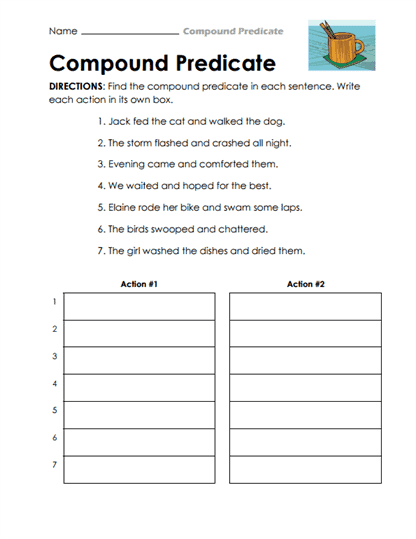
Action Finder
Focus: Identifying compound predicates
Skill: Separating the two actions performed by one subject
Students find the compound predicate in each sentence and break it into two individual actions. The worksheet strengthens grammar and sentence analysis by helping students see how one subject can perform multiple actions. It also supports clearer writing by building understanding of sentence structure.
Picture Predicates
Focus: Writing compound predicates from visual prompts
Skill: Creating sentences with two actions performed by the same subject
Students use pictures to write original sentences that include compound predicates. The worksheet makes grammar practice more engaging while building vocabulary, sentence development, and descriptive writing skills. It also reinforces how compound predicates work in natural sentence construction.
Predicate Basics
Focus: Understanding compound predicates
Skill: Recognizing when one subject performs multiple actions
Students learn that a compound predicate occurs when one subject has more than one verb, often joined by conjunctions like and, or, or but. The worksheet strengthens grammar foundations by helping students identify predicates and understand sentence structure. It also improves reading comprehension and writing by showing how ideas connect smoothly within a sentence.
Predicate Checker
Focus: Simple versus compound predicates
Skill: Classifying sentence predicates accurately
Students analyze sentences to decide whether each predicate is simple or compound. The worksheet builds grammar awareness and close reading skills by requiring students to identify verbs and determine how many actions the subject performs. It also supports editing and revision by sharpening sentence analysis.
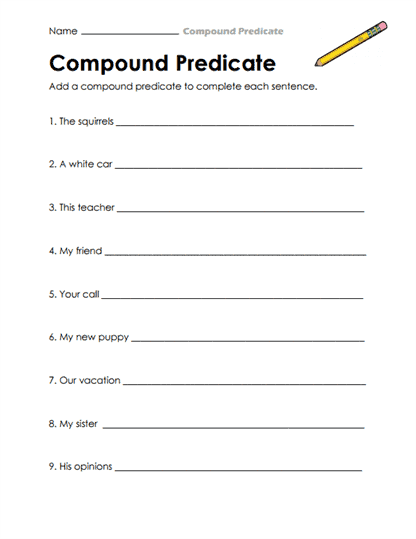
Predicate Creator
Focus: Building compound predicates
Skill: Completing sentence starters with two related actions
Students use sentence starters and add two actions for the same subject to form compound predicates. The worksheet encourages active grammar application while strengthening vocabulary, conjunction use, and sentence construction. It also helps students grow more confident in creative writing.
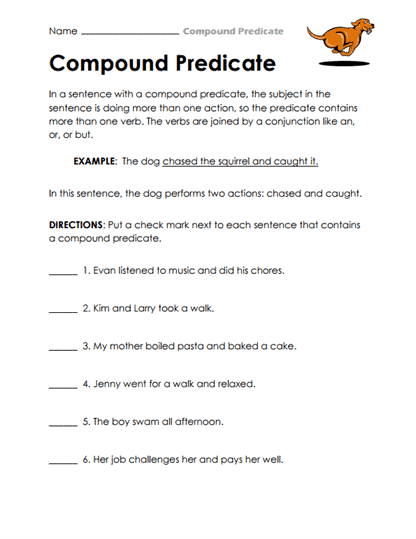
Predicate Detective
Focus: Detecting compound predicates in sentences
Skill: Evaluating sentence structure closely
Students read sentences and decide whether each one contains a compound predicate. The worksheet strengthens grammar awareness by having students examine subjects, verbs, and conjunctions carefully. It also helps students become stronger editors and more accurate readers.
Predicate Practice
Focus: Combining sentences with the same subject
Skill: Rewriting sentences to create compound predicates
Students merge two sentences into one by joining the actions under a single subject. The worksheet improves sentence fluency and helps students avoid repetition. It also supports reading and writing development through stronger sentence structure.
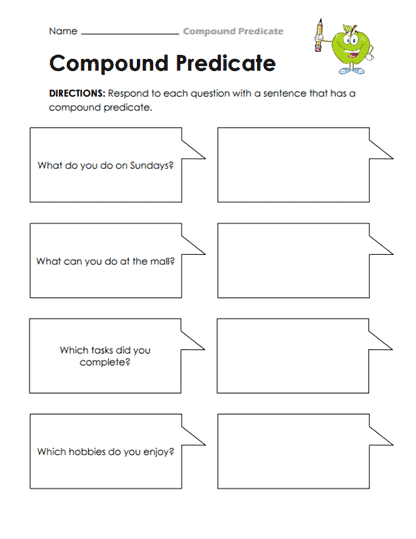
Predicate Responses
Focus: Using compound predicates in responses
Skill: Answering questions with clear, multi-action sentences
Students answer questions using sentences that contain compound predicates. The worksheet connects grammar to everyday communication by helping students express more than one action in a single sentence. It also builds writing fluency and confidence in sentence construction.
Response Builder
Focus: Applying compound predicates in open-ended writing
Skill: Writing complete responses with connected actions
Students respond to everyday prompts with sentences that include compound predicates. The worksheet supports creative application of grammar while strengthening sentence fluency and written communication. It also helps students expand their ideas into more complete responses.
Second Action
Focus: Completing compound predicates
Skill: Adding a logical second verb to a sentence
Students are given a subject and one action, then add a second action to create a compound predicate. The worksheet strengthens sentence-building skills by encouraging thoughtful verb choice and logical connections between actions. It also supports more dynamic and descriptive writing.
Sentence Builder
Focus: Expanding simple sentences
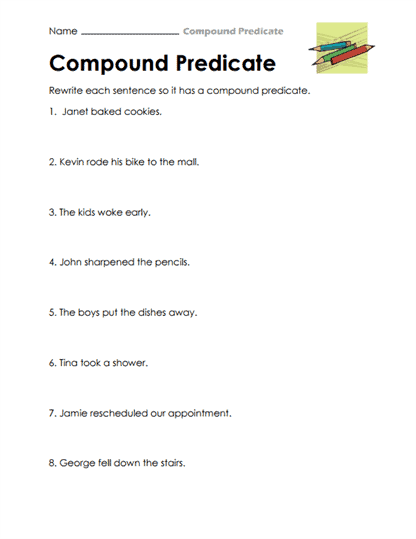
Skill: Rewriting sentences to include compound predicates
Students take simple sentences and add another action for the same subject. The worksheet helps students move beyond short sentences and practice writing with more detail and variety. It strengthens grammar knowledge and supports clearer written expression.
Sentence Combiner
Focus: Joining related actions into one sentence
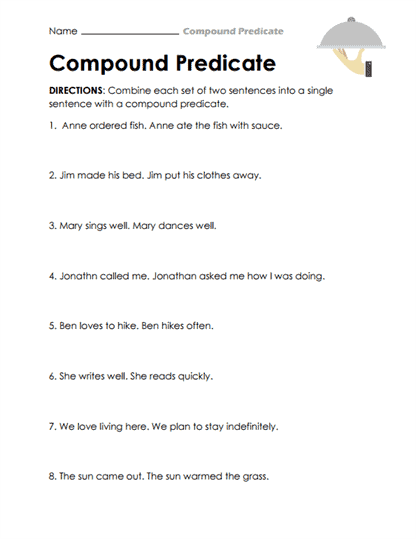
Skill: Combining sentences using compound predicates
Students combine two short sentences with the same subject into one sentence using a compound predicate. The worksheet improves writing fluency by teaching students to reduce repetition and connect ideas smoothly. It also builds stronger grammar and sentence variety.
Subject or Predicate
Focus: Distinguishing compound subjects from compound predicates
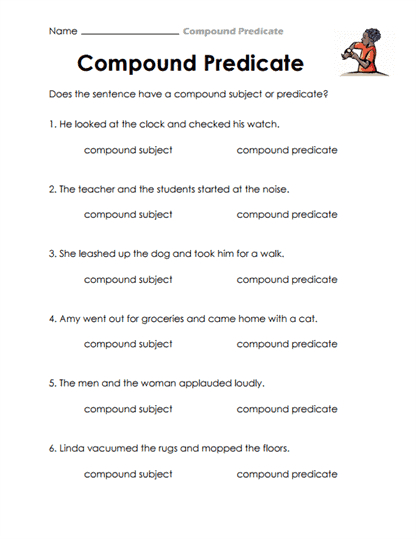
Skill: Analyzing sentence parts accurately
Students decide whether each sentence has a compound subject or a compound predicate. The worksheet deepens understanding of sentence structure by requiring close analysis of both subjects and verbs. It also strengthens grammar comprehension, editing skills, and reading accuracy.
Verb Expander
Focus: Expanding simple predicates
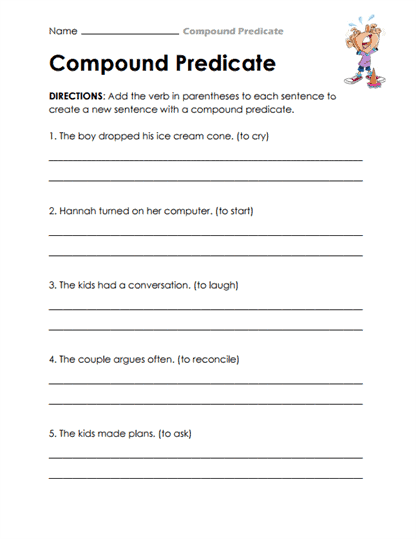
Skill: Adding a second verb to form a compound predicate
Students use a provided verb to expand a sentence so the subject performs two actions. The worksheet builds grammar awareness by showing how simple predicates can become compound ones. It also strengthens verb recognition, conjunction use, and expressive sentence writing.
Verb Pairing
Focus: Using paired verbs in sentence writing
Skill: Constructing sentences with compound predicates
Students receive two verbs and use both in a sentence with one subject performing both actions. The worksheet strengthens verb selection and sentence structure while encouraging meaningful sentence creation. It also improves writing fluency by helping students combine actions effectively.
Instructional Tips for Teachers & Homeschool Parents
The "One Person, Many Chores" Trick
Tell students to imagine one person doing several things:
"Maria washed the dishes and cleaned the table."
One person. Multiple actions.
That's a compound predicate.
Once students picture it this way, the concept usually clicks.
Common Student Mistakes
Watch for these common issues:
Students forget the conjunction connecting the verbs
Students confuse compound subjects with compound predicates
Students accidentally write two sentences instead of combining actions
Quick sentence-combining practice helps fix most of these problems.
Quick Classroom Activity
Try a Live Action Predicate Game.
Choose one student as the subject.
Give them two actions: jump and clap.
The class describes it:
"Ethan jumped and clapped."
Students love acting it out-and they remember the grammar concept much faster.
Grade Levels and Standards Alignment
Compound predicate instruction typically appears within sentence structure and grammar standards for upper elementary grades.
These worksheets best support Grades 3-5, when students begin learning to expand and combine sentences.
CCSS.ELA-LITERACY.L.3.1.I
CCSS.ELA-LITERACY.L.4.1.F
CCSS.ELA-LITERACY.L.5.1.B
TEKS 3.11.D
TEKS 4.11.D
SOL 3.11
SOL 4.11
ELA.3.C.1.1
ELA.4.C.1.1
Make sure to bookmark our website now.
Enjoy all our free reading worksheets.
Our materials adhere to the principles of the Science of Reading.