
Epicenter Explained
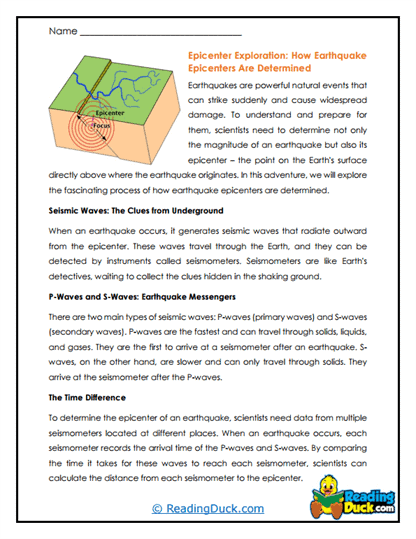
This passage explains how scientists determine the epicenter of an earthquake, which is the point on Earth’s surface directly above where the earthquake originates. It describes how P-waves and S-waves travel through the Earth and reach seismometers at different times, allowing scientists to calculate the distance to the epicenter. The time difference between the arrival of these waves at multiple seismometers helps pinpoint the exact location of the earthquake’s epicenter. These methods are crucial for understanding not only the strength but also the source of an earthquake.
This passage improves students’ scientific literacy by introducing them to terms like “seismometers” and “P-waves.” It challenges students’ comprehension skills as they must follow a process of calculation and interpretation of seismic data. Students also strengthen their critical thinking by understanding how different scientific tools work together to solve real-world problems. Finally, the precise language in the text serves as a model for enhancing grammar and syntax.
Questions:
Answer Keys: