
Canyon History
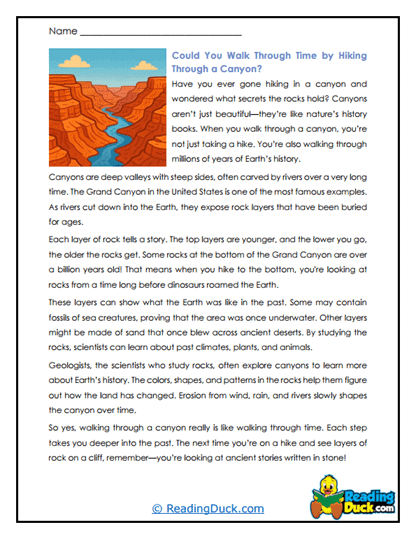
Standing at the edge of a canyon is like looking through a window into Earth’s past. This reading passage explores how rivers slowly carve deep canyons while exposing layers of ancient rock that formed millions of years ago. Students learn why the deepest layers are often the oldest, how erosion shapes the landscape over time, and how geologists study exposed rock formations to uncover clues about ancient climates, environments, and life on Earth. By the end of the passage, readers understand why canyons are some of the world’s greatest natural history books.
This engaging nonfiction text builds reading comprehension while introducing students to one of geology’s most powerful teaching tools. Readers practice following sequences of events, identifying cause-and-effect relationships, and interpreting scientific evidence from natural landscapes. Vocabulary such as erosion, canyon, river, rock layers, geologist, and landform supports both academic language development and science learning. The vivid descriptions encourage students to imagine Earth’s history unfolding one layer at a time.
Questions:
Answer Keys: