
Carbon Dating Short Answer
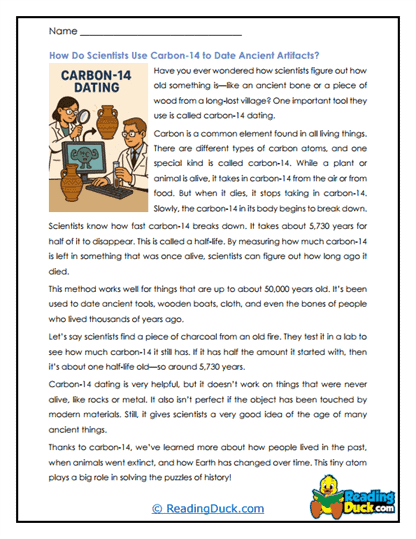
How can scientists estimate the age of an ancient campfire, wooden tool, or piece of cloth? This reading passage explains how carbon-14 dating helps answer those questions. Students discover that all living things absorb carbon while they’re alive, and after they die, the amount of carbon-14 slowly decreases at a predictable rate. By measuring what remains, scientists can estimate the age of materials that were once living. The passage also explains why carbon dating works best for younger archaeological discoveries and why other dating methods are needed for much older rocks.
As students read, they strengthen informational reading skills by following scientific explanations step by step and connecting evidence with conclusions. The passage introduces vocabulary such as carbon-14, half-life, radioactive decay, artifact, archaeology, and dating method in language that’s easy to understand. By the end, students gain a greater appreciation for how chemistry, physics, and geology work together to uncover stories from Earth’s past.