
Diction Dynamics
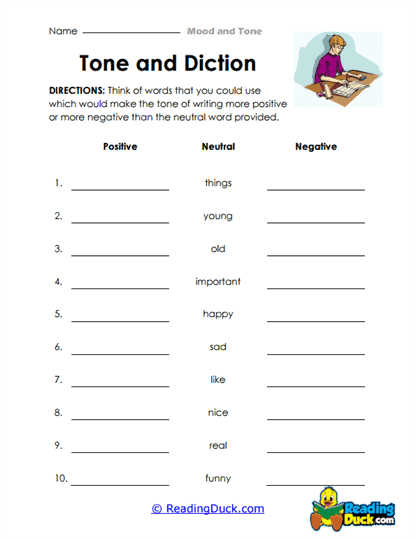
In this worksheet, students examine how diction affects tone by thinking of words with positive or negative connotations compared to neutral terms. Each neutral word, such as “things” or “young,” has space beside it for positive and negative alternatives, encouraging students to explore how word choice influences a reader’s interpretation. This exercise requires students to consider how small shifts in vocabulary can drastically alter the perception of a text. The activity promotes a deeper understanding of connotation versus denotation.
By working with diction variations, students develop a more nuanced understanding of word choice and its impact on tone. This skill is crucial for recognizing subtleties in both reading and writing, as students learn how authors evoke different feelings with specific language. Practicing with diction helps them become more intentional writers, selecting words that accurately convey their intended message. Such exercises also support vocabulary growth, allowing students to articulate their thoughts with greater precision.