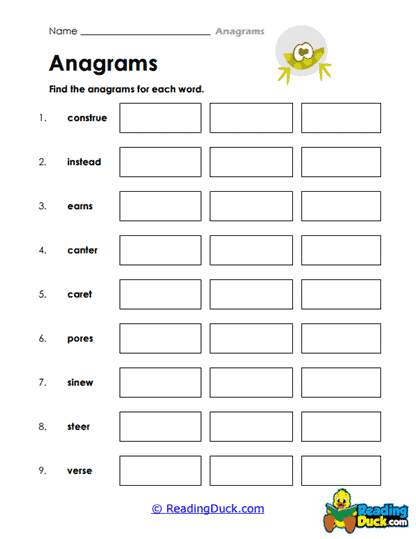
Anagrams are like word puzzles with a secret handshake: you take the letters in a word or phrase, give them a playful shuffle, and-ta-da!-you've made something new. Mastering anagrams helps students notice letter patterns, syllables, and spelling rules while flexing creative problem-solving muscles. This collection is designed to build skills step-by-step-from simple, short-word scrambles to multi-word challenges-so learners grow confident with every page. You'll find a variety of themes and formats to keep things fresh and fun, and each worksheet comes ready to print and go. Several favorites in this set include Anagram Adventures, Phrase Puzzles, Sentence Shuffle, and Word Twist, so there's always a just-right challenge on deck.
Anagram practice strengthens communication by deepening understanding of how words are formed, how sounds map to letters, and how meaning can change when letters move around. As students play with rearrangements, they sharpen spelling accuracy and vocabulary recall-skills that flow straight into reading fluency and clearer writing. It's language awareness in motion: learners compare options, test hypotheses, and make precise choices about letters and words. That thoughtful tinkering turns into confidence when drafting sentences, choosing stronger words, and decoding unfamiliar text.
We've structured this collection so students begin with shorter letter sets and work up to phrases and sentences. Early pages emphasize recognition and sorting; later pages weave in clues, categories, and context so kids apply what they know in new ways. You can use the worksheets independently, in centers, or as quick warm-ups-each format reinforces the same core skill from a different angle. By the end, students don't just "do" anagrams; they understand why anagrams work and how that knowledge makes them better readers and writers. This is more than worksheets-this is wordplay mastery in action!
Looking At Each Worksheet
Anagram Adventures
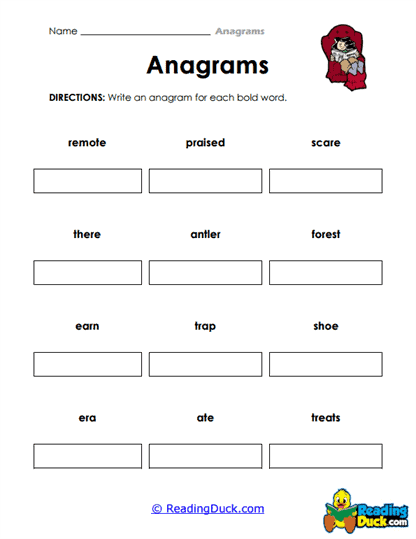
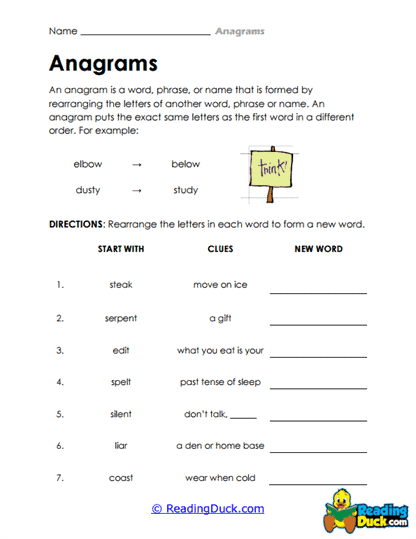
Students journey through themed mini-quests where each stop hides a scrambled word to solve. As they unscramble, they practice spotting letter patterns and building accurate spellings-a core anagram superpower. Picture it like a treasure map, except the X marks the spot where vowels and consonants team up to form real words. Use it as a station activity or a fast finisher challenge. Bonus idea: let students draw a "passport" stamp for each solved word.
Anagram Challenge
This page turns up the heat with timed rounds and trickier letter sets for competitive fun. Learners learn to scan letters, test swaps, and confirm spellings, cementing how anagrams are constructed. Think of it as speed chess for words-strategy meets split-second choices. Run it as a class tournament or a solo personal-best tracker. Bonus idea: award "Most Creative Word" for any legitimate extra anagram students discover.
Anagram Mania
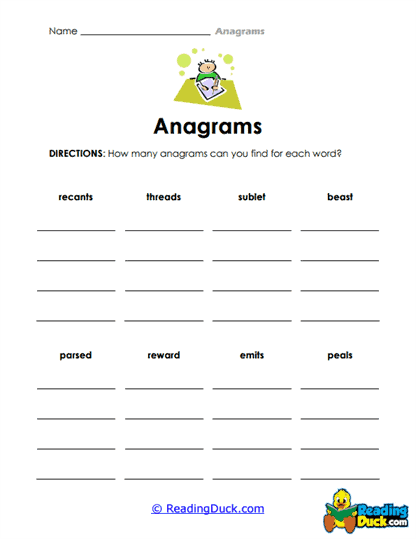
A lively mix of quick hits, from mini-scrambles to longer brainteasers, keeps students guessing. The variety trains flexible thinking about letter positions and common patterns like -ing or -er. It's like a word gym circuit: short reps, then a big lift! Great for homework or warm-ups. Bonus idea: have kids color-code consonant clusters they rely on most.
Bold Wordplay
Here, students sort scrambled words into categories-animals, foods, or school stuff-after solving them. Categorizing builds semantic networks, helping anagram skills flow into broader vocabulary knowledge. Imagine your brain's filing cabinet getting sleek new labels. Try it as a small-group race: solve, then sort! Bonus idea: invite students to add one new word to each category.
Clue Codewords
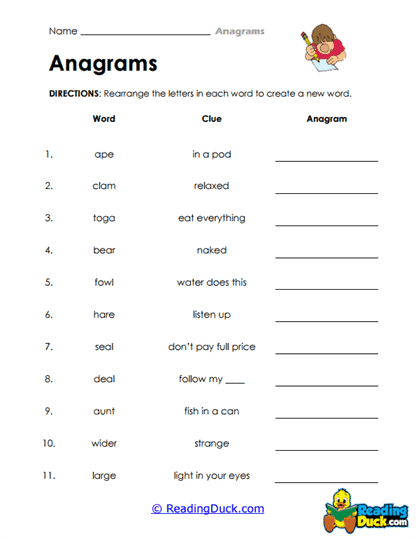
Each scramble comes with a clue, so learners connect meaning to the rearranged letters. That marriage of context and patterning is the heart of strong anagram work. It's basically a word escape room where vocabulary is the master key. Use it to model "guess-check-confirm" strategies for decoding. Bonus idea: students write their own clues and swap with a partner.
Double Wordplay
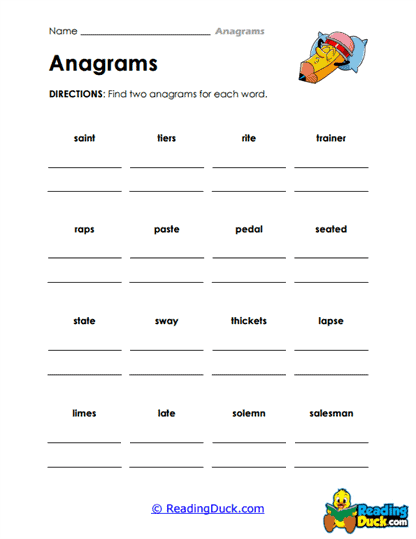
Students solve two related anagrams that unlock a final mini-puzzle. Linking pairs reinforces recognition of shared roots, prefixes, or endings. It's like a buddy system for words-two brains, one breakthrough! Perfect for partners or centers. Bonus idea: challenge pairs to invent a riddle that uses both solved words.
Name Games
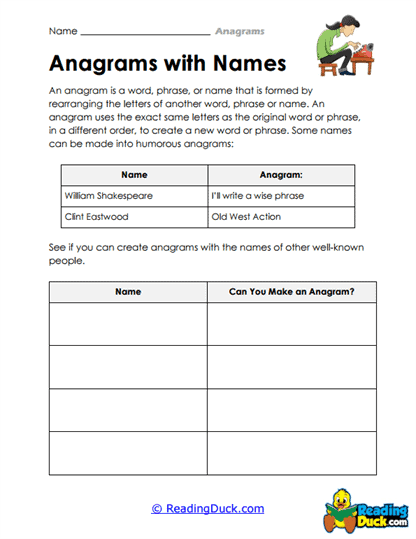
Learners turn class names (first or last) into playful anagrams and compare results. They'll test letter counts carefully, building attention to detail and spelling accuracy. Think of it as a friendly remix of your classroom roll call. Great icebreaker or Friday fun page. Bonus idea: make a gallery of the funniest (school-appropriate!) name anagrams.
New Word Mix
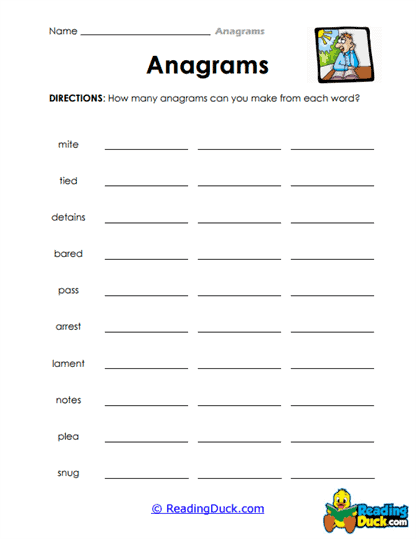
This sheet spotlights shorter base words with many possible rearrangements. Students explore how tiny shifts create brand-new meanings, deepening morphological awareness. It's like a smoothie bar for letters: same ingredients, wildly different flavors. Use it for differentiated practice-everyone can find a level that fits. Bonus idea: track the "word-of-the-day" and collect all valid anagrams for it.
Odd One Out
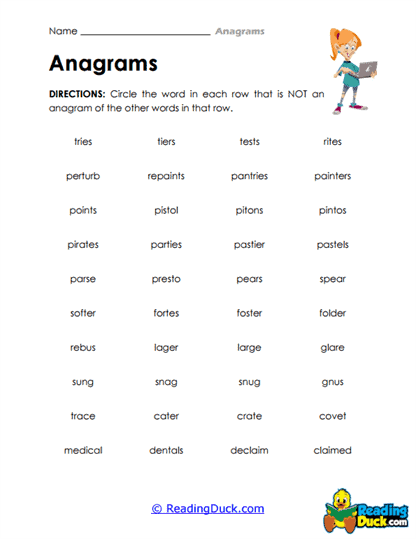
Solve several anagrams, then pick the answer that doesn't belong in a set. Discerning categories after solving reinforces meaning, not just mechanics. It's a word detective game-magnifying glass optional, curiosity required. Great for quick formative checks. Bonus idea: have students justify their choice in one sharp sentence.
Phrase Puzzles
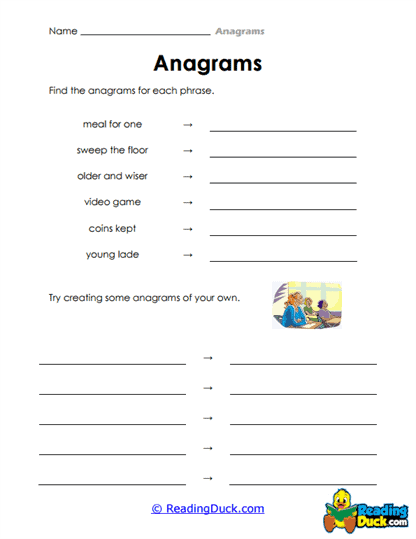
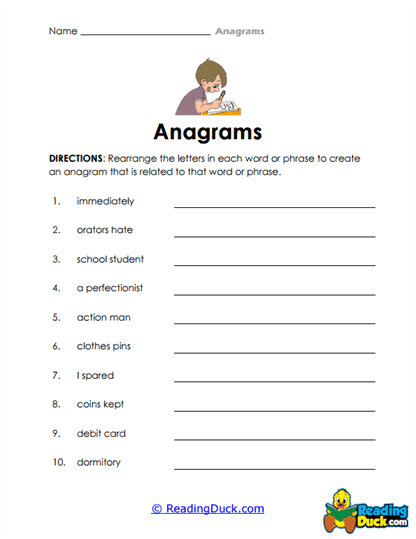
Students graduate from single words to multi-word anagrams, spacing and all. Handling phrases builds stamina with longer letter strings and teaches careful verification. Imagine juggling letters while also keeping an eye on punctuation-thrilling! Use it for advanced practice or enrichment groups. Bonus idea: turn solved phrases into doodle captions.
Phrase Twist
Similar to Phrase Puzzles, but with hints that nudge toward idioms or common expressions. Learners connect cultural knowledge to letter play, boosting comprehension. It's like solving a meme with the letters scrambled. Ideal for bell ringers that spark lively discussion. Bonus idea: students create a scrambled version of a favorite classroom motto.
Picture Puzzles
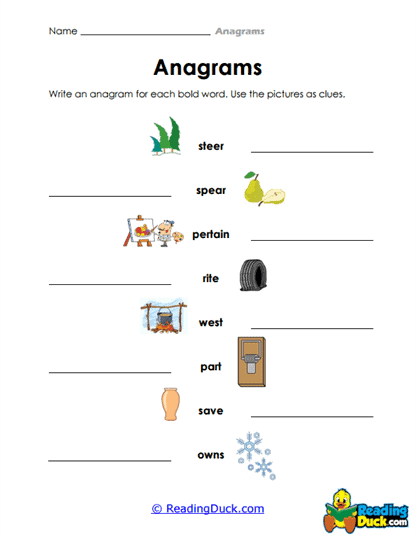
Images act as clues for each scramble, anchoring meaning before letters move. Visual context helps all learners, especially emerging readers and multilingual students. Think of the picture as a GPS pin guiding you to the right word. Use it in literacy centers or as a mixed-modality activity. Bonus idea: invite students to sketch a quick icon for each solved word.
Sentence Shuffle
Words in a sentence are scrambled, and students rebuild the message. Reconstructing syntax after solving reinforces both anagram logic and fluency with sentence structure. It's like rebuilding a Lego sentence from the same bricks. Great for writing mini-lessons on capitalization and punctuation, too. Bonus idea: have students write a new sentence using the solved words.
Word Jumble Fun
A classic jumble with a final riddle revealed by circled letters from earlier answers. The layered payoff motivates careful solving and double-checking spellings. It's the popcorn of wordplay-light, crunchy, addictive. Perfect for homework or family game night. Bonus idea: let students author a riddle for next time's jumble.
Word Twist
This sheet spotlights tricky near-anagrams to sharpen precision (no missing letters allowed!). Students learn to verify every letter, solidifying what makes a true anagram. It's the difference between a magic trick and actual magic-proof matters. Use it as a mastery check toward the end of the unit. Bonus idea: create a "Not An Anagram!" wall of common mix-ups and why they fail.
What Are Anagrams?
Anagrams are words or phrases made by rearranging all the letters of another word or phrase-same letters, new order, real results. They differ from simple scrambles because an anagram must use every letter exactly once and resolve into valid words. Unlike synonyms or antonyms, which deal with meanings, anagrams focus on form: letter positions, patterns, and permissible combinations. That formal play still supports meaning because accurate spelling and quick recognition of chunks (like common prefixes or endings) strengthen the mental lexicon. Think of anagrams as a bridge between phonics (sounds/letters)and vocabulary (word knowledge)-you cross it by noticing how structure shapes sense.
In real life, anagram skills pop up more than you'd think: word games, crosswords, escape-room clues, and even puzzle-y headlines or social posts that love a clever twist. When students decode a scrambled caption or solve a riddle in a group chat, they're using the same pattern-spotting and verification habits. Musicians rearrange hooks; gamers crack ciphers; meme-makers love a good letter flip for a punchline. Classroom projects that involve titles, slogans, or team names often benefit from anagramming to find something catchy and memorable. The skill turns the everyday alphabet into a toolbox for creativity.
Developmentally, anagram practice builds working memory, attention to detail, and flexible thinking-key ingredients for literacy growth. It strengthens decoding by training eyes to scan, compare, and test possibilities, and it boosts encoding (spelling) by reinforcing legal letter sequences. As students progress to multi-word and sentence-level puzzles, they also exercise syntax and semantics, linking form to function in meaningful ways. Those habits generalize: better proofreading, stronger vocabulary recall, and more confident writing choices. You're the bridge between fun activities and serious vocabulary growth-let your descriptions do the teaching and the inspiring.
Make sure to bookmark our website now.
Enjoy all our free reading worksheets.
Our materials adhere to the principles of the Science of Reading.